



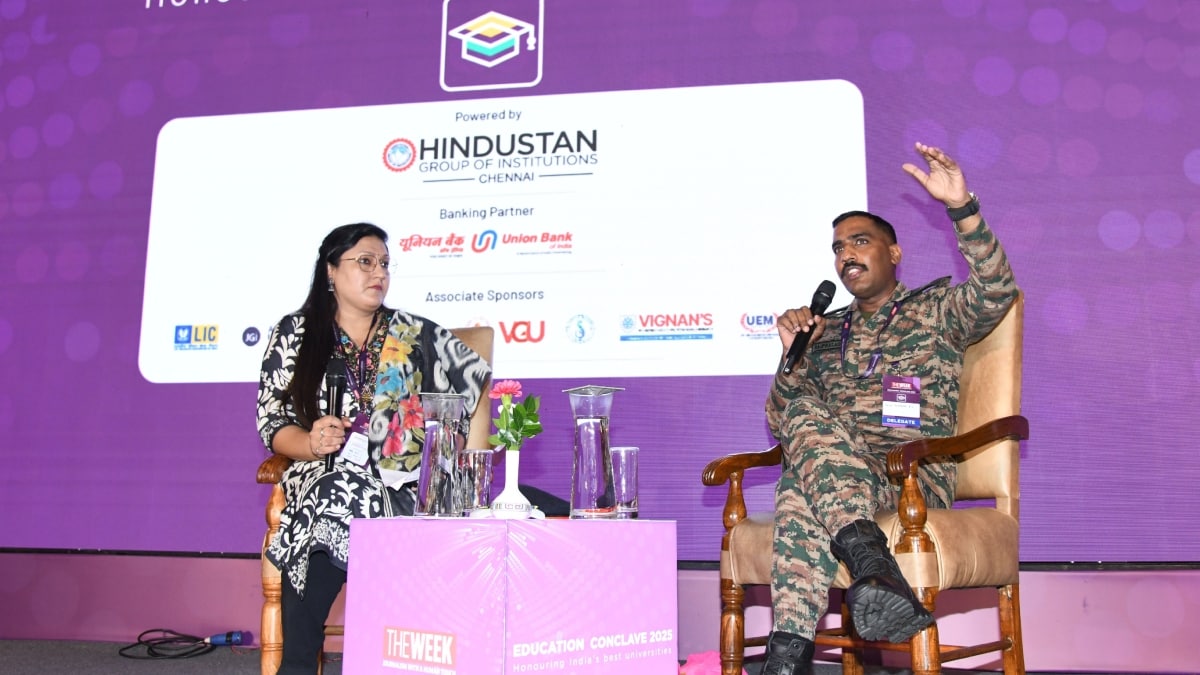
Major Raj Prasad, a decorated officer from the Indian Army’s Corps of Engineers, made a compelling call for deeper civilian engagement in defence innovation during THE WEEK’s maiden Education Conclave held in the national capital.
Speaking on the critical intersection of education, national security, and technology, Major Prasad underscored the urgent need for India to move from being a technology integrator to a full-spectrum developer.
“The Indian Army isn’t just about combat. We are techno-warriors,” said Major Prasad, who joined the Army after completing his BTech and has since led pioneering work in unmanned systems and AI-based mine detection. "We have a vast inventory of systems—radars, wireless detonators, drones. Managing and innovating in this space requires the best minds, including from civil society.”
Recounting his own contributions, Major Prasad highlighted 12 technological innovations he developed, four of which are now operational within the Indian Army. These include unmanned mine detection systems and a patented wireless detonation system with a range of 2.5 km—solutions that have saved lives on the battlefield.
Unmanned mine detection systems come handy during operations when the chances of casualties are very high.
He also pointed to the success of technology transfers under the Indian Army’s innovation framework. “We created a transfer-of-technology model. After field trials, our systems were handed over to private players for mass production. This not only generated revenue but also developed our manufacturing capabilities and created jobs,” he said.
As head of innovation programmes at the College of Military Engineering in Pune and currently leading an Army technology cell at IIT Delhi, Major Prasad is expanding collaboration between the armed forces and premier academic institutions. He said 24 tech proposals have come to IIT Delhi, and the army plans to launch an academia seminar in September to engage institutions nationwide.
Calling for a rethink in how India builds talent pipelines, Major Prasad suggested replicating the MBBS internship model for IIT graduates. “If medical students are required to serve a year in hospitals, why can’t engineering students be placed with Defence PSUs for a year or two to develop indigenous technologies?” he asked.
On education policy, Major Prasad supported traditional examinations but urged greater weight for project-based and co-curricular learning to identify and nurture domain-specific talents. “Written exams are important, but we must also gauge students through their areas of interest and real-world contributions,” he said.
He also addressed the role of AI and mental health in modern education. AI gives students more information than ever, but it’s the teacher’s role to help them course-correct. And in high-pressure domains like defence tech, mental health can’t be overlooked, he added.
There is challenge which the Indian defence forces are facing. Cautioning that technology is leapfrogging at a pace “we can barely match,” Major Prasad called for India’s full-scale participation in platforms like iDEX (Innovations for Defence Excellence), which allows even individual innovators and startups to partner with the military.
“Viksit Bharat and Atmanirbhar Bharat won’t happen unless we build capabilities from the chip upwards. The government has created the platforms—it’s now on us, at the functional level, to participate and make it happen,” the army officer said in the presence of the captive audience. The panel discussion was moderated by Kanu Sarda, Senior Special Correspondent, The Week.
In a final note of inspiration, he reminded students that national service and excellence need not be mutually exclusive. “Whatever path you choose, just be the best in your domain. Don’t go with the flow—become an expert.”
