



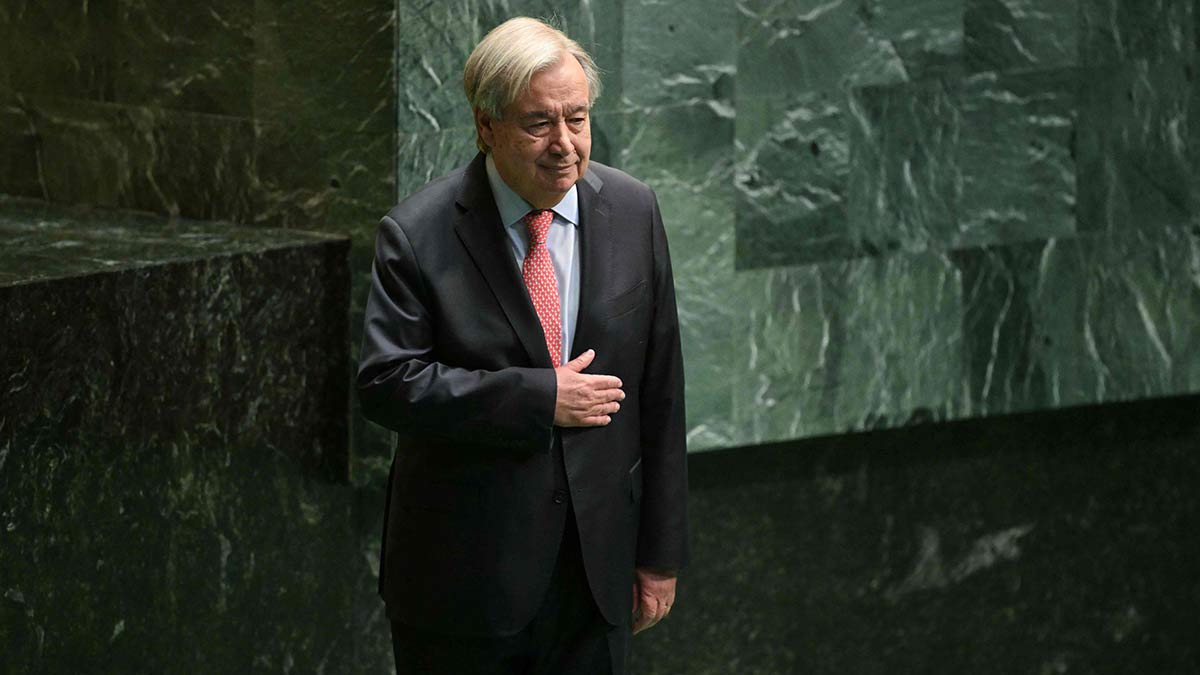
António Guterres is hanging up his boots this year-end after two terms as UN secretary-general (SG). Will his successor, who will take charge on New Year’s Day, be wearing stilettos?
Technically, there’s no bar on giving an SG a third term, but none has got it yet. Nor will Guterres. He gave his swansong address last week.
At the UN, it’s a man’s, man’s, man’s world. In 81 years, the general assembly has had 81 presidents, only five them women, including India’s Vijaya Lakshmi Pandit. The UN has had nine secretaries-general, none a woman.
Chances are fairer, generally and genderwise, this year. In their joint letter inviting nominations, the presidents of the general assembly and the security council requested member-states to consider nominating women.
Though there’s no rule regarding regional representation, various assembly resolutions have favoured rotation of the job among continents. Since Europe has had four SGs, Asia and Africa two each, and Latin America only one till date, the odds favour a Latino this time.
Four of the seven in the race are women, all Latinos. Rebeca Grynspan, former vice president of Costa Rica and currently secretary-general of UNCTAD, María Fernanda Espinosa, former foreign minister of Ecuador and former president of the UN general assembly, Carolyn Rodrigues-Birkett, former foreign minister and current ambassador of Guyana to the UN, and Ivonne A-Baki, former Ecuador ambassador to the US.
Racing against them are Rafael Mariano Grossi, the Argentine boss of the International Atomic Energy Agency, Uganda’s Olara Otunnu, who was undersecretary-general under Kofi Annan, and Macky Sall, former Senegalese president who chaired the African Union.
The secretary-general is not elected but selected. Member states nominate candidates in the last year of an outgoing SG’s term. The 15-member security council holds straw polls to gauge support for each candidate. A candidate must win at least nine votes and no veto from any of the five permanent members. Once a consensus choice emerges, the council recommends him or her to the general assembly. The assembly votes yes and appoints. Till date they haven’t voted no to an SC recommendation.
Guterres had a terrible tenure, with two of the big five getting directly into hot wars, though not against each other. Apart from the Russia-Ukraine war and the US-Iran war, his tenure saw Israel invading Gaza. In all three, the UN was merely watching and preaching to the deaf.
No blame on Guterres. The UN has been rendered ineffective since the turn of the century when the US invaded Iraq without its consent. It showed that a big power could bypass the security council, no questions answered. The wheel came full circle with the strikes on Iran, which were not even discussed over tea in the UNSC.
Can Guterres’s successor, lady or gent, turn the UN relevant again? Doubtful, unless the big three want it to be. India and the rest of the world may cry hoarse or give pulpit talks on peace, but if Trump, Putin or Xi decides to have things his way, he will have it, come high water from climate-changed polar ice or armageddon by nuclear war.
Tailpiece: USSR-Russia has used veto 131 times till date, the US 89 times (51 times for Israel), Britain 29, China 21 and France 16. For three years after the collapse of the Soviet Union and the end of the Cold War—from May 31, 1990 to May 11, 1993—there was no veto of any resolution. Russia has since been the most frequent user of the veto, followed by the US and China. France and Britain have never used the veto since 1989.
