



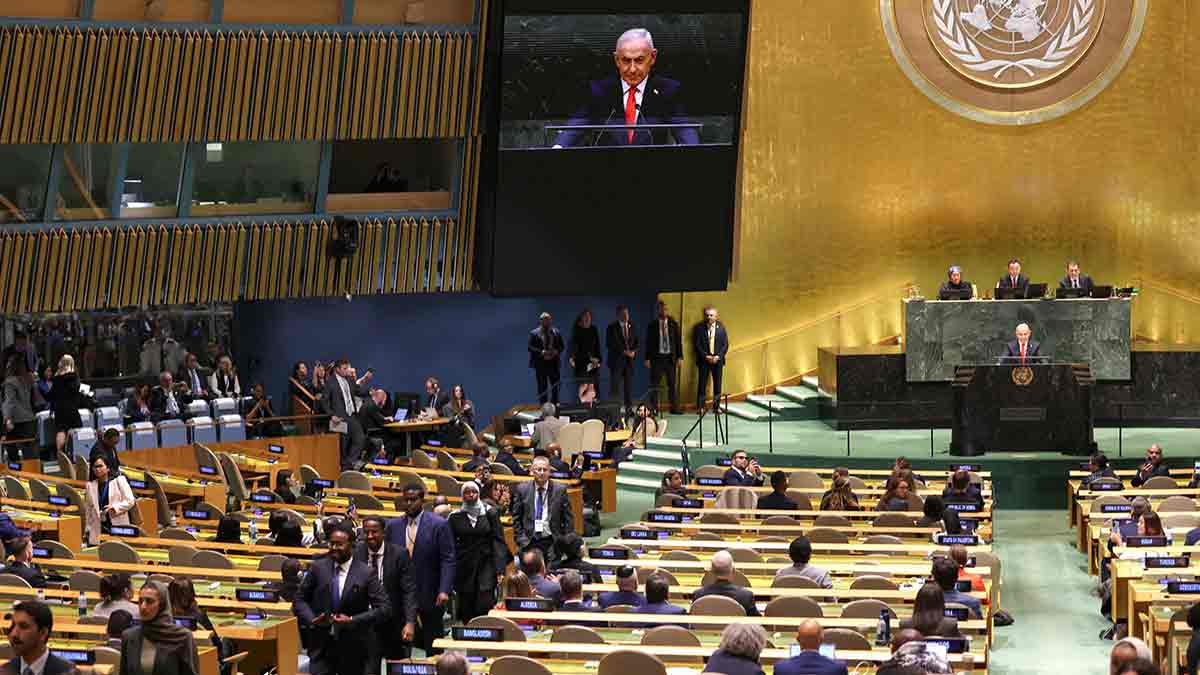
A casual observer, seeing the representatives of Turkiye, Iran and several other countries simultaneously filing out of the hall during the recent Baku summit of the Conference on Interaction and Confidence Building Measures in Asia (CICA), could well have concluded that hot coffee had just arrived outside. Plenary sessions of multilateral meetings are notoriously soporific and the promise of a caffeine shot brings instant alacrity to dozing or doodling delegates.
But this was not our typical coffee rush: more than 10 countries staged a walkout during the speech of Israeli President Isaac Herzog to protest Israel’s policies. Prime Minister Benjamin Netanyahu had faced a similar protest when over 70 countries walked out before his speech at the UN General Assembly; marshalling all his famous chutzpah, Netanyahu labelled them “moral cowards”. A lone American diplomat at the UNGA also left the room when Iranian President Masoud Pezeshkian criticised the US for civilian killings. Such is the dog-eat-dog state of our world that walkouts don’t target just adversaries: in July, after France criticised US’s deteriorating record on human rights under Donald Trump—lumping it with North Korea and Russia—the Americans walked out of a Security Council meeting, refusing to be lectured with “politicised drivel”.
Walkouts, wherein absence spells rejection and vacant chairs echo jeers, were liberally deployed during the Cold War. In January 1950, the Soviets walked out of the Security Council, insisting that the China seat be occupied by their Communist partner, the People’s Republic of China, and not by the Nationalist Government (Taiwan). The USSR stayed away for months, intending thereby to delegitimise the UNSC. This turned out to be something of an own goal: when, a few months later, North Korea invaded the South, Moscow could not veto the formation of UN-backed, US-led international military forces to defend South Korea. In a still debated ex-post facto explanation, Stalin later justified this as deliberate policy to trap the US in Asia while he strengthened his grip on Europe. Another Soviet walkout, this time from the 1983 Intermediate Range Nuclear Forces (INF) talks in protest against the placement of Pershing II and cruise missiles in west Europe, would freeze arms control negotiations between the superpowers for years.
Two famous walkouts mark the India-Pakistan engagement. On December 15, 1971, on the eve of the fall of Dhaka, an emotional Zulfikar Ali Bhutto stormed out of the Security Council blaming it for the “legalisation of aggression”. “You can take your Security Council. I am going,” was his parting shot, as he tore up his papers.
A less dramatic walkout after the India-Pak 1965 conflict is recalled in the memoirs of the late foreign minister Natwar Singh. The two foreign ministers invited to attend the Security Council meetings on the “India-Pakistan question” were a study in contrast: India’s Swaran Singh—earthy, undramatic, unflappable and infinitely patient; Bhutto—the stormy petrel, eloquent, arrogant, ostentatious. Bhutto’s hatred for India was patent, his invective unrelenting. Finally, during the 1247th meeting of the Council on October 25, 1965, the Indian delegation, comprising Ambassador G. Parthasarathy (Sr), Brajesh Mishra, Natwar Singh and S.K. Singh, recommended a walkout to Swaran Singh if Bhutto continued his intemperate attacks. The foreign minister consulted prime minister Lal Bahadur Shastri, who deftly left the decision to him, since he was “on the spot”. When Bhutto again launched his vicious tirade, going well beyond the ceasefire issues deep into India’s internal affairs, Swaran Singh disassociated himself politely from the discussion and led the Indian delegation out of the Security Council. The UN archives do not mention a walkout: in elegant UN-ese, the record reads: “Mr Swaran Singh (India) withdrew.” Indeed.
The author was India’s high commissioner to the UK and ambassador to the United States.
