



August was quite a month for the Muslims of India. First came the census figures, and they were castigated for pushing their population to grow faster than that of the Hindus. Until someone saw fit to congratulate them for the sharp drop in the growth rate as compared to the previous decade. It would appear that India’s Muslim population will level off at about the same time as the population of the country as a whole stabilises—around the centenary celebrations of our independence.
There followed the RSS jamboree at which some pracharak declared that the Muslims are our “brothers”, before adding “just like the Pandavas and the Kauravas”. And we know whom he had in mind when he compared them to the evil Kauravas!
From this nonsense, the community was rescued by Vice President Hamid Ansari in a must-read speech to the All India Muslim Majlis-e-Mushawarat, whom he accurately described as a “consultative body”, for the Majlis confines itself to providing advice and guidance, but refrains from active political participation. Once again, the communal element attempted to stir controversy that the vice president had sought reservation for the Muslims when all he had stressed—quite correctly—was the importance of “affirmative action” to raise the community from the dreadful socio-economic morass in which it finds itself, as revealed by the Sachar Committee.
The committee had carefully analysed the double whammy inflicted on the community by the partition. Although they number 180 million and are “the second largest national grouping” of Muslims in the world, the Muslim elite vanished during the partition to Pakistan as carpetbaggers, leaving their Indian brethren stranded as a poor, deprived community with little local leadership to face the residual discrimination after the holocaust of partition ended.
It would be true to say that while the Muslim elite voted with their hands for Pakistan, the Muslim masses voted with their feet to stay behind. However, instead of being celebrated as the most patriotic segment of India‘s population, they are blighted by the “physical and psychological insecurity” of having “to carry, unfairly”, as the vice president said, “the burden of political events and compromises that resulted in the partition”. Seven decades after they insisted they were Indian, not Pakistani, they are still being administered the loyalty test.
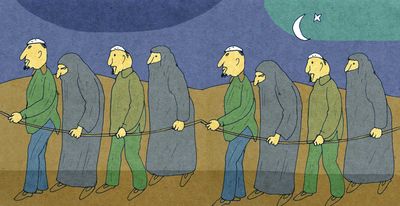 Illustration: Bhaskaran
The salience of ‘Muslim’ to ‘Pakistan’ in far too many Indian minds is what gives rise to the first of our major minority’s problems—the crisis of “identity and security”, as the vice president put it. Next, the relative backwardness of Indian Muslims is related to their distressingly poor performance in “education and empowerment”. This is to be solved not only by the government, but also through community action, in which the Muslim leadership has been found to be woefully lacking. Hence, the vice president’s pertinent question: “Equally relevant is the autonomous effort by the community itself in regard to its identified shortcomings. What has it done to redress the backwardness and poverty arising out of socio-economic and educational underdevelopment?”
Finally, securing “an equitable share in the largesse of the state” and a “fair share in decision-making” has been identified by the vice president as a key issue requiring attention. He doesn’t, however, underline the importance of Panchayat Raj institutions in this regard. If Panchayat Raj is strengthened to ensure genuine “empowerment” and “education”, Muslims, as much as other deprived communities, will benefit the most. Yet, for neither the ministry of minority affairs nor the National Minorities Commission has Panchayat Raj been an area of priority. I wish the vice president had raised his voice on this.