



Spanish singer Angie Corine insults her Prime Minister Pedro Sánchez, calling him a “dog”, “nutjob” and “traitor”. In some countries that would invite ostracism, imprisonment, even death. But in Spain, Corine, 27, has gone viral, harvesting millions of hits on TikTok and YouTube. Belying the sweet face is her carefully curated image as a “baddie rapper”, an archetypical “bad ass, urban bitch”—with full-arm tattoo, neon hair, thick makeup, exaggerated eyelashes, curling acrylic nails and glittering tooth-gems.
Closely aligned with the far-right populist Vox party, Corine is prominent in Spain’s polarising political culture wars. Draped sometimes in national flag colours, she offers a trendy rhythmic beat to right-wing populism. She sneers, ridicules and abuses left-winger Sánchez for corruption, high taxes and house-squatters. When an elderly widow was evicted, street protests erupted. Sánchez saw his moment. Frustrated by right-wingers’ opposition to his socialist housing policies, Sánchez called snap elections… joining France, Poland, Italy, Finland, Greece, Estonia, Slovakia in a super-cycle of elections in the coming year, the likes of which Europe has not seen in a generation. Political scientist Nathalie Tocci fears, “I don’t think it is hyperbolic to say it’s the end of the European Union as we’ve known it.”
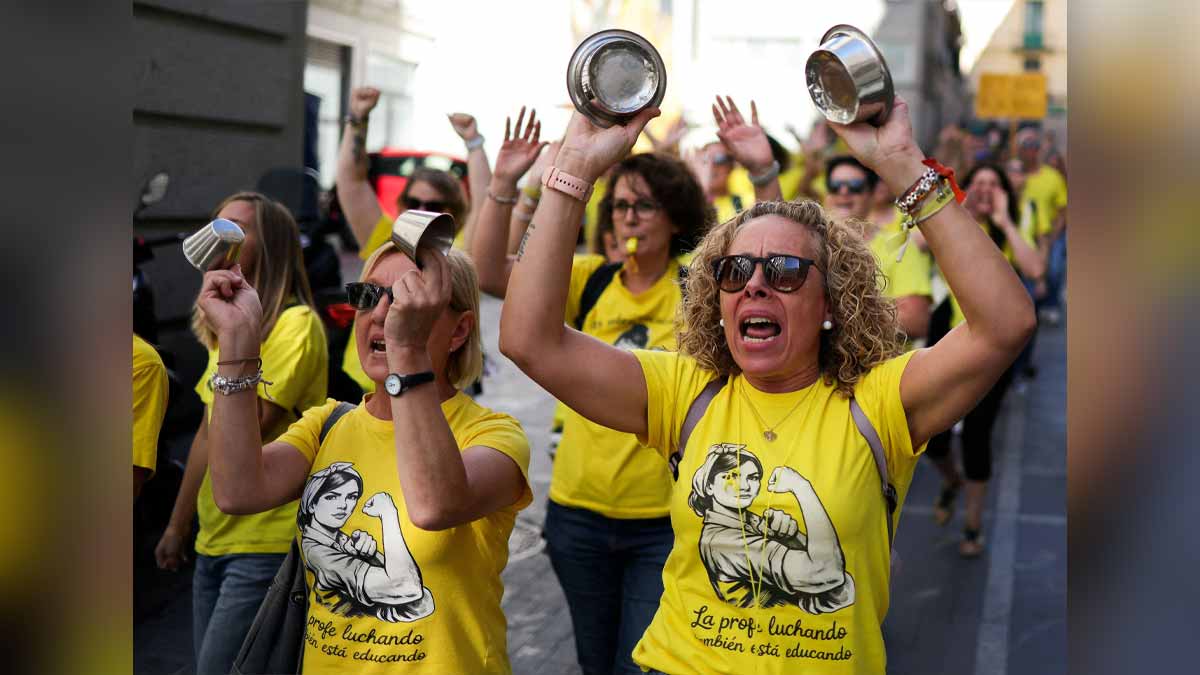
Across Europe, a common pattern emerges—the far-right surges, left-right polarisation deepens. Teenagers are now taking to the streets, shouting slogans, ducking flares and battling police, turning heritage cities like Paris, Rome and Madrid into battlegrounds of public discontent, even violence. Protestors rage against deteriorating government services, shoddy classrooms, immigration, corruption, inflation. Political theorist Mark Leonard calls street protests “unpeace”, explaining, “There is a widespread sense that we live in a golden age of peace. But we don’t. Unpeace captures this broad condition of being suspended between war and peace.”
“Unpeace was spawned by globalisation that millions of ‘left behind’ citizens found hurtful, risky, scary, robbing their jobs and livelihood,” says Leonard. Earlier, frustrated people were inaudible and invisible. Now they connect and combine against their common enemy. These “connectivity conflicts” have fatalities, but they are difficult to quantify, unlike the war-dead, says Leonard.
Citizens worry. Surveys reveal 90 per cent of Europeans are pessimistic about the future. French far-right presidential candidate Marine Le Pen says, “Tens of millions of French people live in fear of tomorrow.” Failed by centrist parties, European voters now turn to extreme left and extreme right for support. Left-oriented social democrats and right-oriented conservatives have ruled Europe since WWII. But now the centre fails to hold, “legacy” parties fall between the left and right stools as disillusioned voters defect to the extremes. Political scientist Catherine de Vries says, “When the left or right is already in government, how do you innovate? By going more extreme!”
This polarisation foreshadows turbulence, deadlock and a probable shift in European policy and priorities—resuming Russian energy supplies, cutting aid to Ukraine, a “Europe First” profile that excludes migrants and foreign competitors from welfare, jobs and public contracts. Europe’s culture of liberalism, consensus and genteel politeness could give way to vitriol, hatred and brash demonisation.
With the newfound power of the hitherto powerless, patriotically-correct Corine raps, “In Spain we have Sánchez, his wife. And his brother who, with any luck, will end up in prison, too. With every cancel campaign, my listeners only increase. If you are not in my favour, I label you a Nazi.”
Experts fear the phenomenon of “unpeace” and the rise of extremes suggest that Europe may not be the same again—at least for a generation.
Pratap is an author and journalist.
