


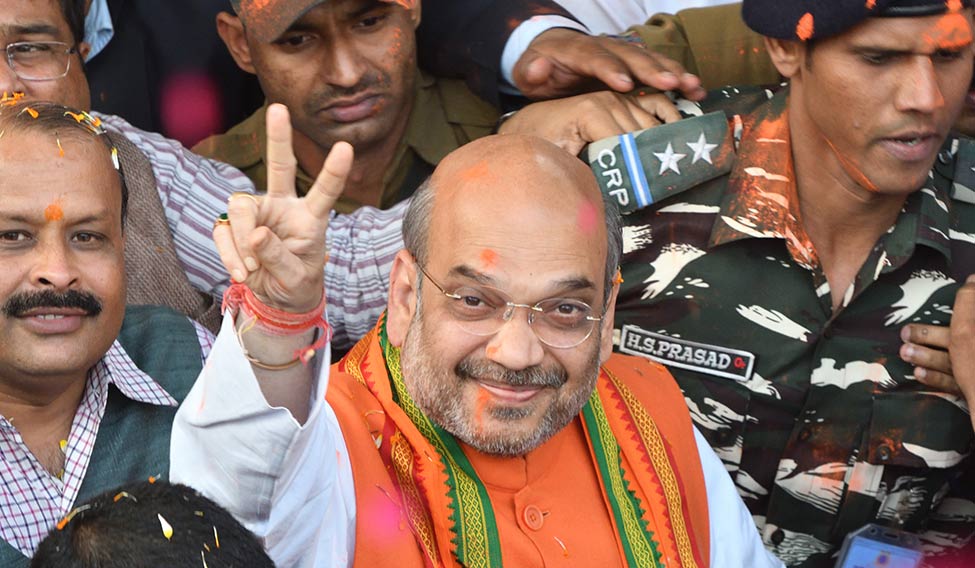
Amit Shah never stops campaigning.
On March 10, two days after polling had ended in Uttar Pradesh, and hours before the results were to arrive, the BJP president was in Gujarat to give a pep talk to party workers. Assembly elections in his home state are due in December, and he wanted them to be well-prepared. His next mission was on.
Shah has always been the man with the plan. He had begun making moves to win Uttar Pradesh as early as October 2014, when the BJP scored thumping victories in the Maharashtra and Haryana assembly polls. Less than a week after those results, he sent Om Prakash Mathur, the architect of the BJP’s victory in Maharashtra, to Lucknow. Mathur took charge of the party affairs in UP and met Sunil Bansal, who was Shah’s apprentice in the Lok Sabha elections held just months before.
The two bachelors made a formidable team. Both Mathur, then 62, and Bansal, 44, had earned their stripes as RSS pracharaks in Rajasthan. Mathur was close to Prime Minister Narendra Modi, and had known him since the days they were pracharaks. He was BJP general secretary in charge of Gujarat when Modi became chief minister in 2002.
Bansal was general secretary of the Akhil Bharatiya Vidyarthi Parishad in Rajasthan before he moved to Uttar Pradesh to assist Shah to oversee Lok Sabha polls. Always clad in kurta-pyjama and Nehru jacket, with a tilak on his forehead, Bansal made his mark with his affable manners, steely resolve and ability to get things done. What he did not know at that time was that the modest room he moved into, on the first floor of the BJP headquarters in Lucknow, would become his home for the next three years.
It was Bansal who laid the groundwork for implementing Shah’s grand plans for Uttar Pradesh. In the Lok Sabha elections, the BJP and its allies had won 73 of 80 seats in the state, garnering a vote share of 42.6 per cent. It translated to 323 assembly seats, out of the total 403. Bansal and Mathur had their task cut out.
By that time, Bansal knew the obstacles to achieving the target. In the Hindi heartland, the BJP was still seen as a party of Brahmins and Banias. The party had no presence in most parts of the state and it was caught in a downward spiral. It had won 221 assembly seats in 1991, when the Ram Mandir agitation was at its peak. The figure dropped to 174 seats in 1996, 88 in 2002, 51 in 2007 and 47 in 2012. The 2014 result, many people said, was just a flash in the pan.
But Bansal was upbeat. He suggested that the BJP contest the 2015 panchayat polls in the state. State leaders, however, were averse to the idea. The party had not contested panchayat elections before, and a poor show would reflect badly on Modi.
But Bansal persisted, and Mathur and Shah went along. “My idea was to take the BJP to the villages,” he said. “Once we said we would field contestants, people came forward to contest. Even though most of them did not win, they helped the BJP reach areas where it was never present.”
The party won just 300 of more than 3,000 seats it contested. But it made its presence felt in nearly 1,000 seats. That meant the BJP had 1,000 new leaders.
Bansal set up a war room at the party’s Lucknow office. “I had a team of 150 professionals and 13 teams covering the media, monitoring organisational activities and getting feedback,” he told THE WEEK.
From Shah, Bansal had learnt the art of micromanaging. “Shah would interact with all members in a team to get the feedback,” said Bansal.
Shah himself often stayed in the Lucknow office, discussing plans with partymen late into the night. This was to avoid any disconnect between the leadership and the workers. Some people had hinted that such a disconnect had been the reason for the party’s disastrous campaign in the Bihar assembly elections in 2015, which Shah had overseen from a five-star hotel in Patna.
UP was tougher terrain than Bihar. For the BJP to end its 14-year vanvas (exile) from power, it had to break the complex caste equations that had resulted in the rise of the Samajwadi Party and the Bahujan Samaj Party. The vanvas analogy, which the BJP used widely in its campaign, had significance in this context: Lord Ram’s vanvas had also lasted 14 years.
BJP strategists had for long known that building the Ram Mandir had limited appeal as an electoral issue. What was needed was a better, more effective narrative that would pull votes. They arrived at nationalism as the answer, with the narrative weaved around Modi’s “twin achievements”: demonetisation and the surgical strikes against terrorists.
It was decided that the BJP would never overtly raise the temple issue. “I would never raise it, as the media will make it into an issue,” Shah reportedly told associates. “When they ask me [about the temple issue], I just have to smile, and they would talk about it.”
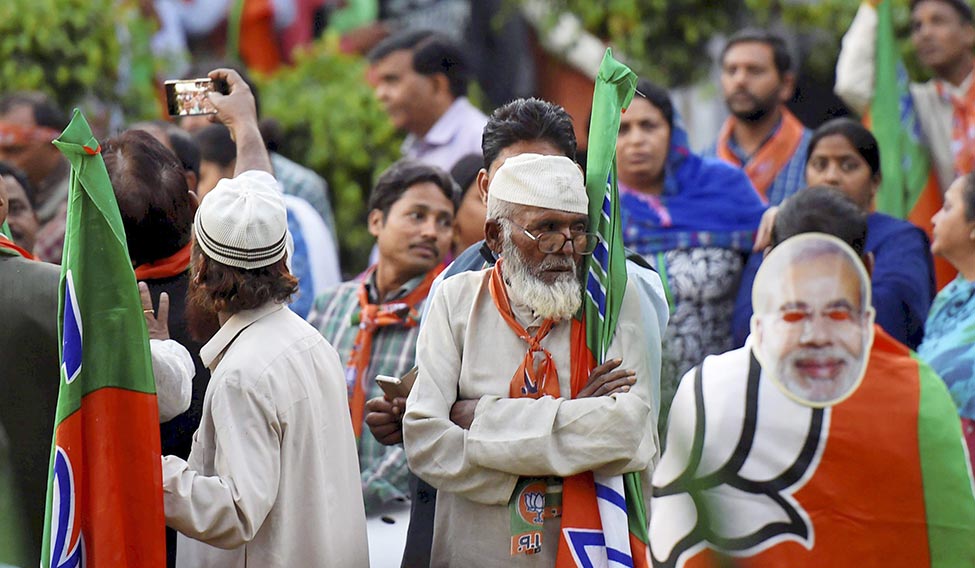 Green light for saffron: Muslim supporters of the BJP celebrating in Delhi | PTI
It was good strategy, but it was not enough to win UP. The BJP had to break the deadlock of caste equations, like it had done in 2014. So it started wooing more than 200 different castes, focusing on Other Backward Classes, which constitute more than 40 per cent of the population. The Yadav community was a natural ally of the SP, and the Jatavs, the largest community among dalits, were considered the BSP’s vote bank. So the BJP focused on non-Yadav and non-Jatav voters.
Ticket distribution was handled deftly. Shah fielded 126 OBC candidates, even as he ensured that the share of upper caste candidates was not reduced. He also gave preference to non-Yadav, non-Jatav candidates. Since the BJP had little hopes of getting the support of Muslims, who made up 19 per cent of the population, it decided not to field anyone from the community.
Even as the decision gave the BJP a lot of leeway in ticket distribution, it also made the party dependent on a consolidation of Hindu votes. The efforts for moulding them in its favour started last year, when the BJP began reconstituting its organisational apparatus.
Last April, Shah appointed Keshav Prasad Maurya, an MP belonging to an OBC subcaste, as the president of the BJP’s state unit, replacing Laxmikant Bajpai, a Brahmin. “We set up samanvay samitis [coordination committees] in each district, comprising elected representatives like MP and MLAs, and even those who had never been elected before,” said Mathur.
The BJP picked its district presidents from across many castes, while committees right up to the booth level had representation from all castes. “The BJP was able to give all castes a sense of belonging,” party spokesperson Sudhanshu Trivedi told THE WEEK. “It became clear to non-Yadav OBCs that the SP had favoured only one caste, the Yadavs, while Mayawati [of the BSP] favoured only Jatavs. The remaining were neglected.”
MPs were asked to tour their respective constituencies, while the BJP’s 40 dalit MPs from the state toured all 403 assembly constituencies. By the time the campaign ended, the BJP had organised 200 OBC samellans, 88 youth-centric programmes, and a programme for women called Udaan. Public meetings were organised in a way that it specifically addressed the concerns of groups like farmers, traders and even intellectuals. Apart from all this were the parivartan rallies led by senior leaders across the state, which drove home the BJP’s message to voters to usher in change.
That the party had not declared its chief minister candidate was a handicap, though. Apparently, Mathur told Modi and Shah that the BJP should not project a CM candidate. “There were too many local leaders vying for the post, but hardly anyone with pan-state appeal,” he said. “Projecting a single person would make the other claimants angry.”
There was also an inner-party rebellion to deal with. In its effort to achieve a caste consolidation, the BJP had inducted and fielded leaders from rival parties such as Swami Prasad Maurya from the BSP and Rita Bahuguna Joshi from the Congress. It led to longtime leaders raising the banner of revolt for being denied tickets.
In Varanasi, Modi’s Lok Sabha constituency, Shyam Dev Rai Chaudhary, a seven-time MLA from Varanasi South, refused to take part in party rallies. To assuage the anger of leaders like him, Modi spent three days in Varanasi. He went to visit the Kashi Vishwanath temple with Chaudhary, and even held Chaudhary’s hands as he prayed. The gesture worked, and Chaudhary yielded.
Apparently, Modi’s passionate appeal to impose a ban on triple talaq also worked wonders. “The lives of Muslim women cannot be allowed to be ruined by triple talaq,” he said during the campaign.
The BJP’s vote share in Muslim-dominated areas indicates that a significant proportion of Muslims voted for the party. It makes sense to assume that these voters were largely women. “It is a wrong notion that Muslims do not vote for the BJP,” Tahira Hasan, vice president of the All India Progressive Women Association, told THE WEEK. “Those who know Lucknow well know that a section of Shia Muslims has been voting for the BJP.”
It does Shah credit that, even as he focused on expanding the BJP’s support base in UP, he campaigned hard in Manipur and Uttarakhand. Shah sent party general secretary Kailash Vijayvargiya to Uttarakhand exploit the simmering discontent within the Congress against Chief minister Harish Rawat.
Party strategists worked hard to drive home the message that Rawat was corrupt and was depriving the state of benefits from the Centre. Also, Modi’s image as a strong nationalist endeared him to the state’s predominantly Hindu electorate.
In Manipur, it was Shah who led from the front. He visited the state six times, and planned the campaign in such a way that the efforts of a core group of leaders made up for the BJP’s lack of grassroots presence. “Shah went door to door and earned votes for the BJP. We did not,” admitted Debadatta Singh, Congress spokesperson.
Even though Congress ended up as the single largest party in Manipur and Goa, Shah’s manoeuvres ensured that it was the BJP who would form governments in both the states. In Goa, where the BJP was in power, six of its eight ministers were defeated, including chief minister Laxmikant Parsekar.
Union Minister Nitin Gadkari, who had been camping in the state, swung into action and opened discussions with smaller parties. The BJP legislators got together and wrote to Shah requesting that defence minister Manohar Parrikar be allowed to return to the state as chief minister. It was clear that the request was prompted by the Maharashtrawadi Gomantak Party, which had won three seats and wanted only Parrikar to be CM. Shah was quick to acquiesce, and Parrikar took oath on March 14.
In Manipur, too, it was Shah’s nimble-footed moves that worked to the BJP’s advantage. The BJP had seven seats less than the Congress, but quickly cobbled up an alliance with smaller parties such as Naga People’s Front and National People’s Party. “I was left with no other option but to invite BJP [to form government],” said Governor Najma Heptulla.
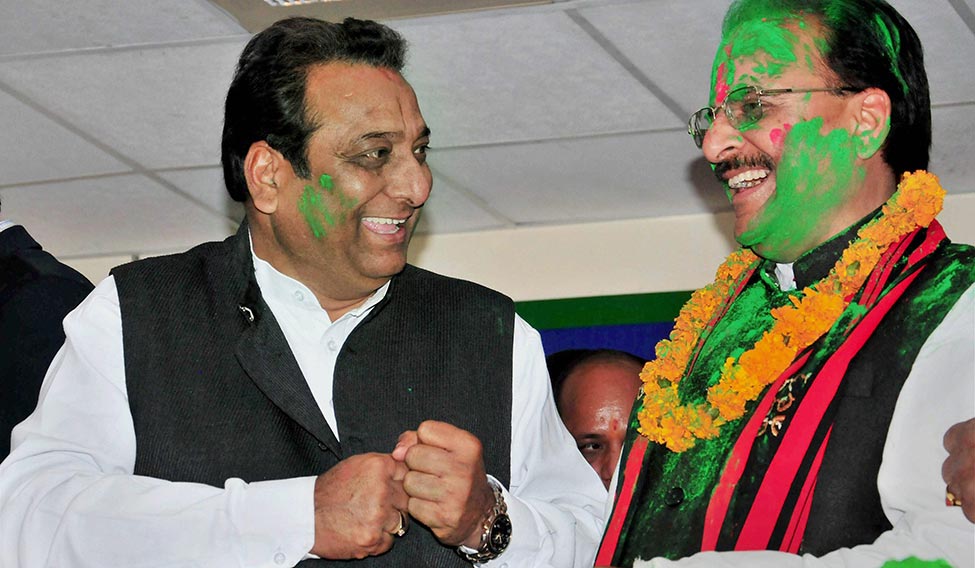 Winning combo: Ajay Bhatt, president of the BJP’s Uttarakhand unit, with Vinod Chamoli, who won from Dharampur | PTI
The BJP’s good show in these elections has shown that the Modi-Shah duo remains the most potent combination in Indian politics. While Modi is seen to be leading front the front, it is Shah who prepares the way for him. The big battles Modi has won so far have all hinged on Shah’s ability to negotiate tricky electoral waters.
A case in point is how Shah won over the powerful and politically savvy Jats in UP. Four days before the state went to the polls, he drove to the residence of Jat leader and Union Minister Chaudhary Birender Singh. Gathered there were elders of the community who came from several districts in western UP.
For the next three hours, Shah patiently listened to their grievances about the government not granting them reservation in jobs and education, and about how their “boys” were “hounded by the police” for their involvement in the communal riots that broke out in the state in 2013. “We were worried whether adhyakshji [Shah] would lose his cool in front of the normally belligerent Jats,” said a BJP leader who was present.
But Shah, surprisingly, did not. “Which party would give you reservation?” he asked them in a calm voice. “If you want to vote for the RLD [Ajit Singh’s Rashtriya Lok Dal, which Jats traditionally support], you can well do that. But will he become the chief minister? Who will win if the BJP loses? If you continue to be cross, you will only harm your own interests and the BJP’s.”
Shah’s words left the Jats with only one option: to relent and rally round the BJP. The RLD was the loser. It ended up winning only one seat, and lost many of its bastions.
Shah won a small victory that day. And Modi won the big battle on the back of such victories.
WITH DNYANESH JATHAR AND RABI BANERJEE
SHRINE ON!
* In its UP election manifesto, the BJP mentioned that it would "try to explore all possible ways under the Constitutional limits to set up Ram mandir" in Ayodhya
* BJP MPs have often claimed that since the dispute is pending in the Supreme Court, they could find an alternate solution if they get enough numbers in the Rajya Sabha
* The landslide UP victory will bolster the BJP's strength in the upper house, and it could become the largest party after the elections to the Rajya Sabha in 2018