



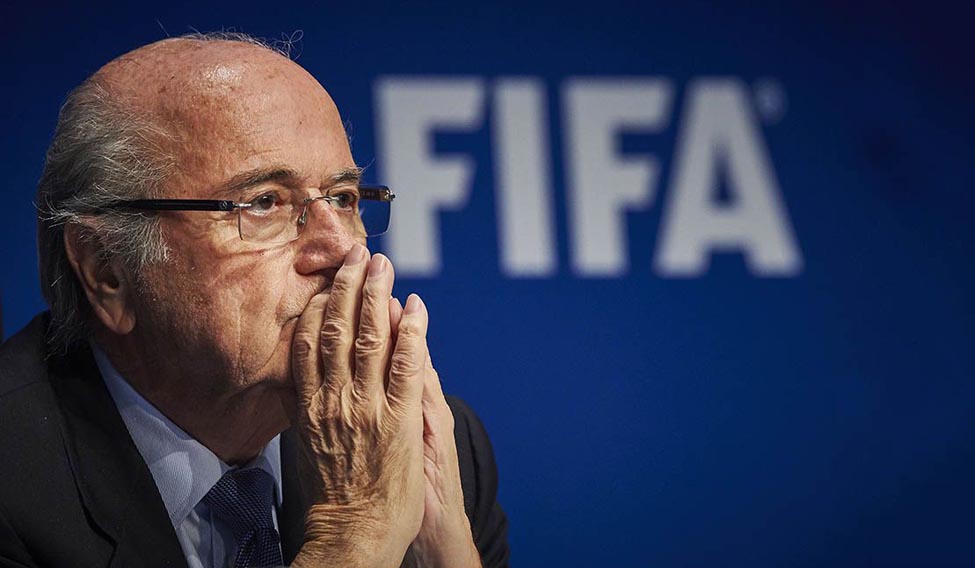
 FIFA president Sepp Blatter at a press conference at the FIFA headquarters in Zurich | AFP
On December 2, 2010, the global governing body of football FIFA (Federation International de Football Association) announced the results for the bids to host the world cup tournaments in 2018 and 2022. Russia edged out Britain for the 2018 edition, while the United States lost the chance to host the tournament in 2022 to Qatar. Former US president Bill Clinton, who led the US delegation, was so furious that he reportedly threw something at a wall mirror in the hotel room in Zurich, where the announcement was made, breaking it into pieces. The US already had 18 completed stadiums, while Qatar had none. The US had twice the number of hotel rooms compared to Qatar. Even more strange was the fact that FIFA had allowed Qatar to hold the tournament in winter, a major break from the past and upsetting the traditional schedules.
A few days later, the US justice department opened investigations into the operations of FIFA and on May 27, 2015, landed the first punch on FIFA’s face, which has left it in complete disarray. Early in the morning on May 27, Swiss plainclothes police entered the Baur au Lac—the five-star hotel, where FIFA is holding its annual meeting prior to its presidential elections—and arrested six senior officials, including vice presidents Jeffrey Webb from the Cayman Islands and Eugenio Figueredo of Uruguay, and Eduardo Li of Costa Rica, Julio Rocha of Nicaragua, Costas Takkas of Britain, Rafael Esquivel of Venezuela and Jose Maria Marin of Brazil. A few hours later in New York City, the justice department announced the indictments on 47 counts against the arrested FIFA officials. Marketing executives and broadcasting officials, who collaborated in the scam too, were charged. Most of the accused officials are from CONCACAF and CONMEBOL, the organisations that govern football in North and South America and belong to countries like Cayman Islands, Trinidad and Tobago, Nicaragua, Costa Rica, Uruguay, and Venezuela.
The indicted officials were accused of corruption in deals between FIFA, sports marketing groups, and broadcast corporations for television rights of international matches, including the world cups, starting from 1991. The accused are charged with receiving kickbacks worth more than $150 million for exclusive television contracts. “It spans at least two generations of soccer officials who, as alleged, have abused their positions of trust to acquire millions of dollars in bribes and kickbacks,” said US Attorney General Loretta Lynch. As former US attorney for New York, Lynch was in charge of the investigation during the last four years. The 161-page indictment charges officials and their accomplices for running schemes “involving the solicitation, offer, acceptance, payment, and receipt of undisclosed and illegal payments, bribes, and kickbacks.” The officials used bankers, financial advisers and currency dealers to help with their illicit payments and set up shell companies and bank accounts in tax havens. They also smuggled cash in bulk and made use of safe deposit boxes to run their corrupt scheme. While the investigation has concluded that the games and tournaments were free of corruption, it said the accused “corrupted the enterprise through their extensive criminal activities.” “By pocketing so much of the cash generated by the sport through marketing rights, the men deprived national teams, youth leagues, and development programmes all over the world of what was rightfully theirs,” said the indictment report. Meanwhile, Swiss authorities have already opened investigations into the suspected anomalies and corruption involving the bids for the 2018 and 2022 world cups.
The indictment soon attracted geopolitical overtones as Russia bitterly criticised the action taken by the US. “We are calling on Washington to stop attempts to make justice far beyond its borders using its legal norms and to follow the generally accepted international legal procedures,” said Alexander Lukashevich, a Russian foreign ministry spokesperson. He said the ongoing investigation was an example of illegal extraterritorial use of American law. Russia has been clearly unhappy about allegations that it won the right to host the 2018 world cup by underhand tactics, including bribes. Russian President Vladimir Putin said he supported FIFA president Sepp Blatter’s approach to running football and that the US move was to hamper the chances of his re-election.
The indictment has come as a major blow to Blatter, who is seeking re-election for a fifth consecutive term as the head of the organisation. His only opponent in the election scheduled for May 29 is Prince Ali bin Al Hussein, the son of the king of Jordan. As FIFA faces the worst crisis of its 111-year history, there is widespread opposition to Blatter and most prominent footballing countries, especially from Europe, have asked Blatter to stand down. The Union of European Football Associations (UEFA), the body which oversees football in Europe, has thrown its weight behind Ali, and so have the American and Canadian football bodies. UEFA president and former football icon Michel Platini hinted at even boycotting the next world cup if Blatter is re-elected.
Major corporate sponsors associated with FIFA, too, have criticised the organisation, alleging it has brought disrepute to the game. World Cup sponsors Visa and Coca-Cola have threatened to walk away from deals with FIFA if major changes are not introduced. “It is important that FIFA makes changes now. Should FIFA fail to do so, we have informed them that we will reassess our sponsorship,” read a statement by Visa.
Blatter, however, said he could not be held responsible for the recent events. “I know many people hold me ultimately responsible for actions and reputation of the global football community, whether it is a decision for the hosting of a world cup or a corruption scandal. But I cannot monitor everyone all of the time,” said Blatter.
He is likely to win the elections on May 29 despite widespread opposition as he commands a majority in the 209-member FIFA, where all national associations have a single vote despite its size and stature. His detractors accuse Blatter of abusing his position to disburse patronage among FIFA members, especially the smaller and financially weaker countries in Africa, Asia and south and central America. However, even if Blatter, who was once described by The Guardian as “the most successful non-homicidal dictator of the past century,” manages to win the election, his long-term prospects as the head of FIFA appears to be bleak. And, unless drastic corrective measures are put in place, so is the future of the beautiful game.