



-
WOMEN FIRST, a series on known and unknown women who broke the glass ceiling and carved a niche for themselves.
When Melba Pria, Mexican ambassador to India was handed her brother’s ashes wrapped in an Indian cloth, her relationship with the country she had always fancied, was sealed forever. It was a strange coincidence that her brother, Tomas, had wished to “bathe” in the Ganga. These, in fact, were among the last few thoughts that he had shared with her before he died: “We had,” Melba recalls, “joked about it. I had forewarned him about the muddied waters in Varanasi but he had simply said: “Holy water, sister, holy water…nothing will happen”. After his death, the words haunted her: he had, she said to herself, spoken about bathing in the Ganges or Ganga as he chose to call it.
Melba took a silent vow: what he could not do in life, she promised to complete after his tragic and untimely death in India.
Melba had flown Tomas in from Mexico for medical treatment but he died the morning he was scheduled to meet the doctor who perhaps may have given him a lease of life. What Melba took back with her were his ashes, covered in a Mexican cloth over the Indian one that the priest had handed her, his remains in. Before he was reduced to a handful of dust, Melba had followed the entire ritual of going around his body and breaking the earthen pot, exactly the way the priest had asked her to. It was Indian but also Mexican: four generations of her family had cremated their dead and therefore Melba was merely following tradition with a little bit of difference. She took him home only to bring back a little bit of him back to India to immerse in the holy Ganges.
Against this backdrop, therefore, to describe her relationship with India merely as an official assignment is understating it. She had lost a brother here and therefore there is a deep wound that perhaps may never heal. The Mexican cloth wrapped over the Indian was a cruel finality, but on the positive side, it was an assimilation of two cultures and memory which celebrates life.
There are, therefore, no tears. “Our family”, Melba says, “is accustomed to death”. Melba has lost loved ones to cancer—a cause she runs for. “Running for a cause,” she said softly, “keeps you focused, helps you handle pain and at the same time gives you the freedom to do what you would like to”.
Melba’s “like” list is rather long. Besides being an avid traveller, she plays music, sings, enjoys biking, and designs jewellery, mostly by stringing beads. She loves cycling from Rajokri where she lives in New Delhi to the walled city at the crack of dawn, something she describes as “that time of the day where night and morning live together”, the poetess in her coming to the fore.
It is here that she gets a “feel of real India”—an India that has the sound of temple bells and the muezzin’s call from the mosque, the men and women, hordes of them, brushing past each other, a truck blocking the road and trying to pull a cow, a car driving the wrong side of the road, others honking like mad, the train station where the cacophony invades your being, the smell of food and cow dung, well dressed young people and a naked sadhu all in one frame: “You may have the worst pollution in the world but then you also have these beautiful trees that you want to hug and embrace. It is a country where you often throw up your hands”.
To Melba, these are asides to the India story. The main script has much more punch: it is one that weaves in innovation, development, capacity and promise: “Things are happening here and India is an actor in shaping the world in more ways than one. This is an interesting time where one can see things unfold both for the region and the world,” Melba says.
As ambassador, it is all the more challenging. The times may be interesting but there is quite a distance that remains to be covered: “India and Mexico have been dating for a long time and it is time for us to marry. We have a good relationship but we never seem to bond the way we should. We stop at courtesies and handshakes”. Of late, however, it has gone beyond this and there is much more warmth and openness to cold diplomacy.
Melba on her part has done her bit by changing the rules of the game and instead of being what one would call behind-the-scenes ambassador, she believes in an open door policy: “I don’t understand close doors; I am happy being with the people and exploring the city I live in. In the world that is fast changing, the role of ambassadors has also changed. They can no longer function from behind closed doors but need to be out there, reaching out and touching lives of common people.”
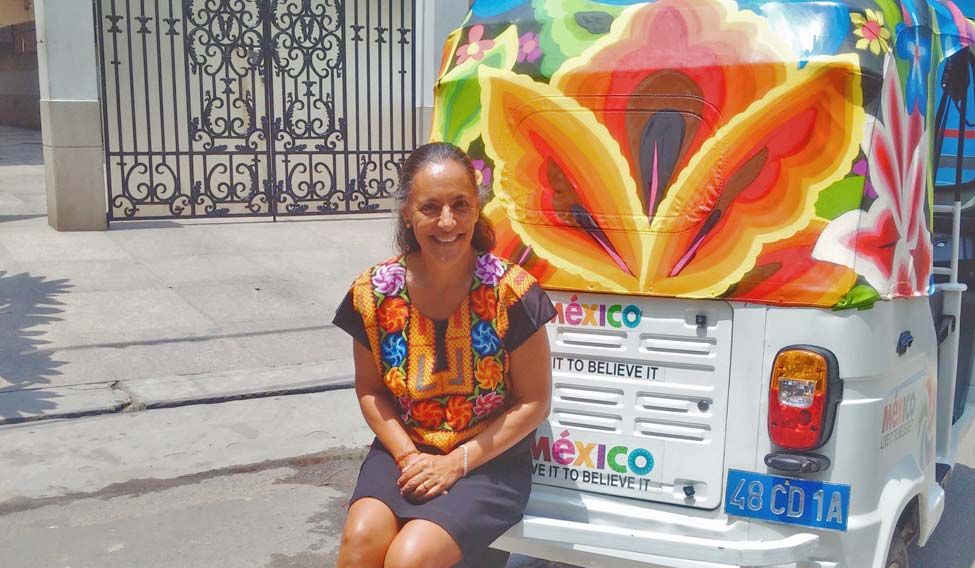
It is true that Melba Pria has, since she took over as ambassador, created waves, hit headlines and made news. She is one of the few ambassadors who has been written about extensively. None of it is of her own making but “it was the autorickshaw” she says.
Her using an autorickshaw instead of a car as her official vehicle grabbed eyeballs and earned her the tag of an “autorickshaw diplomat”. When her vehicle was not allowed to enter the Parliament House premises, she shot off a letter to the Speaker drawing her attention to how the House of the People could bar a people’s vehicle from entering its precincts. That apart, even basements of malls and parking lots of five star hotels do not allow autorickshaws in. Hers carries a Mexican flag but still runs into procedural wrangles.
India was a posting Melba had asked for and waited to get. It did not happen easily. But once it did, it was nothing short of a “wow”. Today she takes pride in being the second woman Mexican ambassador to India. When it actually happened, among the first few things Melba did was to call on Graciela de la Lama Gomez, the first woman to hold the office of ambassador to India: “I have always looked up to her. So meeting her and understanding her vision and her work in India was in order. For me the greatest satisfaction was that like her, I had made it to where she once was and I always wanted to be”. The two postings were some 30 years apart and even though the demands and pressures were different, Gomez has remained Melba’s idol. Melba was also the youngest member of the diplomatic corps, having joined the foreign service when she was barely 21. She vacillated between being a public servant and a career diplomat.
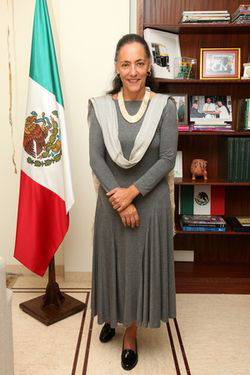 Melba Pria
For Melba, staying and working in India was a dream come true. This is because she had known the country much before setting foot on its soil. She had read Tagore when she was nine and played with the strings of the sitar sitting on maestro Ravi Shankar’s lap. By virtue of her mother being in the Ministry of Culture, musicians, singers and painters were friends of the family: “I would often come home from school and hear the sitar being played. It was a sound I grew up on.” So Ravi Shankar had remained “Ravi uncle” to Melba for most part of her growing up years. It was therefore quite natural that she trained as a classical singer “sadly not Indian, but western” she laments. She is now learning jazz: “Trying but not quite there yet”. Equally, she is drawn to Sufi music and among the few things she enjoys doing while in Delhi, is to visit the Nizamuddin Dargah on a Thursday when the rhythm of Sufi music kind of transports you to another world: “These were sounds that were profoundly Indian,” she says.
And here started the blue shawl story which goes something like this: Given that it is customary to cover your head within the precincts of the dargah, Melba when she visited the mausoleum, as its special guest, was presented a blue shawl: “It had stars on it and for weeks my younger colleagues joked about the blue shawl with stars hanging from it, like berries. I still put on the blue thing though the stars are gone”.
Posted as ambassador some three years ago, India was not new to her. She had been here half a dozen times on her own, the first time as a tourist. She was then a public servant, working in the ministry of education: “I remember telling the minister that I had a wedding to attend in France and on my way would go to India. He looked at me and repeated: Go to India on your way from France? The next morning, I found a world atlas on my work table with a note: “You need to brush up your geography. There is no way you can go to India on your way from France.” Melba being Melba, did. India beckoned her and there was no way she was going to give it a miss whether on her way from France or out of it. That was 25 years ago.
Melba was not the first in her family to come to India. Her mother had before her and so also her grandmother: “She had taken back a sari with her and I remember my mother made it into a robe and when she wore it, she looked like a princess. My siblings used many saris as drapes all over their homes”. Melba was the only one who wore the six yards as a sari, except she wore it as a sarong instead of a sari: “Having lived in Indonesia, I wore it as a sarong and was always cautious about it falling off”. It was only after she came to India that she realized the existence of a petticoat: “My life changed from there because wearing a sari over a petticoat is both easy and safe. I never ever had to worry after that,” she says. India, however, put an end to her sari-spree: “I wore saris before coming to India but once here, I stopped wearing them. Women here wear beautiful saris and in comparison, mine would look like nothing,” she says.
There is a lot of India in Melba Pria, beginning with her name that has an Indian connotation. It is among the first things she tells you: “My name is Pria which is unusual in Mexico. It has nothing to do with India but it has a connect. A funny coincidence but I grew to the idea of having a name that means beloved.I found it exotic.”
India and Mexico, she says, are similar in many ways: “We have an independent life of over 200 years and yours maybe 70 but many things are happening in India that happened in Mexico when it got independence. India and Mexico are like hinges and whatever happens to one will in some way impact the other. India tests you every day, it tests your patience and the capacity to understand nuances. It is a country where different centuries coexist—a cart drawn by camels and rockets being launched in space by ISRO. So one has to learn to adapt and be in tandem”. Being a Mexican, Melba finds this rather easy because Mexicans, she says, adapt easily. Her mother in any case taught her to be rooted while giving her wings to fly: “We were rooted enough to know where we were coming from and wings to understand what the world was made up of”.
Fly she did and soared heights but Melba remains a Mexican to the core and even while talking India, she thinks, lives breaths Mexico. “I am Mexico,” she says.