



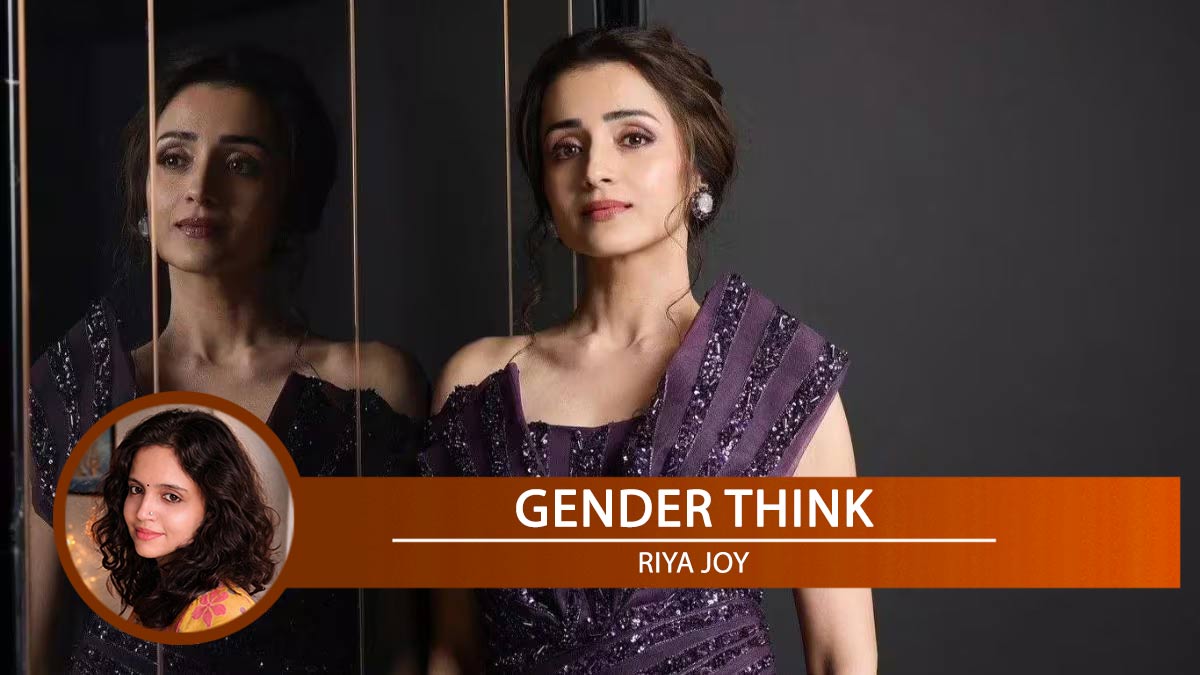
Kollywood is celebrated—and sometimes notorious—for its larger-than-life mass masala entertainers. Power-packed action, comedy, item numbers, punch dialogues, skin show, sentimental melodrama—what else do you need to fill your popcorn bucket with an adrenaline rush? Now, the latest crowd-puller from Kollywood is not on the silver screen but in real-life Tamil Nadu politics.
The opening scene of this outrageous show unfolded during a DMK protest at Thanjavur over the Cauvery issue. When Opposition leader Udhayanidhi Stalin targeted TVK leader and Tamil Nadu Chief Minister Vijay over the Cauvery dispute, his supporters raised slogans invoking actress Trisha Krishnan. In response, Udhayanidhi smirked and made a rude remark that was widely interpreted as a sexual innuendo referring to the rumoured relationship between Trisha and Vijay. The ruling party and its supporters accused Udhayanidhi of objectifying actress Trisha and filed a police complaint. An FIR was registered, and Udhayanidhi was arrested. The spark he triggered in Tamil Nadu politics is still burning fiercely across social media.
But beyond the political drama lies a familiar patriarchal script.
It may be just one more episode of objectifying a woman in the long history of dirty power politics. Of course, the actual target was Vijay, and Trisha's name was deliberately dragged into the political debate as the sharpest weapon. We all know that political arguments can descend to the lowest extremes. But the question is: why is a woman, who is not even part of the political battle, so casually dragged into it for a cheap victory? How can men continue to treat a woman's dignity as expendable in political combat? Patriarchy has long relied on the character assassination of women to settle scores between male egos. There need not even be a direct accusation; a hint, a wink, or a dirty double meaning is enough, and society willingly fills in the blanks with its own moral fantasies.
Even when the fight is between men for power, between countries over territories, or between ideologies and religions for influence over the human mind, why does femininity always have to bleed in between? Have you ever wondered why? It is because our society is conditioned in such a way that women are rarely valued for their own identity. Instead, they are often treated as symbols representing someone else's prestige or shame. She is expected to carry the honour of her male counterpart, the dignity of her family, and the morality of her culture. So, when her name is dragged into a dispute, it is not merely her identity that is attacked; her morality and honour become collateral damage as well. In patriarchal societies, a woman's reputation is often treated as the easiest battlefield on which men fight their wars.
In Tamil Nadu, where politics and cinema are almost inseparable, women actors and women politicians often become easy prey to spicy gossip. No celebrity woman is insulated from being dragged into a male-chauvinistic political narrative, where she is reduced to an object that can be morally and sexually interpreted in any way the voyeuristic crowd desires. What begins as a healthy political debate soon shifts into an unnecessary scandal and a 'hot' public discussion. Her name dominates screaming headlines and spreads 'dangerously' across social media through reels, trolls, and memes. Who cares when a woman's dignity is repeatedly slaughtered before the crowd, and her morality is put on endless trial in the digital public sphere? Democracy gives us the right to disagree. But does it give us the right to weaponise a woman's dignity?
