



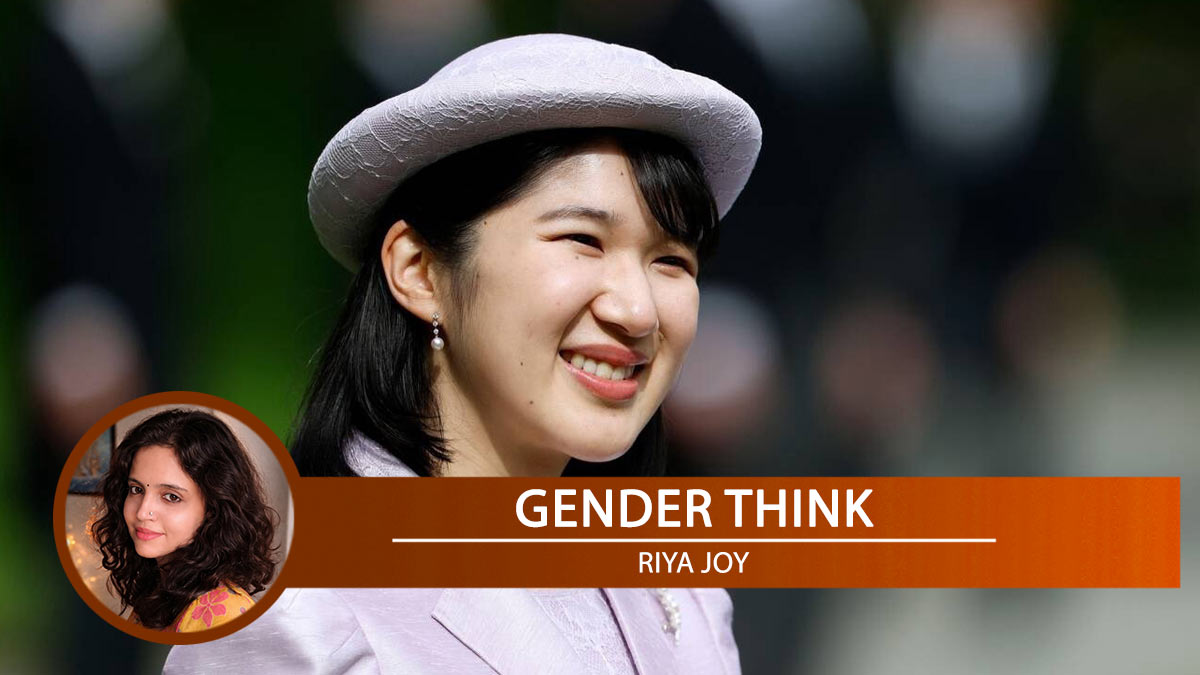
When traditions taught us that blood is thicker than water, have we ever stopped to ask whose blood is considered "thicker"—a man's or a woman's? Apparently, it is the man's. That is why Japan has recently revised its imperial succession framework, once again blocking women from ascending the Chrysanthemum Throne. By completely bypassing the debate on allowing female succession, Japan has chosen to preserve its centuries-old male-line inheritance system. As a result, Princess Aiko, the only child of Emperor Naruhito, remains ineligible to inherit the throne solely because of her gender, despite her royal lineage. While monarchies in countries such as the Netherlands, Sweden and Belgium have adopted absolute primogeniture, allowing the eldest child to inherit regardless of gender, Japan—one of the world's most technologically and economically advanced nations—continues to cling to a male-only succession tradition.
The debate here is simple: Why can't women become the bearers of lineage? Why is a man considered more entitled than a woman born into the very same privilege? It reminds me of George Orwell's famous line in Animal Farm: "All animals are equal, but some animals are more equal than others." The Japanese dilemma mirrors the patriarchal inheritance system that exists in many of our own families. Even today, family names usually pass through fathers, sons are expected to carry forward the family identity and often inherit a larger share of property, while daughters are still viewed as eventually "belonging to another family" after marriage.
A woman's identity continues to remain a forbidden territory for patriarchy, especially when it comes to positions of power. History tells us that women have always been entrusted with preserving traditions—caring for families, making sacrifices and passing on values across generations. Yet when it comes to inheriting power, property, titles or even the family name, she is quietly pushed out of the picture.
No wonder even Gen Alpha children almost invariably inherit only their father's surname, while the mother often becomes an invisible symbol of emotional labour—reduced to being the one who gives birth, nurtures and raises the next generation, but rarely recognised as the one who carries forward the family's identity. The same patriarchal mindset persists whenever women are excluded from positions of authority and succession. When legitimacy is defined by gender, a woman is expected to marry and produce heirs, but not to become one.
Even in an age of robotics and artificial intelligence, the medieval belief that a woman's lineage is somehow less worthy of carrying forward a family's or a nation's legacy survives. That, perhaps, is the real irony. Isn't it time we rewrote this bloodline myth—one that confines women to preserving legacy, but denies them the right to inherit and lead it?
