



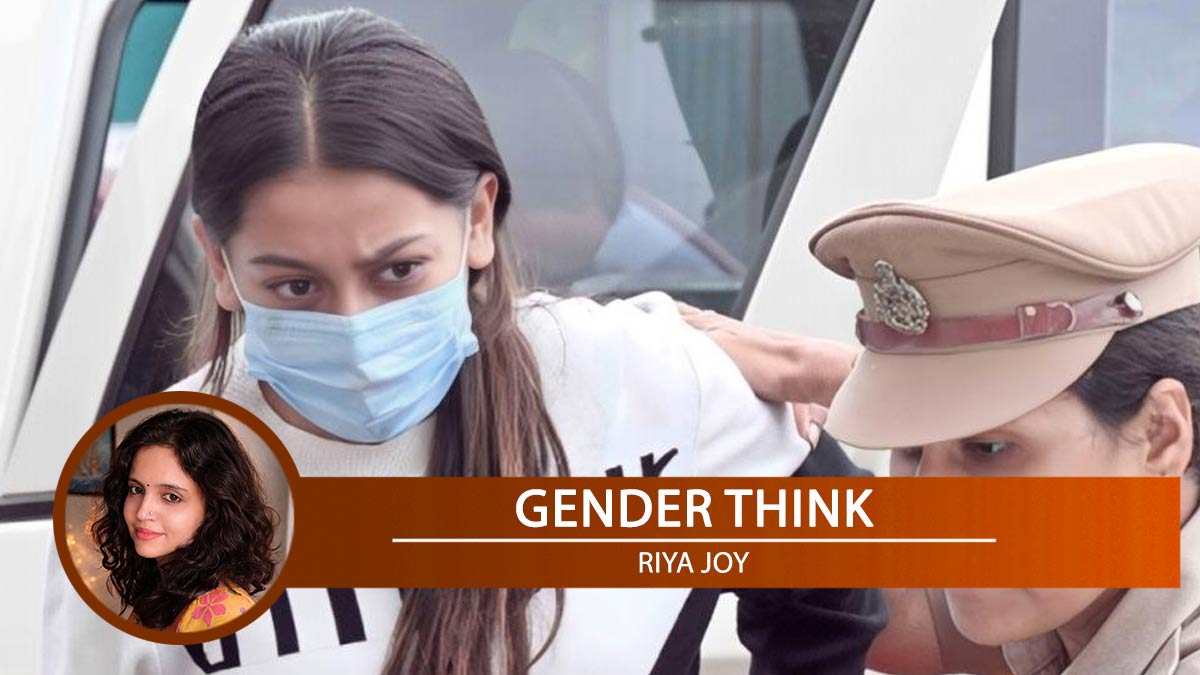
Crime stories are always blockbusters on news channels as well as social media. Every development is enthusiastically amplified, followed up and even "parallelly investigated" by netizens. And when the accused is a woman, the case gains extra mileage, because society opens a file of morality rather than justice, and the epicentre of the trial becomes her gender rather than the crime.
Recently, when a woman from Jaipur was arrested by the Rajasthan ATS under the UAPA on allegations of links with a terrorist organisation, public imagination once again assumed the role of parallel investigator. This is not the first time a woman has been accused of a serious crime. Every time a woman's name appears in the list of accused, patriarchy files a charge sheet against her gender, and the trial begins in the public psyche long before it reaches the courtroom.
Have you ever wondered why a woman accused of a serious crime is often treated as a cultural anomaly, and why her gender becomes a screaming headline? While a male accused is more likely to be described in terms of ideology, network, logistics or operational role, a woman accused is frequently presented through an emotional or romantic narrative. Here again surfaces the age-old stereotype that women act out of emotion while men act out of reason.
Patriarchy has taught us that women are morally superior. That is why, when a woman is accused of violence or extremism, society reacts with collective shock. News headlines never scream "male terrorist", because maleness is treated as the default. But when a woman is accused of the same crime, she becomes a "lady terrorist". If our legal system promises equality before the law, why should a woman receive either special sympathy or harsher moral condemnation simply because she is the 'second sex'?
I remember attending a journalism training session where I was told that a woman accused is considered a highly saleable news peg. Perhaps that is why reports from multiple sources often dwell on her relationships, appearance and personal life. In the Jaipur case too, many reports focused on her alleged desire to marry a terror suspect and on the image of an "ordinary woman living a secret life". The complicated part of patriarchal reporting is that she becomes a "woman" before she becomes an accused. Even her social media photographs and glamorous lifestyle become subjects of public debate.
While background investigations into male accused often end on a relatively restrained note, society continues probing the so-called emotional vulnerabilities of a woman accused. Who she was dating, whether she had multiple relationships and similar details are publicly dissected. Patriarchy tends to believe that a woman involved in crime must either be an innocent victim manipulated by men or an unnatural woman who has violated the ideal of "pure femininity". Both narratives deny her full agency.
Treating women as incapable of committing crime is yet another form of paternalism. Just as traditional society is often reluctant to acknowledge women's achievements, it is equally unwilling to accept their agency in crime. When a woman stands in the dock, society derives almost a kind of voyeuristic pleasure in repeatedly scrutinising her femininity rather than rationally examining the allegations against her. Isn't it high time we stopped putting her gender on trial?
The opinions expressed in this article are those of the author and do not purport to reflect the opinions or views of THE WEEK.
