



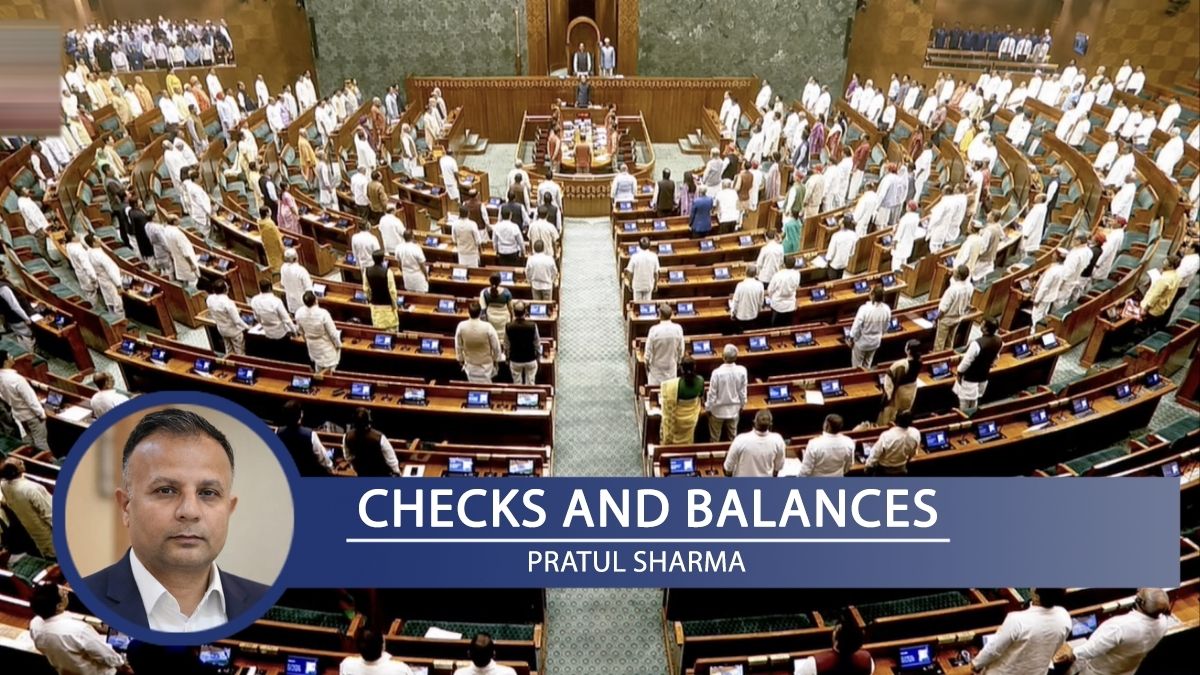
As India marks 80 years of independence, one word that best describes what Indian politics has been missing lately is samvaad. It means dialogue, or the willingness to hear and engage with another view. An older Indian tradition of such engagement is shastrarth, in which arguments are met with counter-arguments and ideas are tested through debate.
The Constituent Assembly worked on this principle for nearly three years. It spent another 114 days debating before giving India its Constitution by giving voice to a multitude of views and concerns.
Now, take a look at the recent events. The Monsoon Session of Parliament lasted 25 days, but the two Houses used only a fraction of their scheduled time. Parliament passed 12 bills, 11 of them without any MP other than the minister piloting the bill speaking during the debate. Question Hour, one of Parliament's main tools for holding the government accountable, lasted only nine minutes.
The government says it was ready for debate, but the Opposition chose disruption. The Opposition says the government did not create the conditions for meaningful debate. Both sides have a case. But both also spent much of the session making their arguments to television cameras rather than to each other.
This kind of posturing may work during elections, but it has increasingly found its way into Parliament too.
Outside Parliament, however, there were signs that samvaad has not disappeared from public life. But it is increasingly being used only as a last resort.
At Jantar Mantar, students protesting the NEET paper leak spent weeks on the streets before Union ministers finally met their representatives. The talks eventually led to an education minister resigning, compensation being promised and cases being dropped.
But dialogue came only after a 26-day hunger strike, a march towards Parliament and weeks of protests.
A similar situation emerged in Jharkhand over alleged irregularities in JPSC and JSSC recruitment examinations. The government formed a panel and met student representatives, but talks broke down before an agreement could be reached. In both cases, the government eventually chose dialogue, but only after protests had already taken a toll.
Earlier, the delimitation and women reservation amendment bills were defeated due to lack of numbers, simply because the Opposition claimed it was not consulted enough. Now, again as a last resort, there have been talks between the parties and the government so that the bills can be brought again.
The more unexpected examples of dialogue came from opposite ends of the political spectrum.
RSS chief Mohan Bhagwat, speaking to a young audience in Mumbai, referred to the tradition of shastrarth and Ambedkar's belief in constitutional dissent. He argued that Gen Z protests should not automatically be treated as anti-national and that young people needed to be engaged. His point was simple: there has to be a relationship before there can be meaningful dialogue.
Leader of Opposition Rahul Gandhi, speaking at his party's convention in Delhi, made a similar argument in a very different context. Despite his long-standing criticism of the RSS, he said he would defend its right to express its views. People, he said, cannot be stopped from expressing themselves.
These calls for dialogue come at a time when politics itself is undergoing a churn. Samvaad was never meant to produce agreement. The Constituent Assembly itself recorded many disagreements, including arguments that eventually lost. What mattered was that those arguments were heard and recorded. That gave decisions greater legitimacy, even when some members disagreed with the outcome.
A law passed while the Opposition is shouting slogans in the well of the House may still be valid. A protest settled only after weeks on the streets may still produce a result. But both raise questions about whether the process was good enough.
Parliamentary disruption is not new, and neither is political disagreement. The bigger problem is that both sides increasingly appear to treat dialogue as a last resort.
That is what should concern us 80 years after independence.
Democracy is not only about winning votes. It is also about listening to those who disagree. Eighty years later, that remains a lesson politics has to keep relearning when discord arises.
