



UNESCO WORLD HERITAGE SITES
There are many ways of travelling through India. One can follow its rivers, its coastlines or its mountain ranges. One can travel by the chronology of empires, from the Mauryas and Guptas to the Mughals and the British. One can follow religion, tracing the journeys of Buddhism, Hinduism, Jainism, Sikhism and Christianity. Or one can simply follow the road.
But there is another remarkable way to understand the country: through its UNESCO World Heritage sites.

Taken together, India’s 45 properties on the UNESCO World Heritage List form something much more than a collection of famous monuments. They constitute a kind of three-dimensional biography of the civilisation. The oldest chapters are written on rock walls at Bhimbetka. The story of urban civilisation appears in the carefully planned Harappan city of Dholavira. Buddhism leaves an extraordinary trail from Sanchi and Bodh Gaya to Nalanda and Sarnath. Hindu temple architecture reaches astonishing levels of sophistication in the temples of the Pallavas, Cholas, Hoysalas and Kakatiyas. The medieval landscape is represented by the ruins of Hampi, the hill forts of Rajasthan and the military landscapes of the Marathas. The Mughals leave behind forts, tombs, mosques, gardens and, in the Taj Mahal, perhaps the most recognisable architectural expression of love in the world.
Then the story changes again. Cities become heritage: Ahmedabad and Jaipur, Mumbai and Chandigarh. A railway line becomes heritage. A university founded on the ideals of Rabindranath Tagore becomes heritage. Even a system of burial mounds of the Ahom dynasty in Assam finds a place on the global list.
And beyond the human story lies another India: the India of Kaziranga’s rhinoceroses, the wetlands of Keoladeo, the forests of Manas, the Himalayan landscapes of Nanda Devi and the Valley of Flowers, the Sundarbans and the Western Ghats. Khangchendzonga National Park goes further still, bringing nature and culture together in India’s only mixed World Heritage property.
UNESCO’s list is therefore not simply a roll call of places to visit. It is an invitation to see India as a layered civilisation—prehistoric and contemporary, sacred and secular, monumental and ecological, urban and rural, intensely human and profoundly natural.
The journey begins long before India had cities, kingdoms or written histories.
In the sandstone country of central India, near Bhopal, the Rock Shelters of Bhimbetka preserve some of the earliest visible traces of human presence on the subcontinent. Their significance lies not in a single spectacular monument but in the continuity they reveal. The landscape contains hundreds of rock shelters, many naturally formed by weathering, and a remarkable sequence of paintings made over long periods.
The paintings show animals, hunting scenes, human figures, rituals and everyday activities. Their colours—especially reds, whites, greens and yellows—have survived with extraordinary resilience. Some images are relatively simple; others reveal movement and composition. A hunter chasing an animal, a group of people dancing, figures carrying weapons or participating in communal activity: across the rock surfaces, prehistoric people seem to emerge from an immense distance in time.
Bhimbetka is important precisely because it reminds us that civilisation did not begin with palaces.
Before the Mauryan emperor Ashoka, before the great Buddhist monasteries, before the Cholas and Mughals, there were communities adapting themselves to forests, animals, seasons and stone. The rock shelters provide a visual record of that relationship. They also demonstrate something that would recur throughout Indian history: the tendency to make landscape itself a cultural space.
From Bhimbetka, the story moves towards the first great urban civilisation of the subcontinent.
In the arid landscape of Kutch in Gujarat stands Dholavira, one of the most remarkable surviving cities of the Harappan civilisation. Inscribed as a World Heritage property in 2021, Dholavira changes our understanding of what an ancient city could accomplish in an environment where water was scarce.
The city was carefully planned. Its architecture included fortifications, reservoirs, drainage arrangements, streets and distinctive public spaces. The inhabitants developed sophisticated methods of collecting and storing water, an achievement all the more striking because of the severe conditions around them.
Dholavira belongs to the same broad civilisation that produced the great urban centres of Harappa and Mohenjo-daro, but it also has its own character. The archaeological remains show how communities could respond creatively to an unforgiving environment.
The lesson is surprisingly contemporary. Water management, urban planning, environmental adaptation and resilience are often presented as modern challenges. Dholavira demonstrates that human societies were grappling with them thousands of years ago.
The city is silent now. Its streets no longer carry merchants or processions. Its reservoirs no longer serve a living population. Yet the geometry of the ruins allows us to reconstruct something of the intelligence that once animated them.
If Bhimbetka gives us glimpses of early human imagination, Dholavira gives us the first great architectural evidence of organised urban life in this journey.
Few figures have shaped the cultural landscape of Asia more profoundly than Gautama Buddha. India contains some of the places most closely associated with his life and with the spread of Buddhism, and several are now World Heritage properties.
At Sanchi in Madhya Pradesh, the great stupa rises from a hill amid a landscape of monasteries, temples, pillars and gateways. Sanchi is particularly valuable because the site preserves a long history of Buddhist architecture and artistic development.
The great stupa is not merely an ancient dome. Its gateways are among the masterpieces of early Indian sculptural art. They are crowded with scenes from the life of the Buddha, stories from the Jataka tradition, animals, plants, celestial beings and symbolic representations. At a time when the Buddha was often represented indirectly rather than through a human image, the empty throne, footprints, Bodhi tree and wheel could evoke his presence.
The artistry is remarkable for another reason: the sculptors transformed stone into a language of storytelling. The gateways do not behave like silent walls. They narrate.
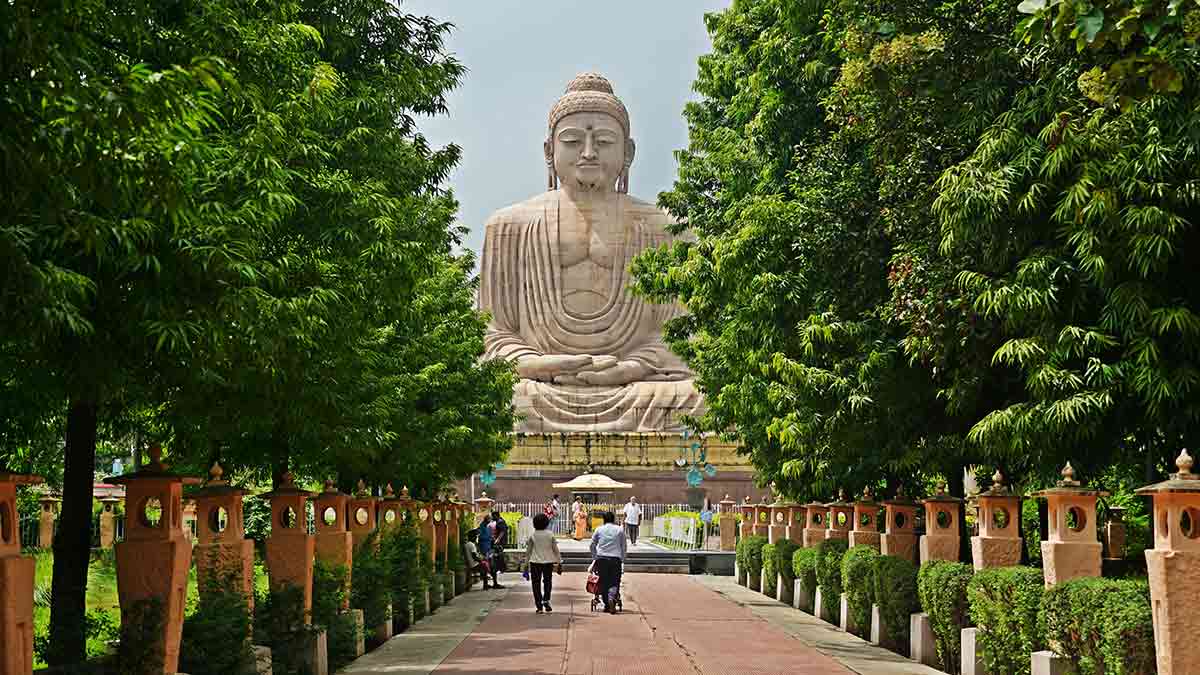
Move eastward to Bihar and the Mahabodhi Temple Complex at Bodh Gaya, and the atmosphere becomes even more intensely associated with the Buddha himself. This is the place traditionally identified with the Buddha’s enlightenment beneath the Bodhi tree.
The temple complex has been rebuilt and modified over centuries, but the site’s spiritual importance goes back to the earliest Buddhist traditions. Pilgrims from across the Buddhist world come here to meditate, pray and circumambulate the sacred spaces.
The Mahabodhi Temple is also an extraordinary architectural object. Its soaring central tower rises above the complex, while the sacred tree and surrounding shrines create a powerful combination of architecture, landscape and ritual.
Bodh Gaya demonstrates an important characteristic of World Heritage in India: a place may have outstanding value not simply because something happened there long ago, but because that event continues to shape human lives.
The same is true of Sarnath.
Near present-day Varanasi, Sarnath is traditionally identified as the place where the Buddha delivered his first sermon after attaining enlightenment. In 2026, the Ancient Buddhist Site of Sarnath became India’s newest addition to the World Heritage List.
Its archaeological remains include the Chaukhandi Stupa and the archaeological area associated with ancient Sarnath. The site preserves evidence of the development of Buddhism as a major intellectual and religious tradition.
The importance of Sarnath lies in the idea of transmission. At Bodh Gaya, the Buddha attained enlightenment. At Sarnath, he began teaching. The first sermon set in motion the Buddhist community and the intellectual tradition that would travel far beyond India—to Sri Lanka, Southeast Asia, Central Asia, China, Korea and Japan.
India’s Buddhist heritage therefore cannot be understood as a collection of isolated monuments. Sanchi, Bodh Gaya and Sarnath are points in a much larger geographical and intellectual network.
That network eventually produced Nalanda.
The Archaeological Site of Nalanda Mahavihara in Bihar represents one of the ancient world’s great centres of learning. Nalanda was not simply a monastery. It was a vast residential and intellectual institution in which monks and scholars studied philosophy, religion, logic, grammar, medicine and other branches of knowledge.
Its fame travelled far beyond India. Chinese pilgrims such as Xuanzang recorded their experiences of studying at Nalanda and provided invaluable descriptions of the institution.
The ruins today consist of monasteries, temples, courtyards and other structures. Walking through them, it is possible to imagine a community organised around learning: students and teachers moving through cloisters, debates taking place in halls, manuscripts being studied and philosophical arguments continuing late into the day.
Nalanda is particularly relevant to the modern world because it reminds us that universities are not solely European inventions of the medieval or modern period. South Asia had large residential centres of advanced learning more than a millennium ago.
The physical ruins are archaeological. The idea they represent is very much alive.
If Buddhism produced one of the great intellectual and artistic networks of ancient India, Hindu temple architecture produced another.
The evolution of the Indian temple cannot be reduced to a single style. Regional traditions experimented with form, proportion, sculpture, engineering and ritual space. The result is an extraordinary diversity of architectural expression.
At Mahabalipuram on the Tamil Nadu coast, the Pallavas carved temples and monuments directly into the granite landscape. The Group of Monuments at Mahabalipuram includes rock-cut caves, structural temples and monumental reliefs.
Among the most famous is the Shore Temple, dramatically positioned beside the Bay of Bengal. Its location is as important to its visual identity as its architecture. Waves, salt air and changing light form part of the experience of the monument.
Elsewhere at Mahabalipuram are the celebrated monolithic rathas, each carved from a single block of rock. They resemble chariots or temple forms and reveal the experimental quality of early south Indian architecture.
The great open-air relief known as the Descent of the Ganges—or Arjuna’s Penance—is another masterpiece. Gods, animals, humans and mythical beings populate the enormous rock surface. The stone becomes a stage on which an entire cosmological world is assembled.
At Pattadakal in Karnataka, another experiment unfolds. The Group of Monuments at Pattadakal represents the flowering of Chalukyan architecture and, significantly, the interaction between northern and southern Indian temple traditions.
The temples demonstrate that Indian architectural styles were not sealed regional compartments. Ideas travelled. Architects and patrons borrowed, modified and recombined forms.
Pattadakal was a laboratory of architecture.
The same sense of experimentation can be found in the temples of the Cholas.
The Great Living Chola Temples are represented by three monumental temples: the Brihadisvara Temple at Thanjavur, the Brihadisvara Temple at Gangaikondacholapuram and the Airavatesvara Temple at Darasuram.
Together they reveal the extraordinary ambition of Chola rulers and their architects.
The Brihadisvara Temple at Thanjavur, commissioned by Rajaraja Chola I, dominates the landscape with its massive vimana. Its scale is astonishing, but scale alone does not explain its importance. The temple is an integrated expression of architecture, sculpture, painting, ritual and political power.
The Chola kings were patrons of art, but the temple was also a statement of kingship. Divine authority and royal authority were brought into a single monumental language.
At Gangaikondacholapuram, the architectural tradition continued, but the forms were refined in different ways. At Darasuram, the Airavatesvara Temple is smaller yet extraordinarily intricate.
Together the three monuments reveal how a tradition can remain recognisably itself while continuing to evolve.
Further north, in Khajuraho, the Chandella rulers created a very different but equally sophisticated architectural landscape.
The Khajuraho Group of Monuments is famous for its sculptural richness, including the erotic imagery that has made the site internationally recognisable. But to reduce Khajuraho to its erotic sculptures is to miss most of the achievement.
The temples are covered with representations of gods, goddesses, musicians, dancers, warriors, animals, mythical beings and scenes of courtly and everyday life. The human body is celebrated in movement and sensuality, but it exists within a much larger sacred universe.
Khajuraho is an architectural statement in which sculpture does not merely decorate the temple. Sculpture creates the temple’s visual world.
The Hoysalas took this process of sculptural elaboration to another level.
The Sacred Ensembles of the Hoysalas, inscribed in 2023, include the temples at Belur, Halebidu and Somanathapura. Their surfaces appear almost embroidered in stone. Friezes, figures, mythical animals and narrative panels cover the structures with extraordinary density.
The Hoysala architects worked with soapstone, a material that permitted exceptionally fine carving. The result is a kind of stone filigree.
At first glance the abundance can seem overwhelming. But the closer one looks, the more sophisticated the organisation becomes. Bands of sculpture run around the temples, while major figures occupy carefully selected positions. The buildings were designed to be experienced from multiple angles.
The Kakatiya tradition offers another variation.
The Kakatiya Rudreshwara, or Ramappa Temple, in Telangana, is distinguished not only by its sculpture but by its engineering and architectural character. The temple was built in the early 13th century under the Kakatiya dynasty and is associated with the master builder Ramappa.
Its elaborate carvings include dancers, musicians, mythical figures and decorative motifs. The temple stands as evidence of a regional architectural tradition that flourished in the Deccan.
And then there is Konark.
The Sun Temple at Konark in Odisha is one of the most audacious architectural conceptions in India. Designed as the cosmic chariot of the Sun God, the temple is associated with the reign of Narasimhadeva I of the Eastern Ganga dynasty.
The surviving structure is famous for its monumental stone wheels, richly carved surfaces and sculptural programme. The wheels are not merely decorative: they have become one of the defining visual symbols of Indian architecture.
Konark’s great temple was conceived as movement frozen in stone. The Sun God’s chariot seems poised to travel across the heavens.
Few places demonstrate the ambition of Indian rock-cut architecture better than Ellora.
The Ellora Caves contain Buddhist, Hindu and Jain monuments created over several centuries. The proximity of these traditions is itself remarkable. Rather than existing as isolated monuments, they form part of a shared architectural landscape.
The crowning achievement is the Kailasa temple, carved out of the living rock.
It is difficult to comprehend the engineering involved. Instead of assembling a temple from blocks, the builders excavated downward and inward, removing enormous quantities of rock to create a monumental structure.
The result resembles a freestanding temple complex, complete with architectural details and sculptural compositions.
Ellora makes the rock itself disappear. What was once a cliff becomes architecture.
Nearby, the Ajanta Caves tell a different story.
Ajanta is particularly celebrated for its Buddhist paintings. Created over several centuries, the murals contain scenes from the Jataka stories, courtly life, religious narratives and an extraordinary range of human expression.
The paintings are among the finest surviving examples of ancient Indian mural art.
Faces turn towards one another. Figures bend, gesture and move. Jewellery and textiles are rendered with care. Kings, queens, monks, attendants and celestial beings occupy richly composed scenes.
Ajanta is not simply an archaeological site. It is a gallery of human emotions preserved in a cave complex.
At Elephanta, on an island near Mumbai, rock-cut architecture takes yet another form. The caves are dominated by monumental Shaiva sculptures, including the famous three-faced representation of Shiva.
The Elephanta sculptures are powerful because they combine physical mass with spiritual abstraction. Shiva appears simultaneously as creator, preserver, destroyer and cosmic presence.
The location also matters. Elephanta is reached by boat from Mumbai, and the transition from the modern metropolis to the island contributes to the experience.
India’s rock-cut tradition thus stretches across centuries and regions. Ajanta, Ellora and Elephanta are not identical, but together they demonstrate the extraordinary willingness of Indian builders to treat mountains and cliffs as raw architectural material.
By the medieval period, Indian civilisation had developed sophisticated urban centres, royal capitals and fortified landscapes.
Hampi, in Karnataka, is perhaps the most haunting of them all.
The Group of Monuments at Hampi preserves the remains of Vijayanagara, one of the great imperial capitals of southern India. At its height, the city was a major political, commercial and cultural centre.
Today the ruins stretch across a dramatic landscape of granite boulders, hills, riverbanks and agricultural fields.
The landscape is inseparable from the city. Temples, bazaars, royal enclosures, water structures and monumental gateways appear among enormous natural rock formations.
The Virupaksha Temple remains a living place of worship, while other monuments stand as archaeological ruins. The Vittala complex is famous for its stone chariot and musical pillars.
Hampi therefore offers something rare: the possibility of seeing how an imperial city interacted with its natural setting.
The hill forts of Rajasthan present a completely different vision of power.
The UNESCO property known as the Hill Forts of Rajasthan brings together a group of formidable fortifications associated with Rajput states. Chittorgarh, Kumbhalgarh, Ranthambore, Gagron, Amber and Jaisalmer represent different responses to geography and warfare.
Their defining characteristic is adaptation.
Chittorgarh spreads across a massive hilltop plateau. Kumbhalgarh is protected by an immense defensive wall. Jaisalmer rises from the desert in golden sandstone. Amber uses the terrain of the Aravalli hills to create a fortified palace landscape.
These forts were not simply military installations. They contained palaces, temples, reservoirs, settlements and spaces for courtly life.
They were cities of power.
At Champaner-Pavagadh in Gujarat, another layered landscape survives. The archaeological park contains remains associated with a medieval Islamic city as well as earlier Hindu and Jain traditions around Pavagadh hill.
The site includes fortifications, mosques, temples, palaces, water systems and other structures. It is significant partly because it preserves a relatively intact medieval landscape rather than a single isolated monument.
The lesson is repeated across India: history is often more legible when monuments are considered together with the roads, water systems, settlements and natural features around them.
Delhi has repeatedly been rebuilt because successive powers have sought to make it their capital.
The Qutb Minar and its associated monuments represent one of the earliest great architectural statements of Islamic rule in Delhi.
The Qutb Minar itself rises more than 70 metres and is richly decorated with bands of inscriptions and ornament. The complex also contains the Quwwat-ul-Islam mosque, the Iron Pillar and other remains.
The monument is both architectural and historical. It marks the beginning of a new political and cultural phase in northern India while also incorporating materials, craftsmanship and architectural practices from the existing Indian environment.
Several centuries later, the Mughals developed a more elaborate imperial vocabulary.
Humayun’s Tomb in Delhi was built in the 16th century for the Mughal emperor Humayun and is widely regarded as an important precursor to later Mughal architecture, including the Taj Mahal.
Its charbagh garden layout, symmetrical planning, monumental dome and use of red sandstone and white marble created a powerful new architectural language.
The tomb is also important because it represents a transition in Indian architecture: the Persianate garden-tomb tradition became rooted in the Indian landscape.
Agra Fort, another World Heritage property, presents the military and residential side of Mughal power.
The massive red sandstone fort contains palaces, audience halls, mosques and other structures associated with successive Mughal rulers. Its walls communicate military strength, but inside them is a world of refined courtly architecture.
From Agra Fort, one can also glimpse the Taj Mahal.
The Taj Mahal hardly needs an introduction, yet familiarity can obscure its achievement.
Commissioned by Shah Jahan as the mausoleum of his wife Mumtaz Mahal, it was completed in the 17th century and has become one of the most famous buildings on earth.
Its power lies in proportion and balance as much as ornament. White marble, geometric planning, calligraphy, gardens, reflecting pools, domes and minarets are brought together in a composition that appears almost weightless.
The building is often described as a monument to love. That is true, but incomplete. It is also a monument to imperial resources, craftsmanship, engineering and the Mughal fascination with symmetry and paradise gardens.
Nearby, Fatehpur Sikri represents another side of Mughal ambition.
Built by Akbar in the 16th century, the city served as the imperial capital for a relatively brief period. Yet its architecture remains among the most distinctive of the Mughal era.
Palaces, courtyards, audience halls and religious buildings are arranged around a planned urban complex. The Buland Darwaza rises with extraordinary theatricality.
Fatehpur Sikri has a strangely poignant quality. A magnificent capital was built, occupied and then largely abandoned. The empty spaces today allow visitors to experience the architecture without the noise of the city that once surrounded it.
The Red Fort in Delhi belongs to a later stage of Mughal imperial architecture. Built by Shah Jahan as part of his new capital, Shahjahanabad, it became the symbolic centre of Mughal power.
Its red sandstone walls are immense, but inside lies a refined palace world of halls, gardens and water channels.
The fort later acquired another layer of meaning. After the end of British rule, India’s first prime minister raised the national flag from the Red Fort, and the monument became associated with independent India.
Thus the same building can carry different political meanings across centuries.
One of India’s most extraordinary monuments is not a palace, temple or fort. It is a stepwell.
Rani-ki-Vav at Patan in Gujarat was constructed as an elaborate subterranean water structure. It descends through multiple levels, its walls densely carved with sculptures.
The stepwell was practical, but it was also ceremonial and aesthetic. Water architecture became monumental.
The deeper one descends, the more elaborate the carved spaces become. Deities, celestial beings and other figures inhabit the walls.
Rani-ki-Vav reveals a recurring Indian principle: utility and beauty do not have to be opposites. A structure designed to store and access water could also become a work of art.
That principle has relevance far beyond the medieval period. In a country where water scarcity remains a critical concern, the intelligence embodied in historic water systems deserves renewed attention.
The Churches and Convents of Goa preserve another chapter in India’s long encounter with the outside world.
Old Goa became a major centre of Portuguese power and Catholic missionary activity. Its churches and convents reflect European architectural traditions adapted to the Indian environment.
The Basilica of Bom Jesus is particularly famous because it houses the tomb of St Francis Xavier. Other churches, including the Se Cathedral and Church of St Francis of Assisi, contribute to the architectural ensemble.
Goa’s importance is not simply religious. The buildings are evidence of the intense maritime connections that linked India with Europe and the wider world.
The Portuguese presence altered trade, politics, architecture and cultural life along the western coast.
The monuments therefore belong to Indian history even though many of their architectural forms originated elsewhere.
In the northeast, the Moidams of the Ahom Dynasty provide a very different form of heritage.
The moidams are mound burial systems associated with the Ahom royal tradition. Concentrated around Charaideo in Assam, they form a distinctive cultural landscape.
The Ahoms established their kingdom in the Brahmaputra valley in the 13th century and remained a major political power for centuries. Their burial tradition created earthen and architectural monuments that integrated ritual, memory and landscape.
The moidams are important because they represent a civilisation often underrepresented in the conventional architectural history of India.
India’s World Heritage map is therefore not simply a map of the better-known northern and southern centres. It reaches deep into the northeast, where different political traditions, belief systems and landscapes developed.
India’s newest major addition before Sarnath was the Maratha Military Landscapes of India, inscribed in 2025.
The property represents a network of forts associated with the military strategy and political history of the Maratha power. Rather than treating a fort as an isolated building, the World Heritage designation recognises a broader military landscape.
The forts occupy different terrains—hilltops, plateaus, coastal areas and other strategic locations—and were adapted to geography.
This is central to understanding Maratha military architecture. The fort was not simply a wall around a settlement. It was part of a network of observation, movement, defence, supply and control.
The Maratha system evolved in response to the terrain of western India and to the military pressures of the 17th and 18th centuries.
Among the most famous are Raigad, associated with Chhatrapati Shivaji Maharaj; Pratapgad, Sinhagad, Rajgad and other great hill forts of Maharashtra. The serial property also includes Gingee in Tamil Nadu, demonstrating the geographical reach of the military tradition.
Seen from above, these forts form an extraordinary relationship with the landscape.
They are mountains turned into military architecture.
For much of the history of heritage conservation, attention focused on individual monuments. Modern UNESCO thinking increasingly recognises that cities themselves can possess outstanding universal value.
Ahmedabad is one such city.
The Historic City of Ahmadabad was inscribed in 2017. Its significance lies in its historic urban fabric: pol houses, neighbourhoods, streets, gates, religious buildings and community spaces.
The old city developed a distinctive pattern of densely organised neighbourhoods in which architecture and community life were intertwined.
A heritage city is therefore not a museum. Its greatest challenge is precisely that people still live in it.
Ahmedabad raises questions that recur everywhere: How can historic buildings be preserved while allowing modern life? How can infrastructure be upgraded without destroying character? How can heritage generate economic opportunity without becoming a theme park?
Jaipur presents another model.
Founded in the 18th century by Maharaja Sawai Jai Singh II, Jaipur was a planned city laid out according to principles of urban design, astronomy, commerce and social organisation.
Its broad streets and planned sectors were unusual in their scale and regularity.
The city’s architecture—palaces, havelis, markets, gates and public spaces—creates a coherent urban identity. Jaipur’s famous pink appearance is now part of its global image, but its deeper significance lies in the planning philosophy that produced the city.
Within Jaipur stands another World Heritage property: the Jantar Mantar.
At first glance, the monumental astronomical instruments seem almost surreal. They are enormous geometric structures built to measure celestial positions and time.
Jai Singh II constructed several such observatories, but the Jantar Mantar at Jaipur is the most spectacular surviving example.
The instruments transform astronomy into architecture.
A visitor can stand beside a huge sundial and realise that this is not a sculpture inspired by science. It is a scientific instrument made on an architectural scale.
This is one of India’s most compelling heritage themes: knowledge repeatedly becomes built form.
Mumbai provides another kind of heritage landscape.
The Chhatrapati Shivaji Terminus, formerly Victoria Terminus, is among the world’s great railway stations. Its architecture combines Victorian Gothic traditions with Indian architectural elements.
But the station’s importance is not merely aesthetic. It symbolises the transformation of Mumbai into a major colonial port and industrial city.
Railways changed India physically and economically. They connected markets, ports, cities and agricultural regions. The terminus became an enormous machine for moving people and goods.
Mumbai’s other World Heritage property, the Victorian Gothic and Art Deco Ensembles, tells the story of the city’s later architectural development.
The Victorian Gothic buildings around the Fort area represent the imperial phase, while the Art Deco structures around Marine Drive and elsewhere embody the modern city of the 20th century.
The juxtaposition is extraordinary.
Within a relatively compact urban landscape, architectural styles associated with different historical moments stand beside one another.
Mumbai demonstrates that heritage does not stop at the threshold of antiquity. Buildings from the 19th and 20th centuries can acquire global cultural significance when they express major transformations in urban history.
Perhaps no World Heritage property in India better illustrates the idea that heritage can be infrastructure than the Mountain Railways of India.
The property is a serial one comprising three railway systems: the Darjeeling Himalayan Railway, the Nilgiri Mountain Railway and the Kalka-Shimla Railway.
These lines were engineering responses to formidable terrain.
The Darjeeling Himalayan Railway climbs through the Himalayan foothills using loops, reverses and other ingenious techniques. The small trains have become part of the identity of Darjeeling itself.
The Nilgiri Mountain Railway uses rack-and-pinion technology on steep gradients. The line winds through the Nilgiri hills, linking the plains with the hill station of Ooty.
The Kalka-Shimla Railway negotiates the mountains of Himachal Pradesh with a remarkable sequence of curves, bridges, tunnels and viaducts.
These railways were built in the colonial period, and their histories cannot be separated from the economic and political structures of British rule.
Yet their heritage significance today lies in the combination of engineering, landscape, technology and social history.
They are still railways.
That matters.
The best way to understand them is not necessarily to examine a locomotive in a museum, but to sit inside a carriage as the train slowly climbs through mountains.
Rabindranath Tagore’s Santiniketan represents yet another definition of heritage.
Founded as an educational and cultural community in Bengal, Santiniketan grew from Tagore’s vision of learning in close relationship with nature, art and humanistic thought.
Its buildings and landscape reflect an educational philosophy rather than a single monumental architectural style.
The campus became a centre of literature, music, visual arts and international intellectual exchange. Visva-Bharati, established by Tagore, embodied the idea of a meeting place between India and the wider world.
Santiniketan is therefore heritage not because a king built a magnificent palace there, but because an educational and cultural experiment acquired physical form.
It asks a fundamental question: Can an idea itself become heritage?
UNESCO’s answer, in this case, is yes.
If Santiniketan represents Tagore’s vision of education, Chandigarh represents the transformation of modern architecture into an entire city.
The Architectural Work of Le Corbusier, an Outstanding Contribution to the Modern Movement, is a transnational World Heritage property with sites in several countries. India’s component is the Capitol Complex at Chandigarh.
The complex includes major governmental buildings designed under the influence of Le Corbusier’s modernist philosophy.
The forms are radically different from India’s historic architecture. Concrete, geometry, monumental planes and open spaces replace domes, carved stone and traditional ornament.
Yet Chandigarh is unmistakably part of Indian history.
It was conceived after independence as a new capital for Punjab and became a symbol of a new India looking towards modernity.
Its World Heritage status therefore extends the story of Indian architecture into the 20th century.
India’s heritage is not frozen in the past.
Then the journey changes completely.
The World Heritage List is not only about what people built. Seven Indian properties are natural, and one is mixed.
Together they reveal another civilisation—one that exists independently of human monuments.
Kaziranga National Park in Assam is perhaps the most famous symbol of this wild India. Its floodplains, grasslands, wetlands and forests support the world’s largest population of the greater one-horned rhinoceros.
The rhinoceros has become almost synonymous with Kaziranga, but the ecological story is larger. Elephants, wild water buffalo, swamp deer, tigers and an extraordinary variety of birds inhabit the landscape.
The annual flooding of the Brahmaputra is not simply a destructive force. It is part of the ecological rhythm that sustains the grasslands.
Kaziranga therefore teaches a lesson that appears repeatedly in Indian ecology: a landscape can be shaped by disturbance.
Manas Wildlife Sanctuary, also in Assam, extends the story into another ecosystem. Located near the foothills of the Himalayas and associated with the Manas River, it contains forests, grasslands and wetlands supporting an extraordinary diversity of species.
Manas is particularly significant for rare and endangered wildlife, including the pygmy hog and golden langur.
Its history also illustrates the vulnerability of protected areas to political and social instability. Conservation cannot be separated entirely from the communities and political circumstances surrounding a landscape.
In Rajasthan, Keoladeo National Park presents a radically different environment. Formerly known as Bharatpur Bird Sanctuary, it is a wetland of exceptional importance to migratory birds.
The part reminds us that wildlife conservation does not always mean preserving a landscape in a supposedly untouched state. The wetland has been shaped by water management and human intervention.
Thousands of birds can gather in the sanctuary during the appropriate seasons. The sight is one of the great spectacles of Indian birdlife.
Far to the north, the Nanda Devi and Valley of Flowers National Parks offer an entirely different world.
The Valley of Flowers is famous for its seasonal carpets of alpine flowers. Nanda Devi, one of India’s highest mountains, rises above a landscape of extraordinary ruggedness.
Himalayan landscapes in India are rarely merely ecological spaces. Mountains are woven into mythology, pilgrimage and local traditions.
The Great Himalayan National Park Conservation Area in Himachal Pradesh protects another extensive mountain ecosystem.
Its forests and alpine habitats support species such as the western tragopan, Himalayan musk deer and snow leopard.
The park is particularly significant because it preserves a relatively intact Himalayan ecological system across different elevations.
As one climbs a mountain, temperature, vegetation and animal communities change. A single protected area can therefore contain several ecological worlds.
The Sundarbans offer perhaps the most dramatic contrast.
At the mouth of the Ganges, Brahmaputra and Meghna river systems lies the vast mangrove landscape of the Sundarbans.
Channels, islands, mudflats and dense mangrove forests create an environment in constant motion.
The Bengal tiger is its most famous inhabitant, but the ecological importance of the Sundarbans extends to fish, reptiles, birds, crustaceans and countless other forms of life.
The landscape is also one of the most vulnerable on the planet to climate change and sea-level rise.
The Sundarbans demonstrates the fragility of the relationship between land and water. Islands change shape. Channels shift. Storms can transform the landscape.
Here, heritage conservation becomes inseparable from climate science.
The Western Ghats run along much of India’s western edge and form one of the world’s great biodiversity hotspots.
The UNESCO property consists of 39 component parts grouped into clusters across several states. It represents a chain of mountain ecosystems with exceptional levels of biological diversity and endemism.
The Western Ghats are far more than scenic mountains.
They influence the Indian monsoon, generate major river systems and contain forests that support species found nowhere else on Earth.
From the shola-grassland systems of the high mountains to evergreen forests lower down, the ecological variety is remarkable.
The region also has an enormous human dimension. Millions of people depend directly or indirectly on the water, agriculture, forests and climate-regulating functions associated with the Ghats.
The World Heritage designation therefore carries an important warning. Conservation cannot mean treating the mountains as a wilderness detached from human society.
The challenge is to preserve ecological integrity while sustaining communities.
Khangchendzonga National Park in Sikkim occupies a special position because it is India’s only mixed World Heritage property.
It is recognised for both natural and cultural values.
The landscape is dominated by Mount Khangchendzonga, one of the world’s highest mountains, and contains glaciers, valleys, forests and high-altitude ecosystems.
But the mountain is also deeply embedded in the cultural and spiritual traditions of Sikkim.
This combination is important. In many parts of the Himalayas, separating nature from culture can be artificial. A mountain may simultaneously be an ecosystem, a sacred landscape, a source of water and a cultural symbol.
Khangchendzonga makes that relationship visible at the international level.
