



Before you hear a single word, you notice the silence.
A long driveway shaded by old rain trees leads to Belvedere House, in a quieter corner of Kolkata. The 18th-century mansion has housed the National Library of India since 1948. Alongside the library’s vast collection of books, it now holds a museum devoted to something far more elusive: the story of words and languages.
Inaugurated by Union Home Minister Amit Shah in July, the Museum of Word is the first of its kind in India. Developed by the ministry of culture at the National Library, it traces human communication from early sounds and symbols to scripts, literature, oral traditions and contemporary forms of expression.
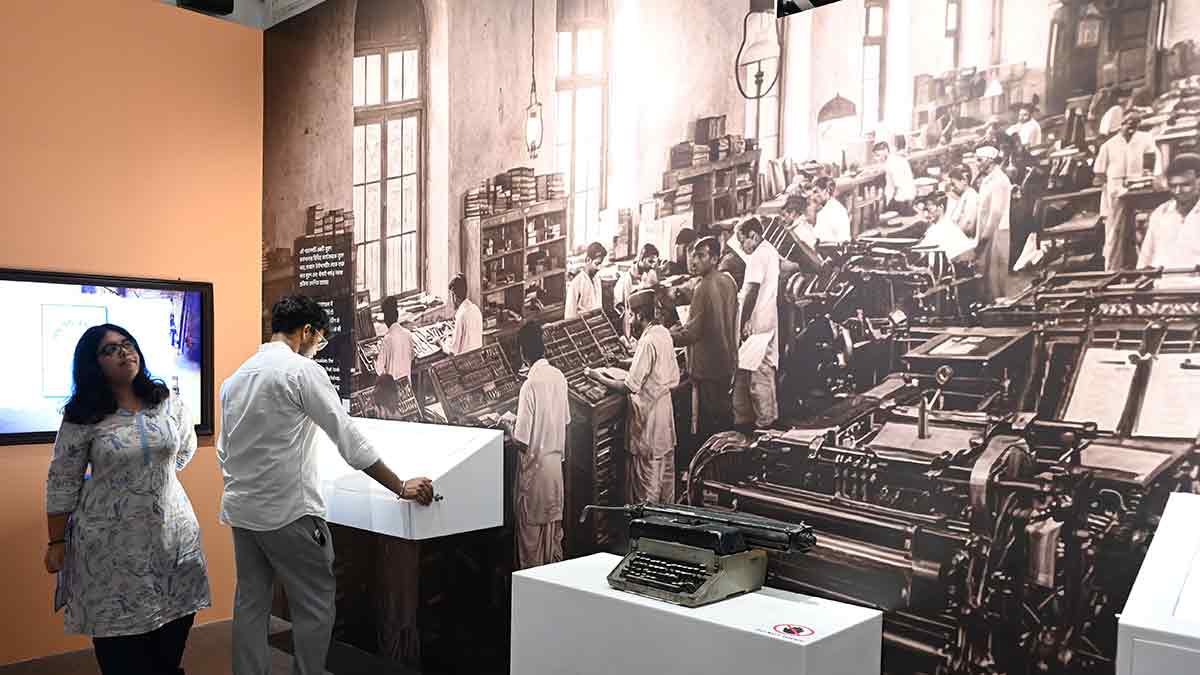
Nothing here is arranged in conventional rows. Words and alphabets hang overhead, screens light up in the darker galleries, voices emerge from installations, and visitors are encouraged to touch, listen and watch. The museum is less about looking at language than entering its world.
BEFORE WORDS CAME SOUNDS
The journey begins before writing and alphabets. Early humans relied on cries, gestures, rhythms and sounds to convey meaning. Over time, these gave way to symbols and systems that could preserve a thought beyond the moment it was spoken.

One installation draws on the tradition surrounding Shiva’s damru. With each beat of the hourglass-shaped drum, sounds and letters appear on a digital display, linking an ancient philosophical idea to the evolution of phonetic expression. Children find it an arresting visual experience; older visitors may see a story they already know in a new light.
From there, the museum opens into thematic galleries.
NINE GALLERIES, ONE JOURNEY
‘First Word’ traces the earliest attempts to communicate, from marks and symbols towards organised writing systems, and shows how language has always developed alongside civilisation. ‘My Mother Tongue’ brings that history home, looking at the emotional intimacy of the language that surrounds us before we learn to name it. In ‘Navrasa’, words become vehicles for feeling. Poetry, music, theatre and literature explore love, sorrow, anger, courage and wonder, showing that language does far more than convey information.
‘Journey of Languages’ widens the view to India’s extraordinary linguistic landscape. Interactive maps, timelines and displays chart how languages and scripts have evolved and moved, and draw attention to those that have declined. The revival of the Gunjala Gondi script is one example of a community reclaiming a significant part of its cultural inheritance. ‘Honouring the Legends’ then turns to the writers, poets, scholars, philosophers and other figures who have shaped India’s literary traditions.
The next two galleries follow language off the page. ‘Oral Traditions’ explores folk songs, myths, epics and stories carried across generations, while ‘Performing Traditions’ shows what happens when language enters music, dance and theatre and acquires movement and rhythm.
‘Global Dialogue’ looks beyond India’s borders, tracing how words have travelled through trade, migration and cultural exchange. Languages have borrowed from one another for centuries, absorbing new sounds, meanings and expressions along the way.
The final gallery, ‘Public Library Movement’, returns visitors to the institution around them. It tells the story of efforts to move knowledge beyond royal courts and elite institutions and make books accessible to a wider public. It is a fitting place to end: language creates and carries knowledge, and libraries help ensure that it survives.
A MUSEUM THAT WILL EVOLVE
The first phase occupies 2,282 square metres on the first floor of Belvedere House, combining sound, projection, touchscreens and other digital elements with physical material.
The project, sanctioned at a cost of Rs41 crore, is being developed in phases, so the present galleries are only the beginning. Further work is expected to bring additional visitor facilities and expand the technological and visual experience, including projection mapping on the historic building.
That suits a museum about language. Languages are never finished: they borrow, adapt, lose words, create new ones and change with the people who speak them. The museum is meant to change with them.
WHY IT MATTERS NOW
India’s linguistic diversity is vast, but it can also be fragile. Migration, urbanisation and the growing dominance of a handful of widely spoken languages can push smaller languages out of everyday use. When a language fades, more than words disappear. Songs, stories, humour, rituals, local knowledge and distinctive ways of seeing the world can fade with it.
That gives the museum particular relevance for younger visitors, who are growing up in a world of rapidly advancing technology. Yet no technology can fully explain why a word spoken by a grandmother carries a different weight, why an expression belongs to one place and not another, or why a childhood lullaby can remain vivid decades later. Those meanings live in people, and the museum gives them a place to be encountered.
A visitor does not need to be a linguist or historian to find a personal connection here. It may be a familiar script, a song remembered from childhood, a phrase used by a parent or a language heard from grandparents. In a country where language is so closely tied to region, community and family, that recognition matters.
As visitors leave Belvedere House, the museum’s larger message becomes clear. Words are not simply instruments of communication. They carry memories, preserve knowledge, give shape to identity and allow one generation to leave something for the next.
The Museum of Word has given that inheritance a physical address. What matters now is what future generations choose to do with it.
