


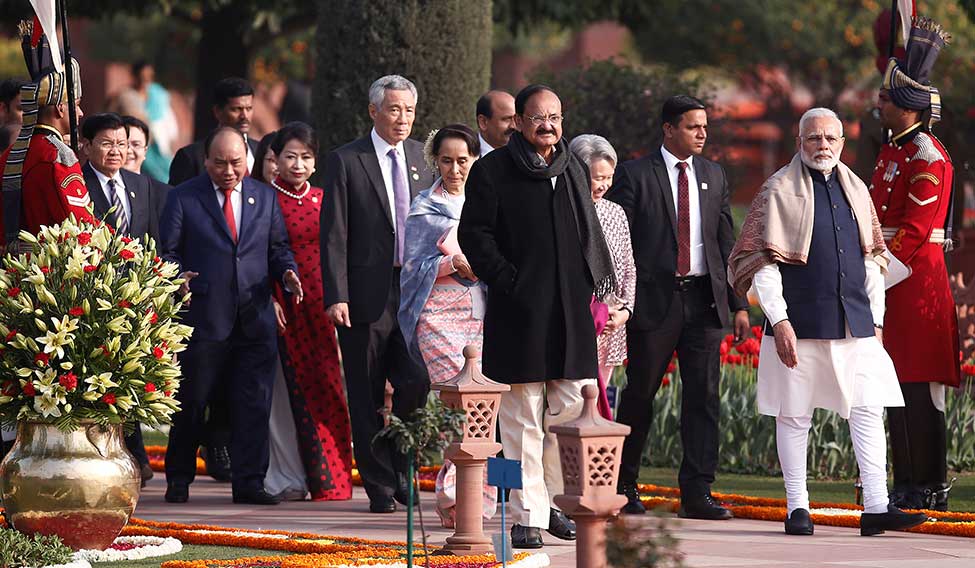
Prime Minister Narendra Modi has had a busy start to 2018. Within a span of 12 days in January, he received his Israeli counterpart Benjamin Netanyahu at Delhi, flew to Davos, Switzerland, to invite global CEOs to invest in India, and hosted the ten heads of states of the Association of Southeast Asian Nations member countries in a mega show on the Rajpath on Republic Day.
The Delhi Declaration, signed during the ASEAN-India Commemorative Summit held on January 25 and 26, focused on enhancing maritime cooperation and security in the region. China, which has been building and financing ports in several countries in the region, is embroiled in maritime disputes with ASEAN members Philippines, Vietnam, Brunei, Malaysia and Indonesia. It would have taken note of the fact that the Delhi Declaration touched upon the South China Sea disputes. The declaration read:
“...we support the full and effective implementation of the Declaration on the Conduct of the Parties in the South China Sea... and look forward to an early conclusion of the Code of Conduct in the South China Sea....”
China had opposed India’s state-run Oil and Natural Gas Corporation exploring oil wells claimed by Vietnam in the South China Sea, and Delhi has been seeking to enhance its position through greater maritime engagement. In the declaration, India and the ASEAN member countries committed to help each other during “accidents and incidents” at sea, and to promote research.
The declaration also said there would be more cooperation in combating terrorism, violent extremism and radicalisation through information sharing, law enforcement cooperation and capacity building under the existing ASEAN-led mechanisms such as the ASEAN Senior Officials Meeting on Transnational Crime and the ASEAN Defence Ministers’ Meeting.
The Regional Comprehensive Economic Partnership (RCEP—a proposed enhanced free trade agreement between the ASEAN and countries with which it already has free trade agreements) negotiations have been held up because of concerns from different sides. The Delhi Declaration said 2018 would be used for effective implementation of the ASEAN-India Free Trade Area, and intensified efforts toward the swift conclusion of a modern, comprehensive, high quality, and mutually beneficial RCEP.
Modi tried to sweeten the discussions by offering the gathered leaders some sops. He suggested that next year be declared as year of tourism between India and the ten ASEAN countries. “The Buddhist tourism circuit could be an important part of this to attract tourists and pilgrims from our region,” Modi told the visitors.
He announced fellowships for 1,000 students and researchers from the ASEAN member countries at the Indian Institutes of Technology and dedicated training courses at the Indian Academy of Highway Engineers for professionals, apart from setting up a network of universities to encourage greater inter-university exchanges. He said India would start a pilot project to create digitalvillages in Vietnam, Cambodia, Myanmar and Laos.
Beyond the declaration, the event was a logistical success for India. Having the heads of the ten ASEAN member countries—Thailand, Vietnam, Indonesia, the Phillipines, Malaysia, Singapore, Myanmar, Cambodia, Laos and Brunei—as chief guests at the Republic Day parade was a definite plus. External Affairs Minister Sushma Swaraj provided a personal touch to the proceedings by celebrating the birthdays of three of the guests that fell on the days of the summit.
The foreign ministry had pulled three dozen diplomats from neighbouring countries to assist in the smooth conduct of the summit. India highlighted its historic and cultural ties with these countries through Buddhism and the Ramayan.
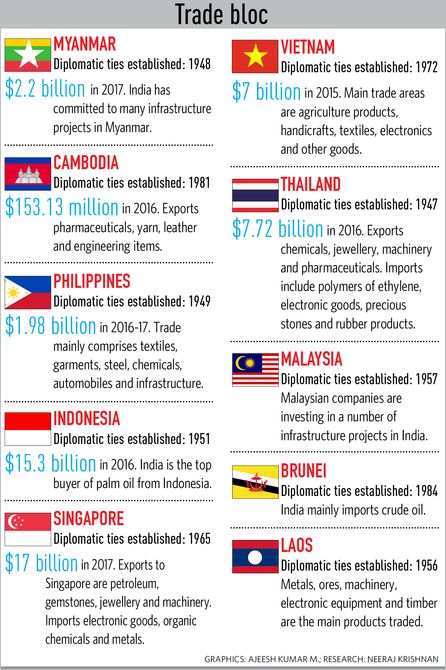
Most of the ASEAN countries have strong trade ties with China. The ASEAN is India’s fourth largest trade partner, with trade of around $70 billion in 2016-17. But China had around $470 billion trade with these countries in the same period. Most of the ASEAN countries have also supported China in its One Belt One Road initiative.
Experts, however, feel that the ASEAN wants greater engagement with India. This was clear from Modi’s op-ed in newspapers in these countries. “All the leaders have appreciated India’s positive role in the Indo-Pacific region and the bilateral relationship that we enjoy with each one of them,” said Preeti Saran, secretary (east), ministry of external affairs. “They feel that India is a very important component for peace, stability and prosperity of the region.”
The US has been pushing India to assume a greater role in the Indo-Pacific region as a counterweight to China. It is in this context that the Quad comprising the US, Japan, Australia and India was revived on the sidelines of the ASEAN Summit in Manila last November.
“Though China has influence on the ASEAN countries, particularly in the South China Sea, these countries do not trust China,” said Ganganath Jha, professor at the School of International Studies, Jawaharlal Nehru University, Delhi. “They want India to take a greater role to keep an assertive China in check.” He said the summit was an important event as it was the first time ten heads of states participated in the Republic Day parade. “Look how China has now offered to talk to India on its economic corridor with Pakistan,” said Jha.
A similar gathering was held in 2012 to mark 20 years of India’s ties with the ASEAN. All the ten heads of state had attended then. The United Progressive Alliance government under Manmohan Singh was trying to follow the Look East policy initiated by former prime minister P.V. Narasimha Rao. Some key infrastructure projects initiated in 2012 are still not complete and trade figures have stagnated. Big ticket connectivity projects like the India-Myanmar-Thailand Trilateral Highway, which was first proposed in the early 2000s, are pending. There have been questions whether the current event would lead to anything more substantial.
“For ASEAN countries, there are many similarities between China and India,” said Prabir De, coordinator for ASEAN-India centre at Research and Information System for Developing Countries, an MEA-run think tank. “There is a strong diaspora of both nations in these countries. They share maritime and land borders with India and China. ASEAN countries have been looking at the rise of India positively, and they want to engage more. Anything they do with China, they want to do with India.”
While China has been engaging with the ASEAN for more than 20 years, India began just ten years ago. India and the ASEAN had projected a trade target of $200 billion by 2022. This seems unlikely, but De said this might be because of global trends rather than any problem between India and these countries.
The ASEAN relies heavily on China because of its investments in member countries and the resultant jobs. But De said there was a perceptible change in the approach of the ASEAN member countries towards India. “Earlier they consulted [India] only when they needed help, but [now] they ask even when dealing with other issues, including China,” he said. “There were only four consultations a decade ago, now it is over 30, many of them at secretarial and ministerial level.” Most of these consultations are in the maritime field. Since the commemoration of 25 years of ASEAN-India ties in January 2017, there have been 70 events, culminating in the summit.