



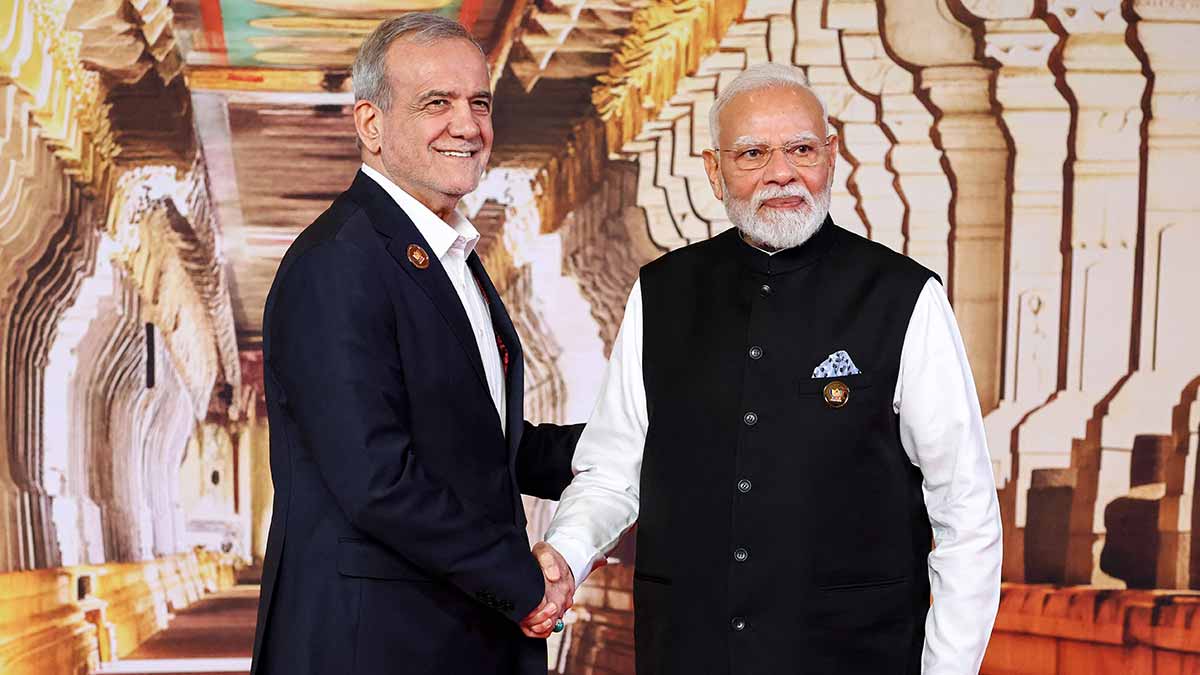
Ambassador of the Islamic Republic of Iran to India

The world today stands on the threshold of a major historical transformation. It is still too early to say with certainty what the final shape of the emerging global order will be. Yet there are clear signs that the existing order is undergoing a profound change, allowing us to identify some of its principal contours.
The Martyred Leader of the Islamic Revolution, Ayatollah Seyyed Ali Khamenei, followed the international developments from this perspective for decades and repeatedly emphasised that the world was moving away from a unipolar order towards a multipolar one. In his view, this was not a temporary development, but part of a broader historical process in which the concentration of power in the west was gradually being challenged by the emergence of new political, economic, scientific and cultural centres of power around the world.
EROSION OF AMERICAN MONOPOLY
In the vision of Ayatollah Khamenei, the United States could not remain the dominant power in the world indefinitely. Following the collapse of the Soviet Union, a perception emerged in the west that the United States had become the world’s sole dominant power. Yet the developments of the past several decades have demonstrated the limits of such an order.
This does not necessarily mean that the United States will disappear from the global equation. Rather, it means that the possibility of one power exercising decisive control over the entire international system is increasingly difficult to sustain. Power is being redistributed, while new actors—particularly in Asia—are assuming a greater role in shaping the future of the world.
GLOBAL CENTRE OF GRAVITY SHIFTING TO ASIA
One of the most important features of the changing world order, according to Ayatollah Khamenei’s vision, is the gradual transfer of political, economic, scientific and cultural influence from the west towards Asia.
Asia is no longer merely a geographical region or the manufacturing centre of the world. It has become one of the principal centres of global power. China and India, as two great civilisations and major economic and demographic powers; Russia, with its extensive political, security and energy capabilities; and Iran, with its strategic geographical position and deep civilisational heritage, are all part of this emerging reality. From this perspective, an increasing share of the future of the world will be shaped in Asia. Asian countries can no longer remain merely consumers of rules formulated elsewhere.
RESISTANCE AGAINST DOMINATION
One of the central pillars of the thought of Ayatollah Khamenei was the concept of resistance—a resistance to coercion, the imposition of the will of major powers and political and cultural domination. Resistance, in this understanding, is not merely a military concept. It means that a nation should be able to make independent decisions, preserve its identity, rely on its own capabilities and refuse to allow major powers to determine its destiny. The Islamic Republic of Iran regards itself as one of the principal centres of this discourse: a discourse that stands against domination and advocates the independence and dignity of nations.
Ayatollah Khamenei repeatedly emphasised that nations should not become accustomed to submission. The history of colonialism in many parts of the world was not limited to the occupation of territory; in some cases, it also involved cultivating a historical acceptance of dependence and the perceived superiority of others. Resistance, in this sense, means restoring the independent will of nations.
NEITHER EAST NOR WEST
Within the intellectual framework of the Islamic Revolution, independence does not mean isolation. Iran has consistently emphasised cooperation with different countries, while defining such cooperation on the basis of independence, mutual interests and mutual respect. “Neither east nor west” does not mean rejecting cooperation with either east or west. Rather, it means rejecting dependency and subordination.
Strategic independence means that a country is able to make independent decisions concerning its national interests, choose its partners on the basis of mutual benefit and maintain the capacity to pursue its own course in the face of external pressure. This perspective has acquired even greater relevance today, as countries around the world seek to conduct their foreign relations according to their national interests, without being compelled to join rival blocs.
SIGNIFICANCE OF IRAN-INDIA TIES
Relations between Iran and India are historic and deeply rooted. The two nations share not only a long history of political and commercial interaction, but also a profound civilisational, cultural, literary and intellectual heritage. Ayatollah Khamenei consistently emphasised the importance of relations with India and the considerable potential for cooperation between the two countries. From this perspective, India is an important country in Asia and one of the major powers shaping the future of the continent.
Today, the considerable existing potential for expanding bilateral cooperation should be fully utilised. Economic cooperation, particularly in the fields of energy and transportation, can serve the interests of both nations. Yet Iran–India relations should not be confined to economics. The historical and cultural bonds between the two peoples are an invaluable asset for the future of bilateral relations. The great civilisations of Iran and India can play an important role today, while cultural and academic cooperation can complement economic and political engagement.
CHABAHAR: MORE THAN A PORT PROJECT
Chabahar can become one of the most important symbols of strategic cooperation between Iran and India in the wider Asian region. Its potential in transportation, transit and connectivity between India, Afghanistan, Central Asia and the wider Eurasian region demonstrates the extent to which the interests of the two countries can converge. Cooperation in energy, transportation, trade, technology, education and culture can elevate Tehran-New Delhi relations beyond conventional bilateral ties.
Relations between the two countries should continue to develop on the basis of mutual interests and mutual respect. Iran welcomes the expansion of relations with India and believes that strengthening Tehran-New Delhi ties will benefit not only the two nations, but also the region and, ultimately, peace and stability in Asia.
BRICS & SCO
If one of the defining features of the emerging world order is the end of the monopoly of a single power and the growing importance of multiple centres of influence, the emergence and expansion of mechanisms such as BRICS and the Shanghai Cooperation Organisation assume particular significance.
BRICS can be seen as one of the most important manifestations of the growing weight of the Global South and emerging economies in global governance. The participation of Iran and India in this framework provides an additional platform for cooperation between the two countries beyond their bilateral relationship. Iran’s participation in BRICS is not based on the creation of another bloc. Rather, it reflects an approach centred on strengthening multilateralism, enhancing the role of independent countries and reforming inequitable structures of global governance.
The SCO is another manifestation of Asia’s growing importance in the international system. The participation of Iran, India, China, Russia and other major regional countries in the organisation provides considerable potential for cooperation in the fields of security, economics, connectivity and regional development. The presence of Iran and India in these multilateral frameworks can, therefore, serve as an important platform for further deepening relations between Tehran and New Delhi.
UNJUSTIFIED ATTACKS AGAINST IRAN
The unlawful and unjustified attacks on Iran’s territorial integrity have brought this debate from the theoretical realm into a tangible reality. In the face of pressure, threats and attacks, the fundamental issue for Iran remains the principle emphasised by Ayatollah Khamenei: the independence of a nation and its right to determine its own destiny. A nation that seeks to preserve its independence must also develop the economic, scientific, technological, cultural and diplomatic capabilities necessary to withstand pressure and continue its path of development.
Iran’s experience has demonstrated that strategic independence and extensive international engagement are not contradictory. Iran can deepen its relations with India, play an active role in BRICS and the SCO, cooperate with countries across Asia and beyond, and at the same time uphold its fundamental principle of independent national decision-making.
EVOLVING WORLD ORDER
It would be premature to claim with certainty what the international system of tomorrow will look like. Yet its broad contours are increasingly visible: a reduced capacity for unilateral dominance, a growing role for Asia, a wider distribution of power, stronger multilateralism, greater emphasis on strategic independence and a growing demand among nations for an international system free from relations of domination. This is the broader horizon that Ayatollah Khamenei emphasised over decades.
In such a world, Iran and India are not merely two cooperating countries. They are two great Asian civilisations with the potential to play a meaningful role in shaping the future of the continent. Tehran-New Delhi relations should therefore be strengthened on the basis of this broader vision, by making full use of the potential in trade, energy, transportation, Chabahar, science, culture and people-to-people relations.
The future of the global order has not yet been written. But nations that possess independence, identity, civilisational depth and the will to cooperate can play a meaningful role in writing it.
Iran and India, drawing upon their civilisational heritage and looking towards the future, can be among those nations.
