



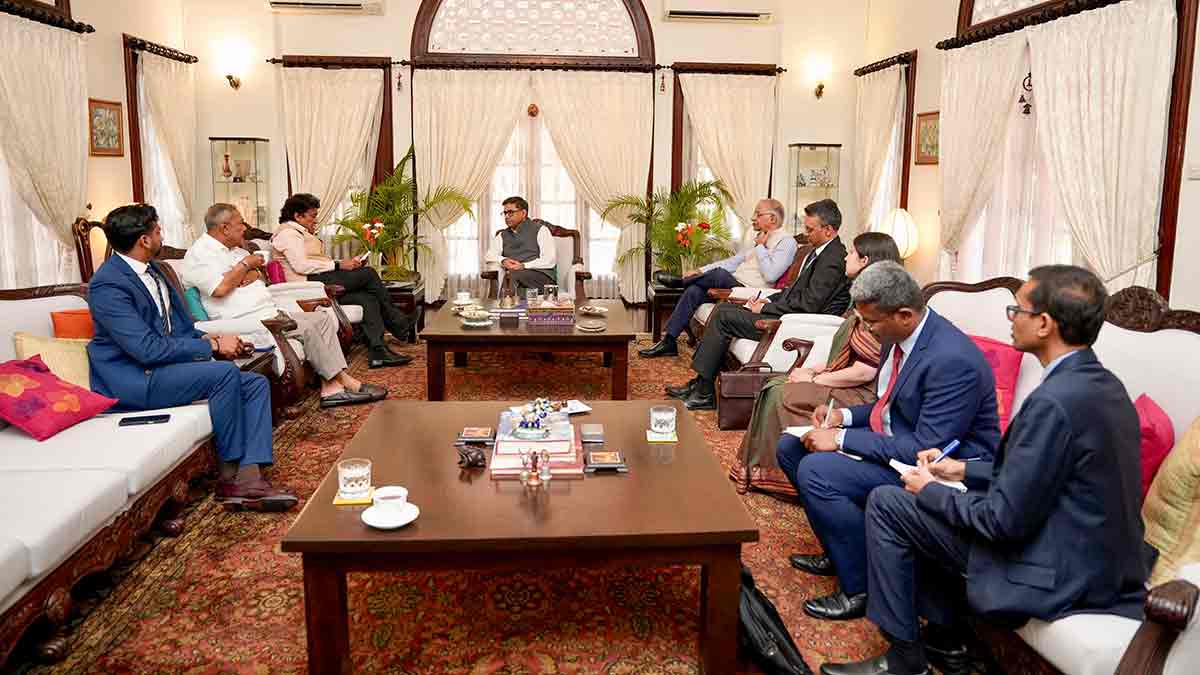
WHEN VIKRAM MISRI touched down in Colombo on August 5 for his first standalone visit to Sri Lanka as foreign secretary, provincial council elections dominated his public remarks. What he told Tamil leaders privately, however, suggested something more cautious. New Delhi was careful not to be seen favouring one ethnic community, wary of unsettling an already fragile balance.
President Anura Kumara Dissanayake’s National People’s Power government is negotiating a difficult position of its own. It is trying to preserve its Marxist-Leninist roots while running a state still under the strict fiscal consolidation programme agreed with the IMF. For India, keeping Colombo close matters more after the setback it suffered in Bangladesh.
Misri’s agenda, meanwhile, extended beyond provincial elections. He discussed Indian assistance for recovery from Cyclone Ditwah, energy cooperation and an upgrade to the existing bilateral trade agreement, along with progress on India-backed projects including the Unique Digital Identity scheme, plans to develop Trincomalee as an energy hub and the rehabilitation of the Kankesanthurai harbour near Jaffna.
But the substance of the visit lay elsewhere, in Misri’s meetings with Dissanayake, Prime Minister Harini Amarasuriya and parliamentarians from the Tamil-speaking provinces. “India’s demand for provincial council elections remains unwavering. New Delhi views the 13th amendment [which established the provincial council system] not as an optional framework but as a non-negotiable component of regional stability,” said Selvam Adaikalanathan, the Tamil member of parliament representing Vanni in the Northern Province. He added that India could only push so far, and that real pressure should come from within Sri Lanka.
Dissanayake has adopted a new formulation, “national consensus”, telling minority leaders that his government prefers a broad agreement over a hurried new constitution or the abrupt scrapping of the executive presidency. By avoiding the unilateral, party-driven constitution-making of the past, he presents himself as a unifier rather than a partisan. The opposition and minority parties, however, see it as strategic ambiguity in the guise of principle. They argue that the NPP is using the language of consensus to avoid provincial council elections, given that the JVP, the dominant force within the NPP coalition, has never shown much appetite for devolving power. “With a battered economy and a nation still reeling from bankruptcy, a prolonged national dialogue aimed at reaching a consensus for a new constitution is only a convenient strategic stall, allowing the government to delay devolution reforms that might alienate its nationalist southern base,” said Adaikalanathan.
Even so, a day before Misri arrived, Dissanayake met Tamil and Muslim MPs and spoke of the need for what his office termed “a broad and inclusive national dialogue” on constitutional reform.
Sources in Jaffna said India understood that federalism had little traction in Sri Lanka at present, even as it maintained pressure for devolution and provincial council elections. The most telling part of Misri’s visit may have been what he reportedly told Tamil leaders in private: that there was a red line around minority aspirations. For years, New Delhi cast itself as the guarantor of devolution, specifically for Tamils. Political observers now detect a shift towards accepting Sri Lanka’s existing unitary constitutional structure, one designed to protect Indian security interests from the kind of ethnic anxieties that have historically destabilised the south.
The structure of the visit itself hinted at this recalibration. Misri met Tamil parties in separate sittings, keeping northern and eastern representatives apart from hill country leaders, sources said, a fragmentation that lets New Delhi manage a divided Tamil political field while keeping the central government steady.
In his meetings, Misri reportedly stressed equality for all Sri Lankan citizens. It amounted to a quiet retreat from federalism, the idea that has anchored Tamil political demands for decades and which the JVP itself rejected during the insurrection of the 1980s.
Adaikalanathan, who attended the meeting with Misri, disputes that reading. He rejected any suggestion that India had counselled Tamil leaders against federalism. “India’s focus remains the functional devolution of power within the existing constitutional framework,” he said. On one point, at least, he insisted there was no ambiguity: India wants the provincial council election held as early as possible, and it is firm on that.
