



HUMAN TOUCH
Sitting beside her fisherman father Manoj, BCom graduate Shonali Patil, 22, picks fish out of a net in Worli Koliwada, the 800-year old fishing village on Mumbai’s coast. The larger fish go into baskets, the smaller ones tossed aside to feed the cats. A basket of silver fish, she tells me, will fetch around Rs300. She is not, however, doing this out of choice. “I don’t want to do this work,” she says. “There is no money in it. No future.” Nearby, women arrive with fish packed in plastic bags and set off to the market. It’s barely 10am.
For generations, the sea has sustained the Kolis, Mumbai’s traditional fishing community, regarded as its first inhabitants. Centuries of migration from Maharashtra, Telangana, Andhra Pradesh and Tamil Nadu, along with ties to Arab merchants and the legacies of Portuguese and British rule, have shaped the community’s diverse culture. At its heart remains the sea. But now, rising marine pollution, dwindling catch and mounting costs of fishing are making this way of life increasingly difficult to sustain.

“The younger generation should look for jobs elsewhere. There’s no income, no fun in fishing any more,” says Manoj. “The catch is less, and sometimes you earn nothing.”
Today, Worli Koliwada faces a difficult question: how does a community preserve its way of life even as it becomes harder to sustain? What happens to its intangible heritage—its food and festivals, art and traditions—when the sea that has shaped its culture for generations is threatened by rapid urbanisation, marine pollution and climate change?
Addressing this concern is at the heart of the RPG Foundation’s The Heritage Project (THP), which is working to document and preserve the settlement’s cultural heritage. “There is so much we can learn about history through stories, cultural heritage and the way people live. Worli Koliwada has a fascinating story to tell,” says Radha Goenka, director of the RPG Foundation. “Yet, there is not enough research or documentation of such heritage. That is what we decided to focus on.”
Of art and culture
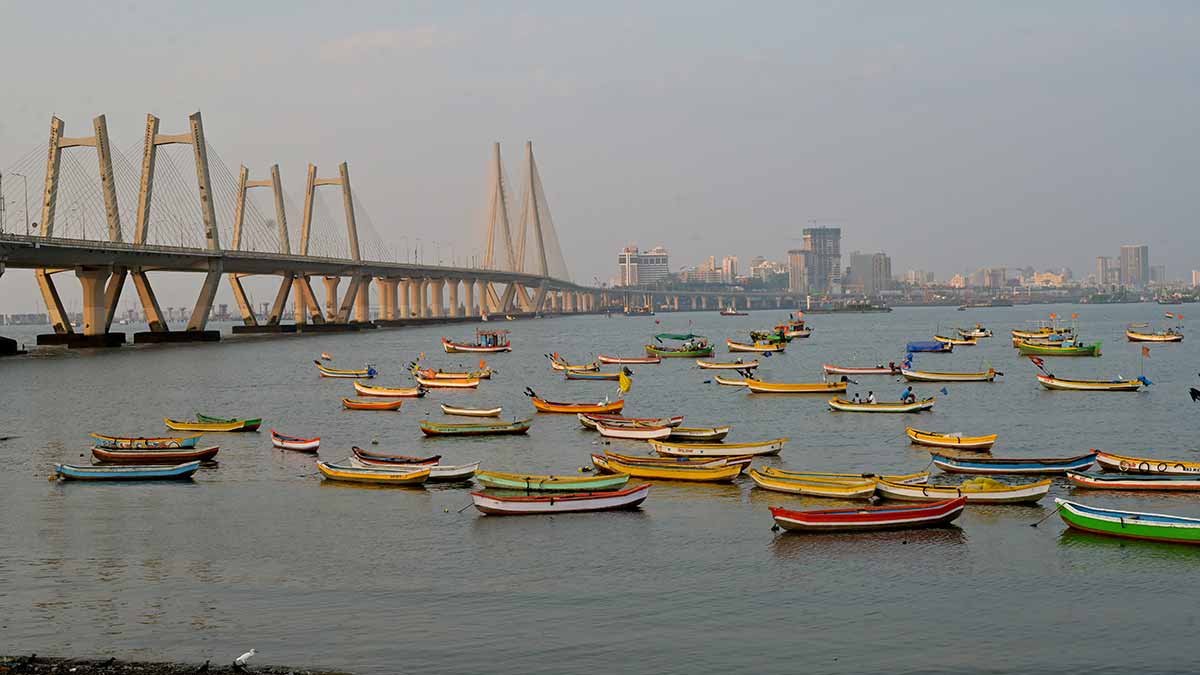
As I make my way through the narrow, densely populated lanes of Worli Koliwada, a towering mural catches my eye. It depicts a Koli woman, her gaze piercing, her presence commanding. Coral, salmon pink, teal and turquoise—the colours of the sea—dominate the mural. The same colours are seen on the fishing boats moored along the Arabian Sea, waiting to head out for the next day’s catch.
“It was an expensive artwork, but I really wanted it there,” says Goenka of the mural commissioned by THP. “I had fallen in love with the strength of the Koli women. Their gods and goddesses are predominantly female, which I find so compelling.”
Near the entrance to the settlement stands the Golfa Devi temple. Inside, the village deity is flanked by Sakba Devi and Harba Devi. Considered the settlement’s protector, Golfa Devi is part of everyday life here: passers-by pause and bow their heads in a silent prayer before carrying on. Just ahead stands a dargah, an Islamic shrine dedicated to Bibi Fatima and Bibi Ayesha, two enigmatic figures believed to protect the settlement.
The sea is unpredictable, and the Kolis’ prayers for protection reflect that uncertainty. Faith here takes many forms. Just ahead of the dargah stands a statue of Our Lady of Velankanni, depicting the Virgin Mary holding baby Jesus, dressed in a bright red sari.
This religious plurality comes into view as you approach the jetty, where two structures stand side by side. One is a chapel housing ‘Dariya Cha Raja’, the king of the sea, depicted as Christ aboard a boat. Beside it stands a temple dedicated to Vetal Dev, a Hindu folk deity worshipped as a protector along the Konkan coast.
Across Worli Koliwada, THP has put up signboards explaining the stories behind its landmarks. “Educating people about intangible heritage can also help preserve a site,” says Goenka. THP has also organised cleanliness drives and worked to improve lighting in the settlement, addressing two persistent problems: inadequate sanitation and frequent, prolonged power cuts. In collaboration with Birla Opus, THP has also undertaken to paint the settlement’s walls.
Meanwhile, a sprawling mural by Koli artists depicts marine life, drawing on Worli art traditions. Community participation is central to the project. Under its ‘Heritage Storytellers Programme’, local residents lead heritage walks, sharing the settlement’s history and traditions with visitors.
Like the mural of the Koli woman and the one depicting marine life, another captures an essential part of Koli life: the Bombay duck. “This particular fish was transported from Bombay through the postal service to Calcutta, where it became a delicacy. That is how it came to be known as the Bombay duck. It was actually ‘dak’, referring to the postal service,” explains Prajakta Deshpande, vertical head—operations, THP. The fish, locally known as bombil, remains a delicacy today.
Of flavours and legacy
The plurality of Worli Koliwada is reflected in its food, too, shaped as much by local influences as centuries of migration. “While the Kolis use more imli (tamarind) and dried coconut, the Agris use more tender coconut in their preparations,” explains Chef Manisha Khirid. Koli refers to the fishing community, while the Agri-Kolis are agrarian communities engaged in farming and salt-making.
Khirid is part of ‘Chefs of Koliwada’, a culinary entrepreneurship programme by THP that seeks to build livelihoods around traditional cooking knowledge. It combines traditional cooking skills with professional exposure and training with some of the city’s top chefs, such as Masque’s Varun Totlani.
The programme has also produced a cookbook, Flavours of Worli Koliwada, documenting traditional recipes ranging from koli kolambi (prawn pulao) to bharle paplet (stuffed pomfret). A QR code outside Khirid’s house takes visitors to a webpage listing her specialities, including kothimbir vadi (a snack made from coriander leaves and gram flour), stuffed bombil and fish fry. It also features other cooks from the settlement and their specialities, who also take orders.
Asked how cooking has changed over the years, Khirid instantly points to the dwindling catch. “We can’t live without eating fish at least thrice a week, but it is becoming less available in the market. The prices are also high,” she says.
Dwindling catch
Manoj and his daughter, meanwhile, sit picking fish out of the net. “All the construction that has happened here has polluted the sea,” he says, as the Bandra Worli Sea Link towers behind him. “As a result, breeding no longer happens near the shore. We have to go deep into the sea, even as the cost of the motor boat keeps rising.”
Uncontrolled construction and marine pollution has also led to the disappearance of certain types of seafood. “Earlier, in August, we would get a good yield of lobsters. On some days, we would even make Rs70,000-80,000. Now, not a single lobster is found because of the pollution,” says Manoj.
At the edge of the settlement is the Worli Fort, a witness to the changes unfolding around it—from marine pollution and urbanisation to the growing effects of climate change. As the sea and the livelihood it sustains is threatened, preserving its intangible heritage—its food, festivals, beliefs and traditions—becomes all the more important.
