



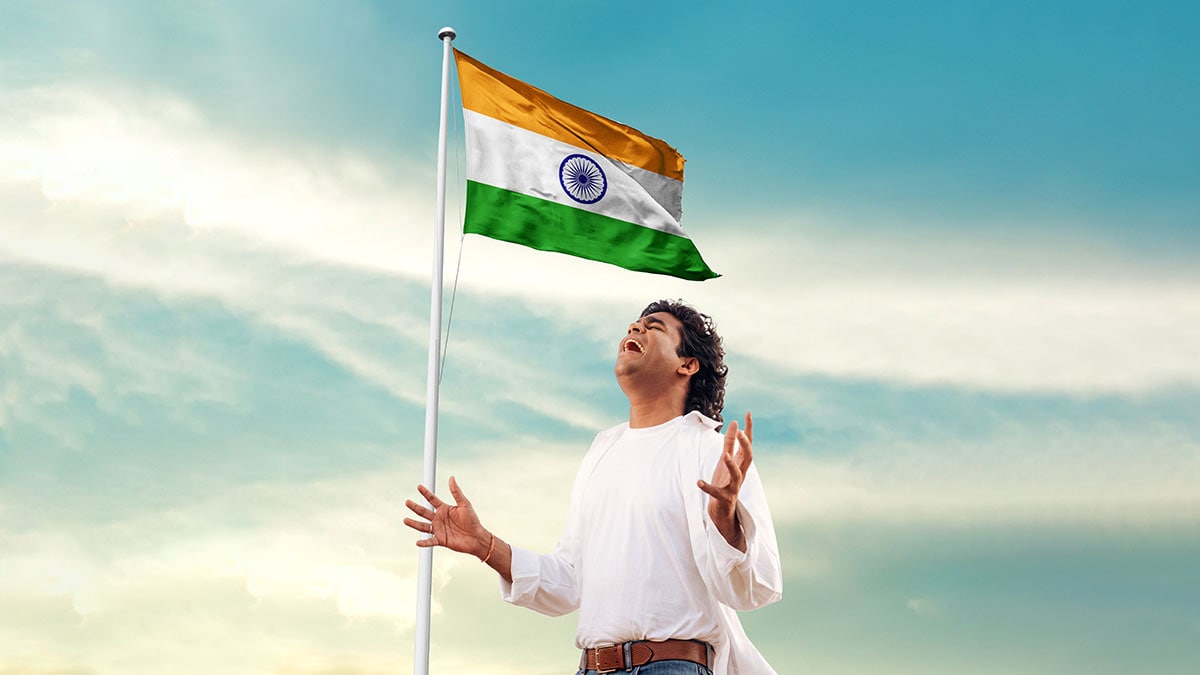
Sabyasachi Bhattacharya, in his book Vande Mataram: The Biography of a Song, conjectures that the first few verses of the song had been lying around for years gathering dust in author Bankim Chandra Chatterjee’s study before it was published in the literary journal Bangadarshan on November 7, 1875. When an assistant came across it and suggested to Chatterjee that it be used as a filler in a galley proof, the novelist apparently refused. “You can’t possibly guess now if this is good or bad,” he said. “Time will tell—I shall be dead by then; it is possible that you might see that day.”
Could Chatterjee have guessed then the magnetic power of the song to unite the country in its fight against the British? How the sacred expression of devotion would become a slogan of provocation, printed on the badges of college students and shouted by the working class in their bazaar demonstrations to boycott foreign goods? Or how, years later, during the height of the freedom movement in the 1930s, it would become a communal war cry, with the Muslim League under Muhammad Ali Jinnah vehemently opposing it for its idolatrous connotations? How the rift it created would widen through history into the polarised landscape of present-day politics, when the ruling party called for the rendition of the whole song to be made mandatory?
Perhaps no other song has transformed so well in the hands of its wielder into a tool or a weapon, into the defender or destroyer of freedom. And perhaps this is proof that the more beautiful something is, the greater its danger of corruption.

INDIA GROWING
On the eve of India’s independence, its first prime minister Jawaharlal Nehru stood on the speaker’s stand of the Constituent Assembly and heralded the new dawn. Afterwards, as though sealing his words, the sky rippled with thunder. The monsoon downpour drenched a jubilant crowd standing hushed with awe on the edge of a new age. As the clock struck 12, the shriek of the conch shell tore through the silence. The old had passed away; the new had begun.
The years that followed were years of optimism, when a nation awakened to its own possibilities. The ‘Vande Mataram’ of our freedom fighters gave way to the ‘Vande Mataram’ of our nation builders. If anything helped us find ourselves, it was our music. It floodlit the national consciousness and helped explain us to ourselves. The India of our songs were the India of our hopes—a land we hadn’t yet inhabited, but whose distant notes animated the strings of our musical instruments.
“When we became independent and the big projects were coming up, like the IITs and the dams which Nehru called the temples of modern India, our songs reflected this optimism,” says Yogesh Pawar, socio-cultural historian and writer. “By the 1950s and 1960s, however, after India faced two crushing wars, the dream offered by the freedom movement had started growing jaded.”
Then, songs of resistance started coming up. A lot of leftist ideology, calling workers to unite against the villain, who would be a rich zamindar or a cunning mill owner, started pervading our music, inspired by extreme poverty, an agrarian crisis and repeated crop failures which the government’s welfare initiatives failed to address. Music in movies like Do Bigha Zamin (1953) was inspired by the theme of an old communist anthem in Soviet Russia. The communists were the first to realise what a powerful medium music could be to capture the public imagination. Those with Marxist leanings like Kaifi Azmi, Sahir Ludhianvi and Majrooh Sultanpuri became some of the most iconic lyricists in the Hindi film industry.
And whenever wealth is monopolised by a few, the rich try to divert attention by encouraging infighting among the poor, says Pawar. This was facilitated by the rise of right-wing politics in India. The Shiv Sena came into being in 1966, and brought in the idea of militant Hinduism. They started ‘otherising’ sections of society, like the south Indians and the Muslims. As the infighting increased, there was also a sense that one should create scenes of amity and propagate the idea that all was well.
“This idea of creating unity led to films that would often be comical,” says Pawar. “In the 1980s and 1990s, there were lots of examples of this, featuring a do-gooder Muslim who sacrifices his life to save the hero from murder or the heroine from rape. And there would be the Muslim courtesan, played by someone like Rekha, who would likely sacrifice her love or life to bring the lead couple together. These films were made in such a haphazard way that they almost seemed tacky.” Pawar refers to a song in the film Desh Premee (1982), which features Amitabh Bachchan standing on a hillock above a slum called Bharat Nagar, which is divided into Muslims, Hindus, Sikhs and Christians. He sings the song ‘Mere Desh Premiyon’ calling for the unity of the communities that are fighting each other for water. There are innumerable such examples, says Pawar.
THE MODERN INDIA
There was a time when footwear in India meant Bata sandals and Lux soap was a luxury. Indians roamed around in Ambassadors and Premier Padminis, and buying a car involved a long waiting list that could last years. Gold Spot was Parle’s answer to Coca Cola and in the evenings, families watched Doordarshan on their Dyanora TV. All that changed on July 24, 1991, when prime minister Narasimha Rao announced the end of the license-permit Raj and finance minister Manmohan Singh presented a historic budget that launched economic liberalisation in India. International brands made a beeline to the country. With that, our music got a makeover.
MTV India launched in 1996, and for a ’90s kid, it was a portal into an alternate bubble-gum world of boy bands and hipster jeans, gelled hair and fake nails, beach parties and punk rock. Even as life, with its endless loop of exams and extracurriculars, droned on, the things that really mattered were happening inside MTV Chill Out, Loveline and Select. Happiness came in 30-minute slots. MTV and Channel V also brought western acts to the country—Metallica, Britney Spears and Jon Bon Jovi strummed their way into our lives.
Raghu Dixit, singer and frontman of the Raghu Dixit Project, recalls the time he got introduced to western music in college in Mysore. As a child, he had imbibed the classical music that the city was famous for, but in college he met students from rich, business families. “It was a huge culture shock for me, because all the rich kids were strutting around in baggy jeans, with Walkmans tucked into their waistbands,” he says. “Unable to afford a Walkman, I was always curious about what they were listening to. So, one day I mustered the courage to ask a boy if I could listen to what he was listening. And to my horror, it was the most aggressive form of music I had ever heard. How is this even music? I asked him. That was my introduction to Guns N’ Roses. It took me some time to develop an ear for hard rock. After that, I got acclimatised to Michael Jackson and Phil Collins, and later Deep Purple and Guns N’ Roses. I was raised on Carnatic music and south Indian Brahmanical values, and later introduced to a young, vibrant India that was just coming into being. My music is a blend of both.”
But we did not just listen to western music; we Indianised it. The opening of the economy and arrival of MTV led to the birth of a young, cosmopolitan middle-class in search of an outlet for self-expression. They synthesised international pop, bhangra and folk traditions into a new genre—indi-pop. “The actual indi-pop boom started in 1995 with three or four hits, the two major ones being Alisha Chinai’s ‘Made in India’ and Daler Mehndi’s ‘Bolo Ta Ra Ra’,” says music critic Narendra Kusnur. “The next year it peaked with songs by Lucky Ali, Colonial Cousins and Mehndi’s second album.”
The year after that, in 1997, A.R. Rahman released his first studio album Vande Mataram on the 50th anniversary of our independence. It took the country by storm, selling over five lakh copies in the first week. “I did not have any idea what the album was about when Rahman asked me to come to Chennai,” says lyricist Mehboob, who wrote the lyrics of the album’s title song ‘Maa Tujhe Salaam’. There, I was introduced to [Bharat] Bala, the album’s director and producer. The first thing the three of us decided was that the song should target the youth. We didn’t want anything deep, just something that would resonate with them. I went to my hotel and listened to the tune several times. I imagined myself as a young Indian residing outside and coming back to his motherland. Then, the line came to me in a flash: ‘Maa Tujhe Salaam’. I immediately rushed to the studio and presented it to Bala and Rahman. They were thrilled."
Two decades later, the music scene in India has changed drastically. Technological advancements have led to an explosion of independent music in the country. Once upon a time, we brought the west to us with indi-pop. Now, we are taking ourselves to the west with popular global acts like Hanumankind and Diljit Dosanjh who proudly flaunt their Indian roots.
THE COMMUNAL INDIA
On a warm dusty evening in March 2019, journalist Kunal Purohit found himself in Gumla, a town in southern Jharkhand. Over tea, the locals there told him about a chilling incident that had happened two years earlier. A Ram Navami procession was making its way through Gumla’s labyrinthine lanes, with loud music blaring from DJ speakers inside the trucks. Suddenly, when it reached Jama Masjid, Gumla’s biggest mosque, the procession turned violent. The reason? As it entered the mosque’s lane, the music switched, playing songs with lyrics like ‘Toss the mullah’s skull cap to the ground’. The crowd was electrified, writes Purohit in his book H-Pop: The Secretive World of Hindutva Pop Stars. They started chanting Hindu slogans until the Muslims outside the mosque, waiting to welcome the revellers, felt threatened. The police had to intervene and switch off the music.
That would have been the end of it, if not for what happened a few hours later, when some Hindu men from the procession encountered a Muslim man speaking with a Hindu woman in a nearby village. They tied him to an electric pole and beat him with rods and sticks. Although the man was taken to Gumla’s Sadar Hospital, he died there within minutes.
That is the power of polarising music to incite violence, bigotry and hatred. “I found this genre of music (hindutva pop) was thriving, with songs targeting everyone from Muslims to Pakistanis, from rival politicians to critics of Prime Minister Narendra Modi and his Bharatiya Janata Party,” writes Purohit. “Across the internet, these songs had been viewed millions of times, shared and liked by tens of thousands of people and disseminated across social media platforms.”
H-pop started becoming popular over the last few years, coinciding with the ruling party’s muscular hindutva and rising antagonism towards the Muslims. The lyrics are aimed at dehumanising the ‘enemy’, mostly Muslims, and are laced with threats of brutal violence, writes Purohit. Any major incident in the country is given communal overtones and turned into hate music with the beats and tempo ‘normalising’ the incendiary lyrics. Songs hailing the government’s decision to scrap Article 370 in Jammu and Kashmir, songs demanding laws against ‘love jihad’, and songs asking Muslims to go back to Pakistan. Many of these songs, like Laxmi Dubey’s ‘Har Ghar Bhagwa Chayega’ (Every House Shall Turn Saffron) and Kavi Singh’s ‘Dhara 370’ (Article 370), have got millions of views.
INDIA FIGHTS BACK
Acting as a counterfoil to the rise of H-pop in the country is the rich and vibrant tradition of protest music. If Singh sang about true patriots being delirious with joy, but traitors shedding tears in ‘Dhara 370’, Kashmiri feminist collective Zanaan Wanaan’s ‘Kashmir Bella Caio’ (2020) bemoaned the normalisation of violence in the valley and called for its freedom from oppressive forces. India’s heritage of protest music goes back to the Bhakti tradition from 7th century onwards, when poets like Kabir and Ravidas questioned the social hierarchy and rigidity of the caste system. After independence, several movements like Vinoba Bhave’s Bhoodan movement in the 1950s and the Naxalite movement of the 1960s harnessed the power of music. More recently, hip-hop has emerged as a popular form of protest, as was seen during the anti-CAA protests of 2019-2020. Young protesters like Shumais Nazar and Manosh Kochi rapped about revolution being the new Hindustani beat in the song ‘Streetocracy’, while down south in Chennai, dalit rapper Arivu released his track ‘Sanda Seivom’ (let’s fight). “Who are you to tell me who I am,” he asked. “Who is your grandfather? The NRC is coming to dig up all that. Aadhar and voter ID are all useless. Now you have to dig out your great great grandfather from their grave.”
At the recent CJP protests in Jantar Mantar, anthems like ‘Sarfaroshi Ki Tamanna’ resurfaced as old wine in new bottles. During the freedom struggle, young revolutionaries sang it with fire in their souls and hope in their hearts. “Sarfaroshi ki tamanna ab hamare dil mein hai/Dekhna hai zor kitna bazu-e-qatil mein hai” (The yearning for martyrdom now stirs within our hearts/ Let us see how much strength the executioner’s arm truly possesses), they sang. More than a century later, Indian youth took up their war cry and made it their own. Time has passed, the country has changed and the cause is different, but the heart is still ablaze with music that refuses to be silenced.
