



Someone accidentally leaves their slippers inside an art gallery. A group of visitors gathers around it. They whip out their phones and click photographs of it from different angles. They stay for interminable minutes staring at it, pondering the profound implications of its placement, the cosmic significance of the space between the straps, the artistic genius in the weathered soles.
So, did this really happen? The question is not whether this is a true story, but whether it could have been. And in the climate in which we live, the answer is a resounding yes. We live, unfortunately, in an age of the absurd. Advances in technology, meant to make us more productive, are in fact doing the opposite. Social media is making us less social. Our politicians are too funny and our comedians are too serious. Smart phones are making us dumber and youth elixirs like botox and Ozempic are making us older. Fast food is taking away the years in our lives and incessant screen use is taking away the life in our years. ‘Free’ and fair elections are costing us the most, and non-communicable diseases are communicating loud and clear. Corrupt technocrats are venerated while honest workers and activists are mocked as dowdy do-gooders.
Unfortunately, hardly anyone can see that the emperor is actually wearing no clothes. Absurdity has percolated into art as well. Take this year’s Venice Biennale, which was the Tower of Babel all over again, with all kinds of indecipherable languages. In a rather graphic comment on climate change and rising sea levels, the Austrian pavilion featured the artist Florentina Holzinger, hanging naked and upside-down in a big bell, marking each hour by ringing it, naked performers navigating flooded rooms and a hose spraying excreta while visitors peed into a purification tank containing a floating woman. The concept note said, “I live in your piss. Whose wet dream is this?” Definitely not that of the floating lady.

And then we move on to the Greek pavilion, in which architect-turned artist Andreas Angelidakis created a kind of “kink dungeon” called ‘Escape Room’, replete with neon lights, chain-wrapped columns and lit-up floors. One critic compared it with “the glitch-ridden vortex of the early internet” or a “queer goth disco”, the operative word being “queer”. The installation referenced Plato’s allegory of the cave to denigrate modern political populism and online misinformation.
Nothing so static for the Belgians, whose pavilion featured people performing absurd rituals until exhausted, crawling all over the place, shouting and banging on drums, apparently exploring the importance of human connection. (And here we thought we were past that phase of our evolution.)
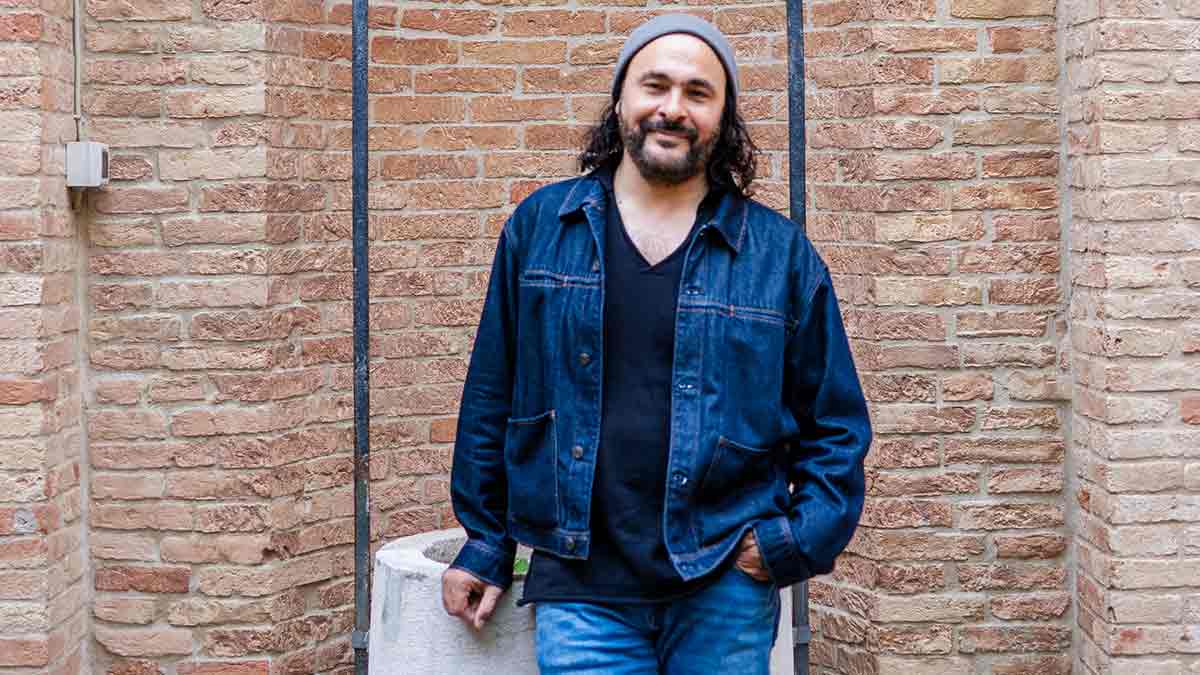
Unable to make sense of all this absurdity, we asked Kader Attia, next year’s Kochi-Muziris Biennale curator, if he could decode it for us. How are we expected to appreciate such art if we can’t understand it? “Sometimes, people from the contemporary art world take for granted that others have the vocabulary to understand their art,” he says. “I’m also a professor of art, and for me, being inclusive is extremely important.” One of the ways he ensures art connects with its viewers, he says, is by building a bridge between art and the environment where it is exhibited. He is hoping to do this at his edition of the biennale.
Concept notes explaining the art sometimes leave you more confused than before. To depend on them to understand the artworks is like asking Taylor Swift to explain the Mahabharat to you. Take, for example, this note accompanying the work of a Kashmiri artist at the last edition of the Kochi-Muziris Biennale. “[The artist] mobilises hauntological and posthuman to speculate radical ruptures that unsettle the epistemes and technologies of colonial power. Through a keen sensing of the insurgent, radical agencies emergent within and against infrastructures of colonial erasure, his practice refuses the narratological limits of this violence, listening instead to spectres, glitches, and negations as sources of resistance and liberation.”
Huh? Anybody else feel like a particularly heavy PhD thesis hit you on the head and left you reeling?
Attia agrees that sometimes concept notes can be obscure and says he tries to ensure that his never are. “It’s important to remember that without the public there is no art,” he says. “The public makes the art, and art is about sharing. I studied philosophy and psychoanalysis. When you read philosophy, you have to get into the author’s language. But art is not that. Art is a window into the universe of the artist, but also into the universe of the viewer. Art is a mirror, so it is important to ensure that this mirror is not opaque.”
And if you thought such art was only for the shock value, here today and gone tomorrow, think again. Some of the obscurest art is selling for millions. Italian artist Maurizio Cattelan, for example, made an easy $1,20,000 for an artwork of a—wait for it—banana duct-taped to a wall. The piece, aptly titled Comedian, was seen as a commentary on the world of contemporary art. Five years later, in 2024, Justin Sun, a big name in cryptocurrency, bought the piece at a Sotheby’s auction for $6.2 million.
Or take British artist Damien Hirst’s 2004 artwork of a 22-ton dead shark preserved in formaldehyde. Titled The Physical Impossibility of Death in the Mind of Someone Living, the work reportedly fetched $8 million. Then there is the 18-carat solid gold toilet, again by Cattelan, that sold for $12 million at Sotheby’s in 2025. Somebody’s bowel movements sure are getting a Midas touch.
Attia says it is important to distinguish the art from the mart. “Sometimes we conflate art with its peripheral aspects,” he says. “There is a difference between art and the world of art, or the milieu. The milieu is the market or the gallery, but art can exist without them. The market might peak for various reasons, including the financial interest behind an artwork or artist. But the market is only one cluster of the constellation that I call art. For me, good art is something new. It could have existed for the last 60 years, but we wouldn’t have seen it. Suddenly we look at it and think, ‘Wow, this has a language and grammar that I never saw before.’”
So, can someone born without an eye for art develop one? Attia says it is possible. He, for example, developed his growing up in a poor neighbourhood outside Paris inhabited by migrants from all over the world—North African, Spanish, Italian, Indian and Pakistani. When he was a teenager, he worked at a market to make some extra money. The market, he says, was something like a biennale, with its panoply of sights and sounds. “I saw Senegalese women carrying their children on their back,” he says. “I saw Indian women in saris [hawking wares]. I internalised the smell of spices and all kinds of food. The doors of the flats in my building featured the Jewish mezuzah, the Christian cross or the Muslim hadith. I did not learn ethnology as an academic at the university. I was introduced to it in a living system.”
This diversity, says Attia, is going to be a crucial part of the biennale he is curating. “The biennale offers possibilities for various universes to meet,” he says. We, for one, are all for it, as long as there are no naked women dangling from bells.
