



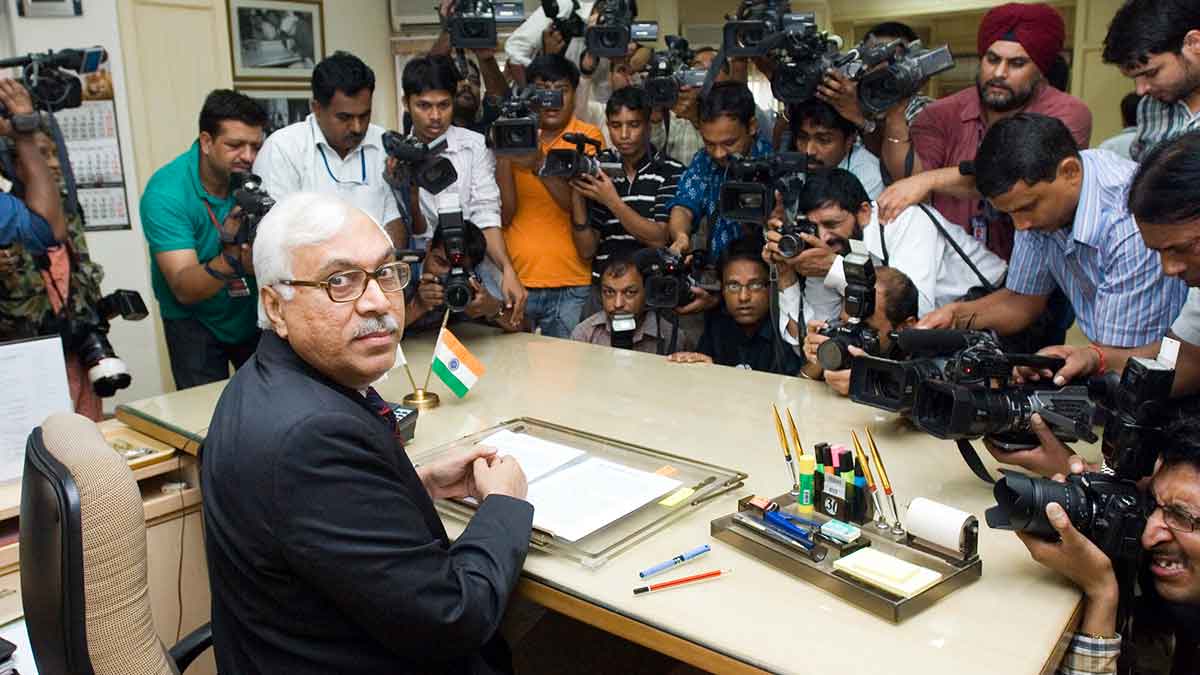
In 1975, sometime after Indira Gandhi imposed Emergency, writer V.S. Naipaul found himself at a dinner gathering of bureaucrats in Chandigarh. Naipaul was travelling through India for what would become A Wounded Civilisation. During the evening, he struck up a conversation with a young civil servant whose story would eventually find its way into the book’s foreword.
When Naipaul asked where he came from, the young man replied that his family had lived in Delhi for 500 years. “What in Europe would have sounded like boasting,” Naipaul wrote, “wasn’t boasting in India.”
The young man traced his ancestry to Arabs who had settled in Delhi centuries earlier. He belonged to the generation of “midnight’s children”, born as India became independent after centuries of foreign rule—“Muslim for the first 500 years,” Naipaul wrote, “British for the last 150.” Coming from a modest family and becoming the first Muslim from Old Delhi to join IAS, he embodied, for Naipaul, the weight of history and the promise of a new India. “Indian history telescopes easily,” he noted.
Half a century later, the young civil servant—S.Y. Quraishi, former chief election commissioner—returns to the same idea in India and I, a 100-chapter collection of reminiscences. The book shows that memory can indeed have a telescopic quality, compressing decades until distant events slide into one another.
“Eighty years may be an entire lifetime for an individual, but it is only the opening chapter for a nation,” Quraishi writes. “When the republic shines, I feel proud. When it stumbles, I feel the bruise.”
Organised into 11 thematic sections, the book doubles as both personal story and institutional history. What could have become a scattershot anthology of reminiscences is elevated into a coherent account by one of India’s most distinguished civil servants.
The pages are populated by an eclectic cast: Bill Clinton and Barack Obama, Mohan Bhagwat and Javed Akhtar, and Alyque Padamsee and Hank Marvin. Like Marvin’s guitar, Quraishi—who played in a rock band at the IAS Academy with the delightfully quirky name Garibaldi and His Three Hairs—often makes memories reverberate.
Perhaps, Quraishi has learnt something from Naipaul. “There was no notebook, no tape recorder, no obvious sign of an interview,” he writes about the conversation. “I had no inkling that Naipaul was storing it away.”
Great writers are always working, he notes, and sometimes people become not just a source but a symbol—“a single thread Naipaul pulled to unravel something larger about the country he was trying to understand.”
With India and I, Quraishi may well be inviting readers to pull a hundred such threads.
EXCERPTS:
The day I became an actor at FTII
Tripurari Sharan, director of the Film and Television Institute of India (FTII), Pune, once invited me to speak at a conference on cinema and society in 2004. The theme intrigued me. At the time, I was deeply engaged in social welfare, especially women and child development, and one fact weighed on my mind: the scale of under-five mortality. Speaking about that before filmmakers, actors, and writers seemed both daunting and irresistible.
The hall that morning was full of celebrities: Javed Akhtar, Shabana Azmi, Sudhir Mishra, Adoor Gopalakrishnan, Saeed Mirza and several others. Each spoke about the power of cinema in awakening social conscience.When my turn came, I chose to speak about a story cinema rarely tells: around 6,000 under-five children dying each day, deaths that, in a more just world, should never occur.

Midway through my speech, an idea came to me, risky, probably brash. Maybe it was the air of FTII, or maybe just my frustration at how numb we’d grown to grim statistics. I decided to play a prank, a small, dangerous experiment to make a big point.
Pausing for effect, I reached into my pocket, took out my phone, and said in a grave voice: ‘Ladies and gentlemen, I’ve just received a message that there have been a series of explosions at Mumbai airport; thousands of people have died.’
The reaction was instantaneous. Faces went pale. People instinctively reached for their phones, searching for updates.Then I cut in quickly, before panic could spread.
‘I apologise. What I just said about explosions is not true. But what I am about to say is true: in the last twenty-four hours, around 6,000 under-five children have died, deaths that were entirely preventable.’
I ended the prank there. Mercifully, it was not the age of social media; otherwise, the rumour could have travelled faster than my clarification. But in that moment, I could see the impact. Relief, yes, but also something else. Discomfort, maybe embarrassment.
‘You see,’ I said, ‘you reacted instantly to just a mention of disaster. Yet the real catastrophe, six thousand young lives lost every day, barely moves you.’ Then I reached for a reference etched into public memory: Air India’s Kanishka, Flight 182, bombed on 23 June 1985. Three hundred and twenty-nine people died. We remember the number, the grief, the date. But if you translate under-five mortality into that arithmetic, the equivalent of roughly eighteen Kanishkas are crashing every single day, and we have somehow trained ourselves not to notice.
The hall fell completely silent.
The PMO posting I refused
One day in the 1990s, my colleague Gupta walked into my office beaming. ‘Congratulations!’ he said. ‘You’ve been appointed joint secretary in the prime minister’s office.’
I was stunned. I knew nothing about it, and my first feeling was not of pride but alarm.
I was joint secretary for youth affairs and director general of the Nehru Yuva Kendra Sangathan, a network of 3,00,000 youth clubs across the country. I also headed the National Service Scheme in over three hundred universities. It was a rare posting where files did not imprison you. The work kept pulling me out into campuses, villages, small towns and remote districts. I loved it.
The PMO was a dream posting for most officers: prestigious, powerful, close to the nerve centre. Yet for me, it raised three concerns.
First, I did not want to leave a job that energised me. Second, I had silently decided to avoid three places, home, defence and the PMO, because, as a Muslim, I feared ‘extra vetting’. The idea offended me. I was an IAS officer, secular to the bone; I did not want my religion to become an additional file on someone’s table. Third, I was allergic to being a ‘representative’ slot. I wanted to be there as an officer, not a label.
As soon as I reached home, I went to see my neighbour, N.K. Sinha, the additional secretary in the PMO who handled postings.
He was visibly angry.‘How did you know?’ Once his irritation settled, I explained my reasons. He dismissed them. ‘There is no quota,’ he said. Then he added that minority matters sometimes benefited from a Muslim perspective. And finally, the truth: ‘You were selected directly by principal secretary A.N. Verma. You are the only name.’
I would not win on principle. So, I tried a different argument. Sinha was a devoted father. In the evenings, from our balcony, we could hear him teaching his two daughters maths, spelling or whatever the subject happened to be. My wife would tease me: ‘Look at him.What a good father!’
So, I said quietly, ‘Sir, my son and daughter are in classes 10 and 12 this year.’
He melted instantly. ‘Oh, I see! Suggest alternatives.’
Overnight, I studied the gradation list and prepared a note with about thirty officers and brief comments. After scanning it, he sighed. ‘Okay, okay.We’ll handle it.’
They did. The incumbent, Imtiaz Ahmad Khan, was given a two-year extension.
Later, I met K.R. Venugopal, secretary to the prime minister. He listened, became serious, and said: ‘Yaqoob, you did the right thing. I had suggested your name earlier and was told, “We already have one Muslim.” You were being considered through that lens.’
My MoU that Donald Trump and Elon Musk questioned
In 2012, I had exactly 13 days left as chief election commissioner when we signed an MoU with the International Foundation for Electoral Systems (IFES), Washington, D.C.
IFES, a non-government organisation, works in over 150 countries to strengthen democratic processes. It received funding from USAID, with whom India had excellent relations. I signed the MoU with its chairman, Bill Sweeney. The purpose was simple and unexceptionable. I had recently set up the IIIDEM (India International Institute of Democracy and Election Management). The idea was ambitious: besides training our 12 million election personnel, India would share its electoral experience with election managers from other countries, free of cost. Democracy was an export India could afford to give generously. The practical difficulty was obvious. We couldn’t have funded their travel and stay. Election officials would not travel to India merely to learn about Indian elections. They wanted training relevant to their own contexts. IFES agreed to bring international participants and provide expertise to customise programmes….
The MoU was professional and transparent. Crucially, it stated, twice, that there would be no legal or financial obligation on either side. In a five-page document, such a clause normally appears once. We included it twice. Uncanny, in hindsight.
Years later, in 2025, after Donald Trump returned to the White House and Elon Musk headed a new Department of Government Efficiency, USAID funding to IFES came under attack and was stopped. In that changed climate, India was dragged into an absurd narrative, as if Indian elections were ‘handed over’ to America. India’s ‘godi media’ pounced immediately. The chief election commissioner being Muslim had long been an unspoken irritant. Certain television channels questioned my integrity and patriotism….
Much was made of the timing. I had signed it thirteen days before retirement, clearly suspicious, clearly sinister.
What was never explained, because it did not suit the narrative, was what happened next.
The MoU survived. Governments changed. Political winds shifted. The National Democratic Alliance (NDA) had been in power for eleven years. If anything had been objectionable, the arrangement could have been terminated instantly.
Instead, it flourished. Under Prime Minister Narendra Modi, IIIDEM’s global relevance has been formally recognised and strengthened. Since 2011, IIIDEM has trained election managers from 143 countries. The Election Commission, celebrated as vishwaguru in electoral matters, owes much to this MoU.
Excerpted from India and I by S.Y. Quraishi with permission from the publishers, Hachette India.
INDIA AND I: A HUNDRED MEMORIES, NOT A MEMOIR
By S.Y. Quraishi
Published by Hachette India
Pages 232; price Rs699
