

The Durian Flavour: India and ASEAN after a decade of the Act East Policy by Gurjit Singh encapsulates India’s relationship with ASEAN and its member states with clarity. Like the durian—an acquired taste that is at once pungent and delicious—India-ASEAN ties have developed gradually, gaining salience, yet fraught with complexities.
Having moved beyond early hesitation and tentativeness, India–ASEAN ties need greater imagination, creativity and broader engagement.
As one of the very few works that rigorously examines India’s Act East Policy (AEP), the book deftly and comprehensively analyses the genesis of India’s ASEAN policy and its transition from the Look East Policy (LEP) to the AEP. The AEP differs from the 1992 LEP as a multifaceted policy encompassing political, strategic, defence, economic, connectivity and cultural pillars; and backed by a whole-of-government approach put in place through necessary institutional mechanisms, including the creation of a division for ASEAN matters in the ministry of external affairs, and the appointment of an ambassador to ASEAN. Singh’s tenure as the ambassador of India to Indonesia, Timor-Leste and ASEAN at the time of announcement of India’s AEP by Prime Minister Narendra Modi in 2014 adds strong credence to the narrative.
During Singh’s tenure, the then Indian mission covered Indonesia, Timor-Leste and ASEAN; now it is limited to Indonesia, with separate missions for ASEAN and Timor-Leste. Complementing this is India’s Indo-Pacific vision through the Indo-Pacific Ocean Initiative (IPOI) promulgated in 2019, which has injected renewed momentum into the AEP. At a time when the US engagement in the Indo-Pacific appears to decline, India could prove to be an important mover of ASEAN’s Outlook on the Indo-Pacific (AOIP).
A recurring theme in the book is ‘ASEAN Centrality’: often invoked but little understood. Is it leadership, or convening power? ASEAN Centrality, perceived as the bedrock of ASEAN’s foreign policy, can be defined as ASEAN being the “primary driving force in fostering regional collaboration and maintaining its central role in regional cooperation mechanisms”. ASEAN’s ever constant push to be in the driving seat underpins its cooperation across its various dialogue and sectoral partnerships and regional and development cooperation mechanisms, including the ASEAN Plus Three (APT) with China, Japan, and South Korea, as well as the East Asia Summit.
The author asserts that ASEAN doesn’t consider the strategic partnership with India to be in the same league as with its other dialogue partners, for India, the only dialogue partner in Global South, is challenged with resource constraints.
A parallel examination by the author, on the importance attached to ASEAN Centrality by its partners, shows that some dialogue partners have wrecked ASEAN’s unity, when convenient, for economic and strategic ends, treating centrality selectively. He also assesses AUKUS and Quad, attributing them to China’s rise, which has reduced ASEAN’s strategic weight. Unless ASEAN asserts its centrality substantively, its relevance is at risk.
Chakravorty is the ambassador of India to Indonesia
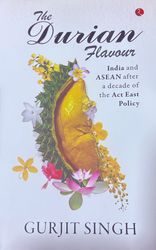
THE DURIAN FLAVOUR: INDIA AND ASEAN AFTER A DECADE OF THE ACT EAST POLICY
By Gurjit Singh
Published by Rupa
Price Rs795; pages 288