



THE OPPOSITION DOES not have the mechanism to deal with the challenges surrounding electoral rolls in Uttar Pradesh, where elections are due in a few months. I have consistently argued that opposition parties need a 24×7 election management apparatus of their own rather than outsourcing the responsibility to poll strategists.
They need to build their own mechanisms, backed by professionals and technology experts, to monitor everything, including the Special Intensive Revision of electoral rolls.
Chief Minister D.K. Shivakumar is doing this in Karnataka, but that is a Congress-ruled state. The opposition has to be more careful in states it does not rule.

There has been little investment in this area. Without people on the ground, it becomes difficult to identify and address problems. Every political party has an organisational structure extending from the block level to the parliamentary constituency. The Congress, for instance, has district and Block Congress Committees. But what is their role? It cannot simply be to provide office-bearers with visiting cards. They need to understand the electorate, know their constituencies and maintain contact with voters.
In nearly 90 per cent of cases—I am not exaggerating—Congress functionaries and people on the ground are clueless about these responsibilities. Many get organisational positions because of their proximity to a leader or because of their caste, sub-caste and religion. There is little accountability.
The Congress in Kerala, by contrast, has a much stronger culture of organisational accountability. The southern states, in general, are somewhat better placed to deal with these challenges.
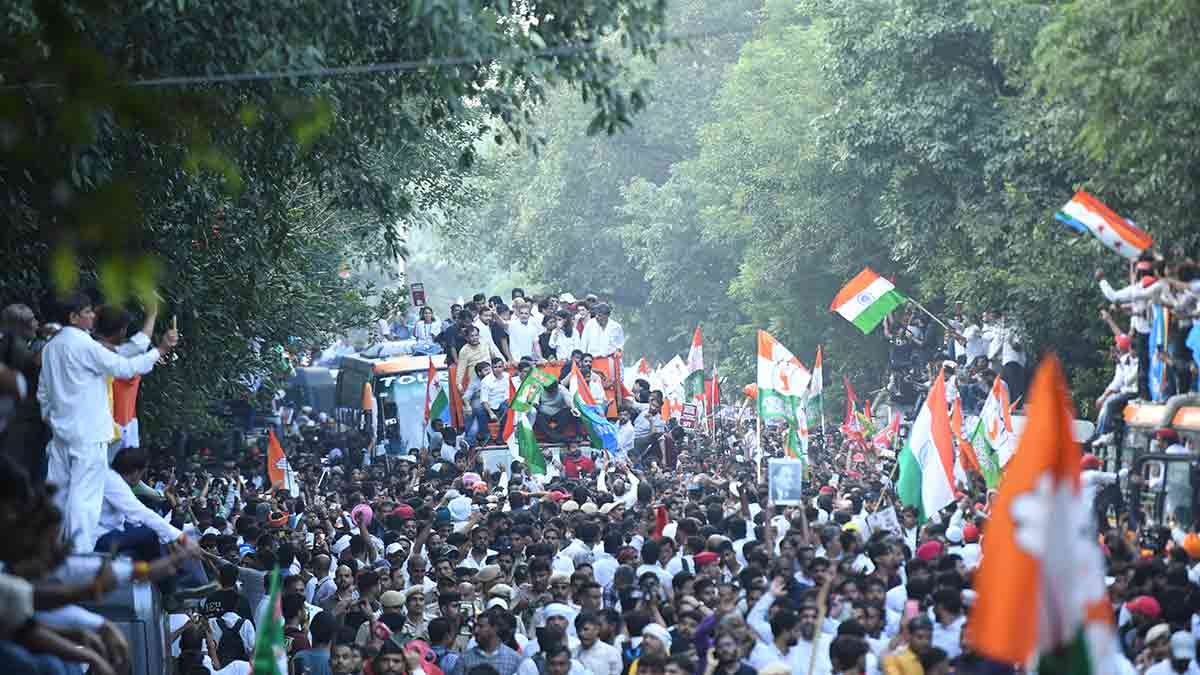
Traditionally, in political agitations, the Congress has largely mobilised its own party workers. What stands out in the recent protests is the participation of people from outside the party structure.
Anecdotally, women might earlier have accounted for around 10 per cent of participants. Now, their share appears to be more than 30 per cent. Similarly, perhaps 30 per cent are lawyers, academicians, teachers and those from other sections of society walking alongside party workers and political leaders.
This matters in India, as it does in other democracies. Only a section of the electorate is firmly aligned with a political party or ideology. A substantial number of people remain open to different political choices.
The BJP has a committed voter base of around 30 per cent. The remaining electorate cannot automatically be treated as belonging to one side or another. Even when the BJP gets 30 to 38 per cent of the vote, opposition parties often remain in the 20 to 26 per cent range. A significant section stays away from voting, while others support smaller political formations.
This is a gap the opposition needs to address. These parties cannot assume that votes will automatically consolidate simply because they come together in an alliance. They need voter mapping and a better understanding of the electorate, both for electoral purposes and for building a sustained political presence.
Has the issue of electoral integrity brought the INDIA bloc together and created common ground with parties outside the alliance? Theoretically, yes. Substantively, however, there is still a long way to go.
An alliance needs a mechanism, a process and a structure. It requires a hierarchy, a leadership model and a vision document that establishes what it stands for. Without these, unity remains largely dependent on the immediate political circumstances.
My experience of covering alliance politics in India suggests that electoral calculations and the pursuit of power are often the principal forces holding parties together. But an alliance formed to contest the Lok Sabha elections faces a different set of challenges when its constituent parties enter assembly elections. Punjab is an example. The Congress and the Aam Aadmi Party are political rivals in the state. In Goa, the Congress, the BJP, the Aam Aadmi Party and emerging political formations have their own calculations. There is no automatic convergence between opposition parties simply because they oppose the BJP at the national level.
Ultimately, parties are reluctant to surrender their political constituencies to their allies. That is why a sustained conversation about their roles and objectives is necessary.
The INDIA bloc needs to answer some basic questions. Where is its central office? What is its organisational structure? Who is responsible for coordination and decision-making? What is its vision on key socioeconomic issues? These are not merely administrative questions. They determine whether an alliance can function beyond individual elections and moments of political confrontation.
Consider the question of electoral reform. The Congress has advocated a return to ballot paper voting. But has the INDIA bloc adopted a unified position on this issue? There is no clear common position.
At present, there are almost as many voices as there are leaders. This lack of coherence makes it difficult to establish a shared political agenda.
The opposition has demonstrated that it can find common ground on electoral concerns and bring people from outside party structures into its protests. But mobilisation alone cannot sustain an alliance. It needs organisational investment, accountability at the grassroots, a shared programme and a leadership structure capable of resolving differences.
Unless the INDIA bloc puts these mechanisms in place, its political convergence will remain more theoretical than substantive.
The writer is a political commentator.
As told to Badar Bashir
