



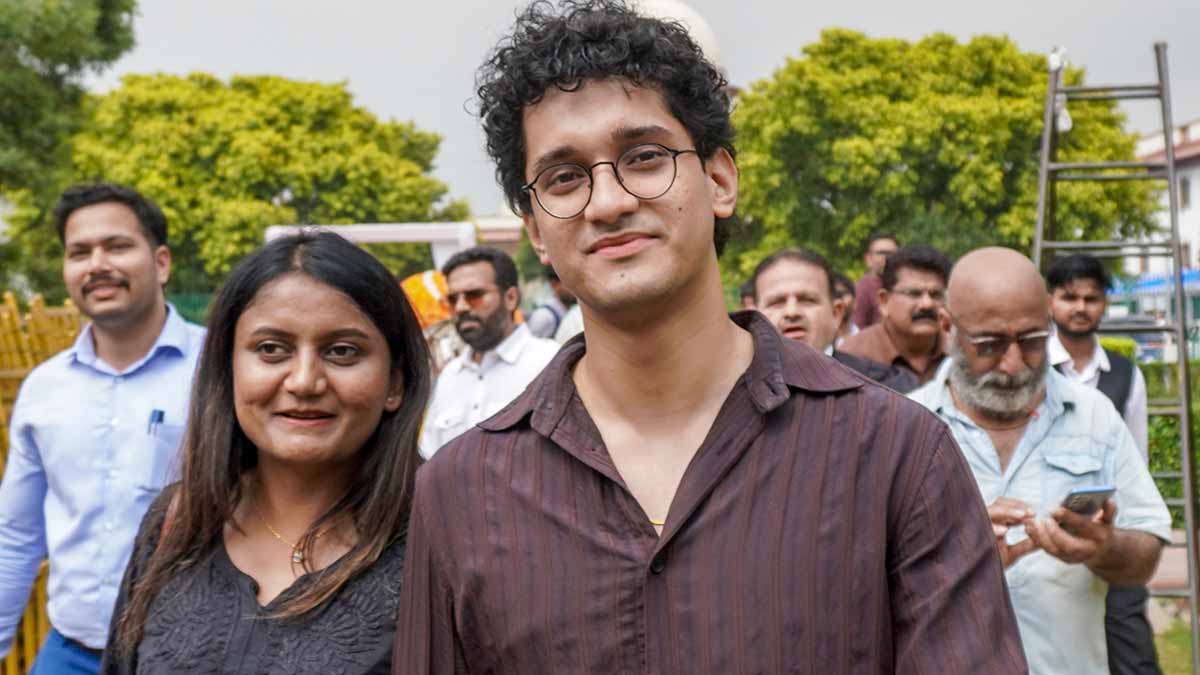
The Cockroach Janta Party might have been born from a courtroom remark, but its evolution is being shaped by something more consequential than its provocative name—a small group of legally trained minds who understand how the judiciary and constitutional institutions work, and where they can be questioned.
At the centre of this are Ratna Singh and Saurav Das, whose background in legal journalism have given the CJP an unusual advantage: they understand how the system speaks, how it functions and, crucially, how to translate that understanding into public campaigns.
Singh is a law graduate who got into legal journalism before joining the movement. Das, the spokesperson, has a degree in mass communication from Amity University, and has worked as an independent legal journalist. Together, their years covering the judiciary means they can follow proceedings closely, understand the nuances of arguments and observations, and explain their implications to other members of the CJP. In a movement made up of students with little legal training, the ability to translate complicated proceedings into simple language has become an organisational asset.
Importantly, they are not approaching the judiciary as outsiders angry with an institution. They are questioning it using the language of the institution.
Armed with this advantage, said CJP legal head Singh, the movement has embarked on its next phase with a special focus on education, the judiciary, the Election Commission and employment. The plan suggests that the group is trying to shed its tag of protesters and looking to establish itself as a pressure group capable of taking grievances from the street to institutions and, where necessary, to court.
The roadmap shows that it does not intend to remain a single-issue movement. The legal team, party members say, will have to operate across each of these areas, identifying where a grievance can be turned into a campaign, where a campaign can become an institutional demand and where an institutional dispute might ultimately require judicial intervention.
The first campaign is education. Its ‘School Thik Karo’ campaign will run for around two months, said Singh, with a measurable objective: if 100 schools are improved, the campaign will have achieved its goal.
Next month, the CJP also plans to launch a listening tool through which its team will speak directly to young people. The idea is to listen first and then determine which grievances can be taken forward. It’s an attempt to build a more direct connection with the constituency the CJP claims to represent.

The legal component cuts across all of this. Singh said her years in legal journalism left her concerned about “a lack of transparency” in the judicial process. The questions they raise range from appointments through the collegium system to the handling of politically sensitive matters and cases such as the special intensive revision of voter rolls.
The argument, said Singh, was not simply that they disagreed with individual judgments. It was that citizens should be able to understand the process through which institutions exercising enormous constitutional power arrive at their decisions. She particularly stressed the importance of open-court hearings, which she believes are a citizen’s right, and also essential for the judiciary to retain public confidence. She was also critical of Chief Justice Surya Kant clarifying his “cockroach” statement, calling it an image-saving exercise.
While this reflects the gap between the CJP and the head of the judiciary, it also underscores the broader questions the movement is raising around transparency, accountability and the relationship between citizens and constitutional institutions.
Anas Tanwir, Supreme Court advocate-on-record, told THE WEEK that scrutiny of the judiciary need not be seen as a threat, and that accountability and transparency are ideals the court has always espoused. “Dissent, scrutiny and asking difficult questions are essential to a democracy,” he said. “And what is good for democracy is ultimately good for the court.”
Singh said senior advocates including Vrinda Grover, Kapil Sibal, Menaka Guruswamy and Prashant Bhushan have also helped the movement in legal cases, including matters outside Delhi. For a young organisation, access to lawyers with experience in constitutional litigation and civil liberties provides an important layer of support.
Such support becomes particularly valuable when protests turn into legal cases. Singh says the CJP’s legal team explains to students what they can and cannot do during protests so that they remain legally safe. Lawyers are not merely brought in after arrests or FIRs; legal understanding is being built into the movement’s strategy before protesters take to the streets. That might be one of the CJP’s biggest advantages.
Singh pointed out something else that had begun to take shape—protests across the country are taking place without waiting for the CJP’s formal support. Young people, she said, were taking cues from the movement and fighting their own battles.
And that, in a sense, is the legal team’s larger ambition while spreading awareness among Gen Z. Singh said the CJP need not be physically present at every protest if the youth understands how to go about it.
The irony is difficult to miss. The “cockroaches” have acquired lawyers, legal researchers and a growing understanding of the institutions they are questioning. The NALSAR controversy was one visible demonstration of this strategy. When students at the Hyderabad law university opposed the invitation to the Chief Justice of India as chief guest for their convocation, the CJP backed them and demanded accountability from the Bar Council of India. The BCI’s subsequent action against the graduating batch—telling state bar councils to not enrol any of the graduates—turned a university dispute into a national debate about dissent, professional regulation and the power of the Bar Council.
The decision was eventually withdrawn, while the Supreme Court made clear that the dispute did not justify punitive action against the students.
For the CJP, the episode demonstrated the success of its strategy of putting facts before the public and understanding the legal implications of institutional decisions. Careful planning went behind it.
And so, the real challenge for the legal establishment might not be the CJP itself, because movements can rise and fall. The more consequential question is whether the legal playbook it is using to model itself on will outlive the organisation.
Social with media
THE SUPREME COURT Registry (administrative wing) now has an experienced media professional in its ranks. Maushumi Chakravarty, a 1991-batch Indian Information Service officer who has spent more than three decades in government communication, has taken charge as officer on special duty with the registry.
Chakravarty has had stints with the Press Information Bureau, Central Bureau of Communication, National Human Rights Commission and as a ministerial private secretary. She also served as director general of Akashvani News.
At the Supreme Court, she is handling media-related inquiries and communication with journalists, bringing an institutional understanding of how information is disseminated and media queries are managed.
Her appointment comes at a time when the court is facing heightened public and media interest in not only its judgments and hearings, but also its administrative functioning. The presence of a senior communication professional could help the registry respond more systematically to queries and provide greater clarity on matters within its administrative domain.
