



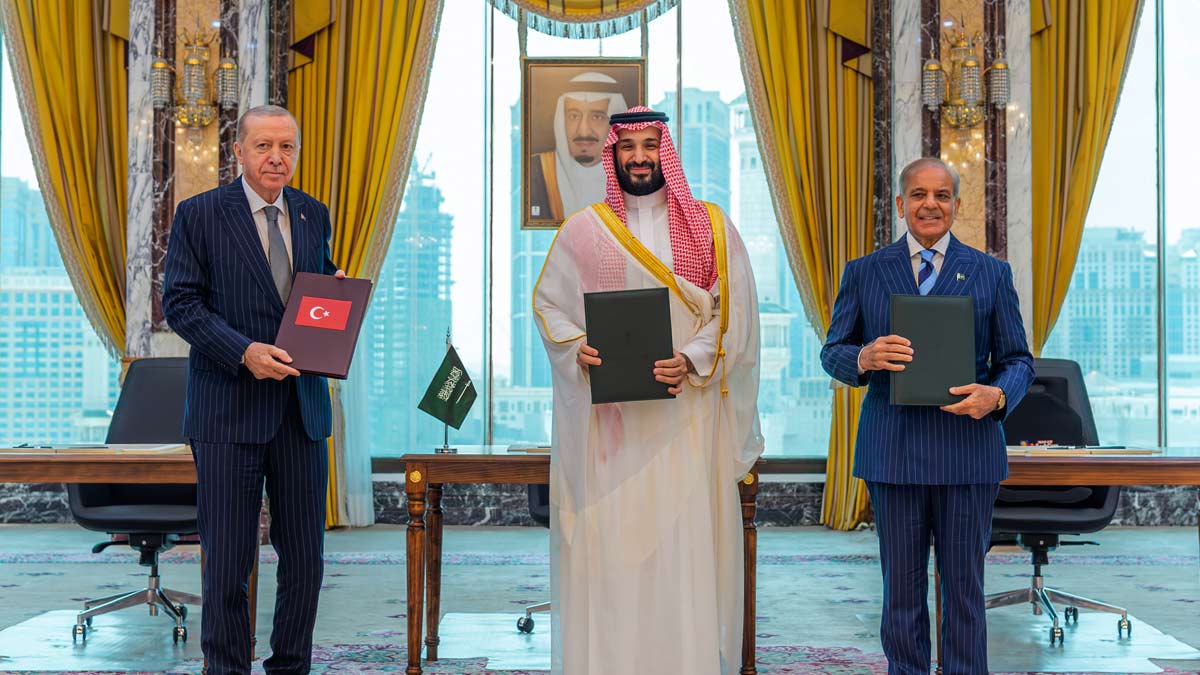
With Pakistan and Turkiye stepping up the military effort to help the Saudi Arabia forces in the running conflict with the Ansar Allah–also called the Houthis–in Yemen, the offensive character of the Makkah Alliance for Defence (Mecca Pact) has been unsheathed.
Under Clause 5 of the Mecca Pact, signed on August 7 and activated on October 5, an attack on either Saudi Arabia, Pakistan or Turkiye, will be construed as an attack on the others resulting in a joint defensive action. This is in direct contravention of the declared defensive character of the alliance.
Because, the truce between the warring sides that began in April 2022 was broken in the latest round of the long-standing conflict when on July 13, 2026, an aircraft with a Houthi delegation returning from Iran was attacked when it was trying to land at the Sana'a International Airport and the runway destroyed.
While the Saudi-backed Yemen’s Presidential Leadership Council (PLC) government-in-exile claimed responsibility for the plane attack, the Houthis blamed Saudi Arabia for the bombing. That in effect, technically, makes the Houthis the ‘victim’ or the ‘defender’ and not the ‘aggressor’ as claimed by the Saudis.
While Pakistani defence minister Khawaja Asif described the Houthis as ‘aggressors’, Houthi leader Abdul Malik al-Houthi described the Saudis as “an occupying power”.
But what the developments reveal is the offensive character of the Mecca Pact.
This has implications for India as the conflict geography has expanded and reached closer to Indian shores. Moreover, given India’s inimical relationship with Pakistan and Turkiye, the offensive element of the Mecca Pact may have deeper connotations for the Indian security architecture.
According to the 2026 Global Firepower Index, the three-country military alliance can cumulatively cobble up a force of about 14 lakh active troops, about 3,400 military aircraft, 6,000 tanks and more than 340 naval warships.
There were earlier news reports that in April itself, Pakistan had deployed about 10,000 desert warfare troops from the 25th Mechanised Division along the Saudi Arabia-Yemen border. This was in addition to the deployment of a 18-aircraft strong fleet of Pakistani fighters at Saudi Arabia’s King Abdulaziz Air Base in March that was made public by the Saudi authorities on April 11.
