



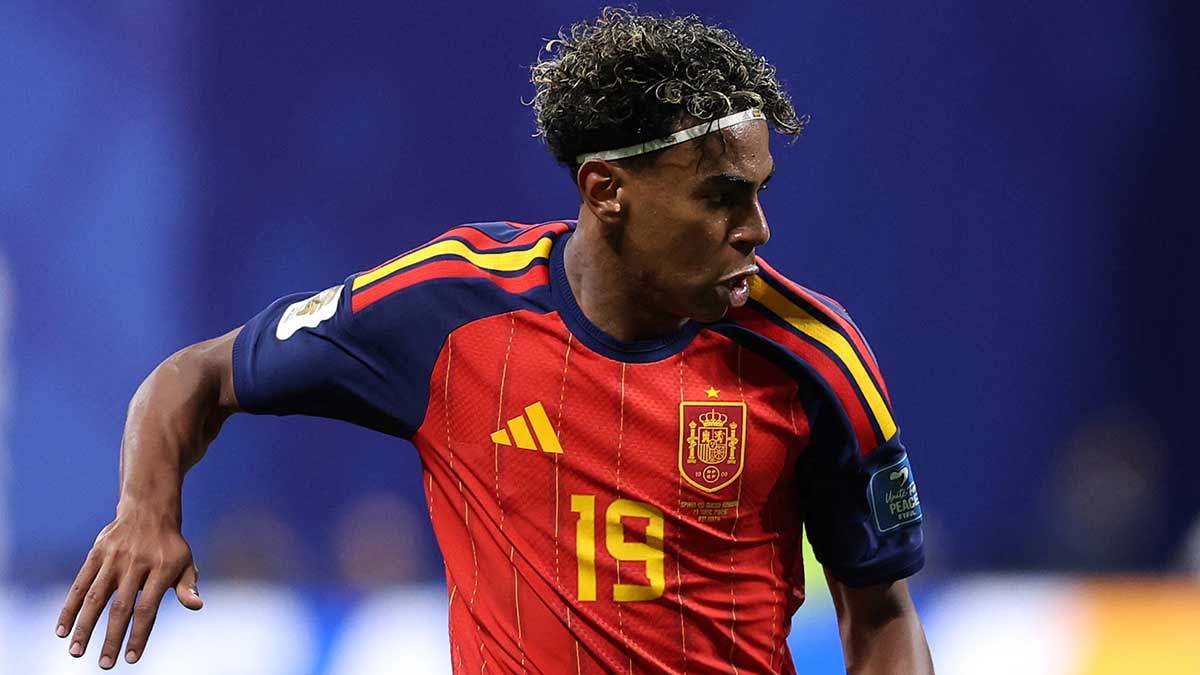
When Lionel Messi was raising his game to unprecedented levels at Barcelona, CF La Torreta, a small club in a Catalan town, stumbled upon a four-year-old going past players three or four years his senior with absurd ease. Catalonia was Barca’s hunting ground, and soon he was on the club’s radar. But, Barca’s local rivals Espanyol moved first. The pressure this development put on Oscar Hernandez, then Barca’s coordinator for U8s and U10s, shows in the email he sent from his car. He tells a colleague to act within the week to bring “Lamine Yamal Nasraqui Ebana”—misspelling Nasraoui—to Barca for a trial.
At the trial, it took only minutes for Barca personnel to realise they had unearthed another gem. By 2025, Yamal was officially the second-best player in the world, having finished as the runner-up in both the Ballon d’Or and The Best FIFA Men’s Player awards. He is expected to be on the podium in 2026 for both the awards. Also, if he wins the Ballon d’Or by 2027, he will break Ronaldo Nazario’s record (21 and 96 days) as the youngest winner. But in the FIFA award, Ronaldo’s record (20 and 124 days) is out of reach.
Born in July 2007 to a Moroccan father, Mounir Nasraoui, and an Equatorial Guinean mother, Sheila Ebana, Yamal grew up in Catalonia’s Rocafonda, where an estimated 2,000 of the 11,000 residents are children of African descent. The neighbourhood is home to residents from 88 nationalities and about half the population is classified as “at risk of poverty” by Spain’s National Statistics Institute. Yamal’s parents were also facing a dire financial situation leading up to his birth. Two family friends became a crucial source of support during the pregnancy. One was a Gambian-origin taxi driver named Lamine (which means ‘the faithful’) and the other was also an African-origin friend named Yamal (beauty), about whom further details are not known. The grateful parents named their son after their benefactors.
Learning the game on the unforgiving streets of Rocafonda made Yamal, in his own words, more resourceful and cunning compared to someone who trained in a school. He has not forgotten those lessons, despite being at Barcelona for more than a decade now—his signature goal celebration is the 304 hand gesture, in which he forms three, zero and four using his fingers, the last three digits of Rocafonda’s post code (08304).
He made his senior debut for Barcelona in April 2023, at 15 years and 290 days, becoming the youngest player in the club’s history.
The whole world now knows that Yamal is special. But, can he go on to have a career comparable to Messi?
It is a tall order. But, the 5’10” right-winger has had a phenomenal start. By the age of 19, he had played 151 games for Barcelona’s senior team, scoring 49 and assisting 52. Messi played 34 (nine goals and five assists). For their countries, Yamal racked up 31 games before his 19th birthday, scoring seven and assisting 12. Messi stood on nine games with two goals and four assists.
The similarities on the pitch are straightforward. The change of direction and pace on the ball, the instincts in the attacking third and the dropping deep to collect the ball and link up play are some of the strongest similarities. Yamal may have an advantage over Messi in terms of defensive awareness. However, his physical advantage is not as pronounced as one may think. Despite being bigger, he still has development left in terms of strength on the ball—an area where Messi punched well above his weight. He is also nowhere near prime Messi when it comes to set-piece ability.
The key checkpoint will be four years from now, when Yamal turns 23. That is the age at which Messi truly shifted gears.
Notably, Yamal may also be better placed mentally than Messi. Consider this quote from 2024: “I think, above all, I want to be a good person and be able to help people. The most important thing, apart from football, is being a good person. When I’m 25, I would like to be a responsible person and know who I am.” Messi, on the other hand, has plenty of Argentine aggression held in reserve. For instance, in 2015, he grabbed Roma’s Mapou Yanga-Mbiwa by the throat during a pre-season friendly. Then there are the memorable histrionics from the quarterfinals clash against the Netherlands in the 2022 World Cup. It is understandable—Messi has dealt with being kicked around by desperate defenders while also shouldering the responsibility of being a demigod. There is also the difference in the cultures and fortunes of their national teams—the Boy from Rosario became what he needed to be to lead Argentina to glory. The Boy from Rocafonda has won it all without having to carry his national team.
This difference in the early careers of these two players makes it possible that after a few years of continuous success, Yamal could lose something within—the fire that drove Messi to do incredible things when the going got tough. The Spaniard, though, clearly has an early lead, by all the metrics that matter. All he needs now is a couple of decades of near-flawless performances.
