



More than conveying the fact that he was retiring from international football, the social media announcement from Lionel Messi on August 31 had an important message: “Nothing left to give.”
On the face of it, it seemed an innocuous statement. All through his playing years at the highest level, Messi mesmerised and enthralled people with his talent. Was the statement yet another example of him ‘nutmegging’, this time his fans? If so the four words would haunt them for a long time, just like the talented Josko Gvardiol would remember the GOAT turning him inside out in the semifinal of Qatar 2022.
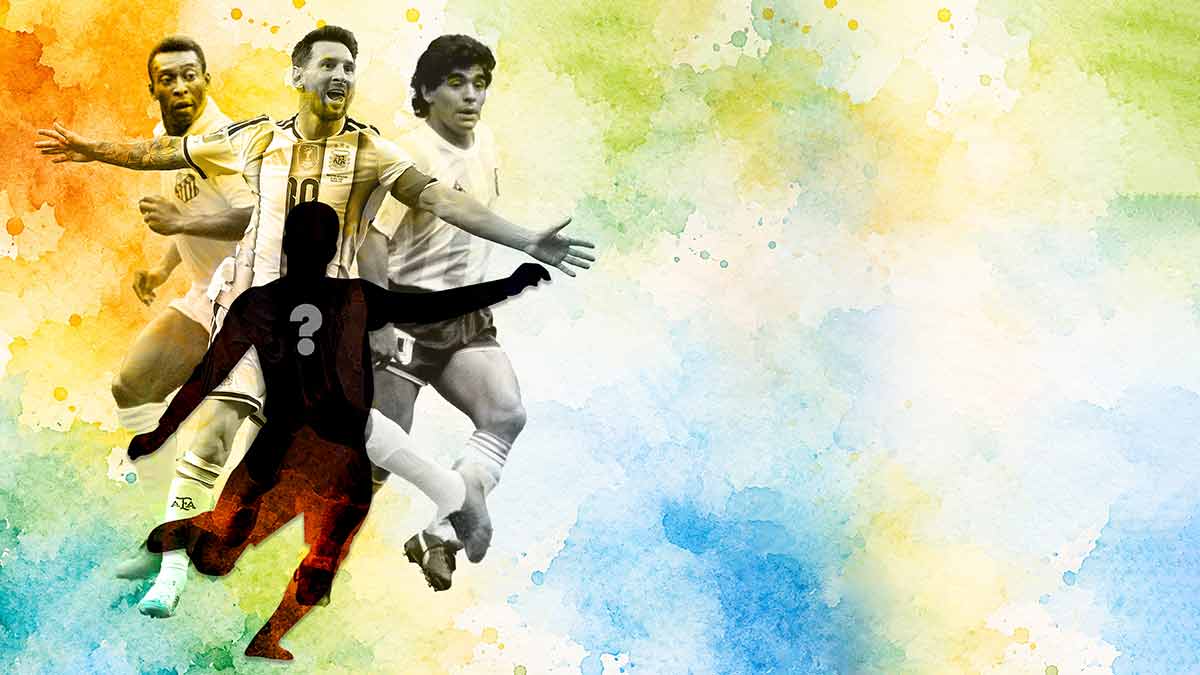
Messi’s contributions to the ‘beautiful game’ have been celebrated many times over. Goals, assists, dribbles and a cabinet full of trophies, including the World Cup. But, part of the puzzle called Messi is what he has not delivered, and come to think of it, there is one unfinished business, which might seem irrelevant to the uninitiated, to those who have not understood the ‘alchemy’ of the game. He has not anointed his successor, while the legendary Pele was liberal in identifying successors out of the talented players who followed him.
According to a 2006 study by FIFA, football’s global governing body, there were over 18.7 million aspiring footballers in registered clubs worldwide. It would have grown manifold 20 years down the line. Europe currently has over 22 lakh teenagers learning to play the game, 10 lakh in Germany alone. Add to that the number of hopefuls from North and South America, Africa, Oceania and Asia, and the figure will run into several millions. Which of these boys would inherit the thinking and dancing legs that made Messi the legend that he is today?
As is evident from the many videos circulating on social media, Messi’s children—Thiago, Mateo and Ciro—have inherited the football genes of their father. But the weight of expectation is like an albatross around one’s neck. And genes alone do not make you a great player. What Messi’s children get from their father is neural-coordination and certain aspects of his game. What the world can see, what the world can imitate, are manifestations of Messi’s watered down genius in the videos of his children playing football.

Let me talk to you about something other than genetics. There are kids out there who take a great footballer as their role model, practise eight to ten hours a day, seven to eight years sticking to the routine, imitating his moves, his plays. They watch and understand how he manages tight spaces, crowds markers, frees up spaces, the speed and movement of the ball and, over and above, his problem solving. More than the play gone by, they, like their idol, would look at where the ball would be the next second, and how to be there before the markers swoop down. They might one day become like their idol, think like him, play like him. It was Aristotle who talked about ‘mimesis’, a process by which we become what we repeatedly behold. Children who perfect the art of mimesis are all over the world. Indeed, this could be why so many of today’s teenage superstars are left-footed attackers. So, from which part of the world will the Next Messi come from?
The football world asked a similar question 29 years ago, when Maradona announced his retirement on October 29, 1997. A few days earlier, playing the Super Classico for Boca Juniors (vs River Plate), he had left the field at half time. Argentinians had begun the search for his successor a few years earlier, when drugs and age started catching up with the virtuoso. Juan Roman Riquelme was the first candidate. Unconfirmed reports said Maradona himself had picked Riquelme and that Boca had allotted the legend’s iconic number 10 jersey to the 19-year-old. But Riquelme never could reach the 1986 highs of Maradona. Ariel Ortega, Pablo Aimar, Javier Saviola and Sergio Aguero were all celebrated as the New Maradona, but 1986 remained a myth none of them could live up to.
In 2004-05, Messi was labelled the New Maradona, but by then the concept and the game had changed. Messi’s rise was meteoric, and Argentinians quickly realised the futility of the search for a New Maradona. A more recent thinking is that Messi completed the Maradona narrative. If the Argentinians initiated and aggressively pursued the search for the New Maradona, the search for Messi’s successor is a pastime of fans and pundits across the world. Even before Messi’s Argentina lost the 2026 World Cup final at the Metlife stadium to Lamine Yamal’s Spain, the world had anointed the Spaniard as his successor. At the age of nine, generational talent J.J. Gabriel was seen as the Next Messi. At 16 now, he is looking for a career move from Manchester United. Max Dowman of Arsenal (16) and Mexican Gilberto Mora (18) are also in the same league as Gabriel.
Who will inherit the number 10 jersey for Argentina is also eagerly watched. Talented attacking midfielders Nico Paz and Franco Mastantuono have already put their hands up.
The football world has changed drastically since the time Messi arrived on the scene. There are people who argue that Messi is a product of La Masia (The Farmhouse, Barcelona’s youth academy). In fact, Messi is a hybrid phenomenon. Messi was born and raised in Rosario, Argentina, and shifted to Barca at the age of 13. But all through his life he remained an Argentinian—in language, culture, family values and loyalty to the land he was born in. He became a Spaniard thanks to Barca’s commercial interests. All through his time at Barca, he remained very much a Latin American in his positional play, rondos and decision making in critical situations. He only added the skills imparted by then Barca coach Pep Guardiola to his repertoire.
Legends like Maradona and Ronaldo Nazario arrived in Europe as finished products from the Latin American school of football. Messi, on the other hand, became a complete player in the most demanding finishing school in Europe.
Messi is a historical outlier, an amalgamation of talent, uniqueness, timing, personality and the skills acquired from La Masia. For Barca, his arrival was at a critical juncture. After Johan Cruyff’s tenure, which saw Barca scaling great heights, the all-conquering club realised that technique and intelligence are more important than the physicality of a player. And Messi had both in abundance.
There was something else that had marked him out from the Latin American talents of his time. From a very young age, Messi had a professional outlook towards life and the game. He led a low-key life, stayed away from parties and drugs that came with it, and remained devoted to Antonela Roccusso and their children. The fact that he remained rooted helped him avoid the pitfalls players like Giovanni Dos Santos had fallen into, like inconsistency, indiscipline, home-sickness, family pressure and nightlife.
As a player, his low centre of gravity, short and frequent steps, exceptional change of direction, decision making in tight spaces and acceleration made him the top gun of his generation.
Messi redefined the great game in his inimitable way. The Next Messi, pardon me for using the term, will not be the Next Messi. There will be generation-defining players like him, but not another Messi.
In the next few pages THE WEEK’s writers pick 10 teenagers who could change the great game, almost the way the most celebrated No 10 of our times did.
