



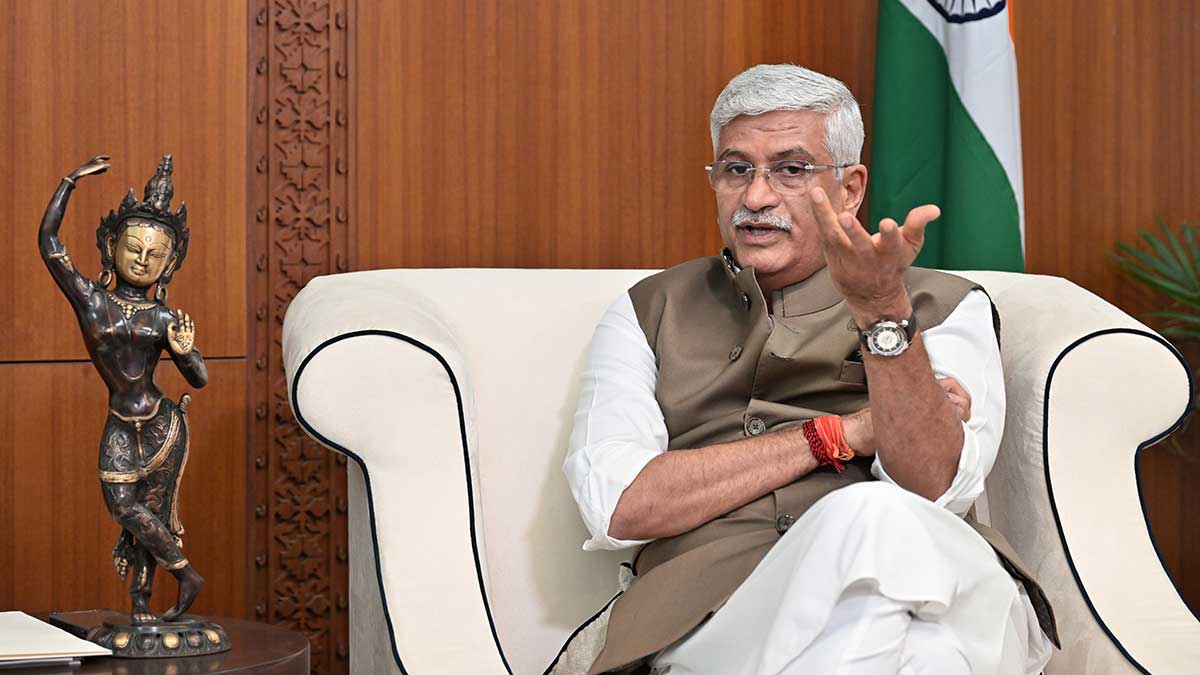
Interview/ Gajendra Singh Shekhawat, Union minister of culture and tourism
What does it take to preserve culture in the 21st century? For the Union ministry of culture, it is no longer about simply preserving India’s civilisational inheritance, but also making it useful to the younger generation and bringing home what was taken abroad.
Digitisation will make knowledge eternal, says Union Minister for Culture and Tourism Gajendra Singh Shekhawat, explaining the Centre’s Gyan Bharatam Mission, which includes digitisation of crores of manuscripts, the use of artificial intelligence to decode ancient knowledge and the creation of Yug Yugeen Bharat National Museum. In an exclusive interview, he also talks about the recent controversy over Vande Mataram and the pending report on the Keeladi excavation. Edited excerpts:
Q/ The previous NDA government had launched the National Mission for Manuscripts in 2003. Over 3.5 lakh manuscripts were digitised under it, and over a lakh had been uploaded. What was the idea behind launching Gyan Bharatam?
The foundation is the mission initiated by the previous NDA government, led by former prime minister Atal Bihari Vajpayee. We had learnings from that. The succeeding Congress-led UPA government, however, didn’t show much interest in it.
So when I took charge of the ministry, I requested Prime Minister Narendra Modi to take it up again. He shared his apprehensions that the mission had failed the last time. The first step, hence, must be to identify shortcomings, he said, which is what we did.
And in March, we launched a survey to identify manuscripts through an app, and about 2 crore have been reported. They were then verified. Thus far, about 1.2 crore manuscripts have been identified. The digitisation process is simultaneously happening. And about 5.5 lakh manuscripts have been digitised and uploaded.
We are also integrating artificial intelligence. The prime minister pointed out that with digitisation, we will be making the knowledge eternal, but the generation of the day will still be unable to read it. So we have made an AI-based platform called BharatGPT, which allows you to interact with AI to understand manuscripts.
Q/ Integrating technology is great. But what next when it comes to research and scholarship? Because in many cases, the scholar pool is shrinking. For instance, not many can read Kashmir’s Sharada script.
Capacity-building is one of the areas we are working on through our partner institutes. Because to deal with over a crore verified manuscripts, and the number will only go higher, we have to focus on capacity-building.
Q/ The goal of Gyan Bharatam is to digitise one crore manuscripts in five years. Is the government on track to achieve that?
I believe we are much ahead of what we initially envisaged. When we started, many had said we would not get more than 20-30 lakh manuscripts. But we have already mapped and verified 1.2 crore manuscripts.
Q/ About 660 Indian antiquities have been repatriated since 2014. Does the government have a number for how many Indian antiquities are still abroad?
Many ended up abroad through illegal means, so we cannot predict an exact number.
But under the UNESCO agreement of 1970, if an antiquity of a signatory nation goes out, and that country is able to prove it, then it has every right to get it back. Since then, India could bring back just 13 antiquities. That number has now almost touched 700, since 2014. And I am sure it will go up to 1,000 soon.
The US is the largest market. And to get just one antiquity back, we have to deal with 60-odd agencies and organisations. It is a very tedious, difficult and time-consuming process. So we entered into an agreement with the US in 2024, which has made it much easier to bring our cultural assets back. Because of it, we have brought back 300-plus antiquities in the past six months, and are expecting the same in the next six months.
We are entering into similar arrangements with other countries.
Q/ A significant part of our cultural heritage lies in the United Kingdom. Are we in talks with the British, too?
The legal framework under which repatriation happens is limited to the day when it was signed. It means we cannot claim assets that were taken away before that, which includes those during British rule. However, we are raising our voice along with other former colonies. And let’s hope that someday those assets will be brought back.
Q/ Many Indian manuscripts are also elsewhere.
For that, we are entering into agreements with several libraries and museums across the world, such as Germany, the US, the UK and Japan. If not physical copies, our focus is to get at least the digital ones so our repository is complete.
Q/ The government’s focus is also on civilisational values and issues. One way of doing that is by developing civilisational corridors such as Kashi Vishwanath. But when issues such as Bhojshala or Krishna Janmabhoomi come up, what’s the culture ministry’s stance?
Our role is limited to scientific studies if required or ordered by courts. For Bhojshala, for instance, the court ordered us to conduct a scientific study into whether it was a Saraswati temple or not. We submitted the report with many reasons that proved it was, in fact, a temple and a Sanskrit research institute. The court gave its order.... For Gyanvapi, too, the court ordered a scientific survey, for which we submitted the report. We do that whenever any court asks us to do it for any monument.
Q/ Archaeological excavations give so much insight into our civilisational history, such as Rakhigarhi and Sinauli.... But when excavations happen, say, in Tamil Nadu, there are arguments that the reports don’t see the light of day.
You are talking about Keeladi. See, that is unfortunate. Excavation is a scientific process, established and recognised worldwide. Any report carries value only if the excavation is conducted according to the set principles. But if those principles are abused or ignored simply to appease political leadership and extend support to the narratives built by politicians for their political interests, then how can a government or an organisation with credibility across the world for its work, excavations and preservation allow that reputation to be diminished? How can it allow someone to use excavation reports that were not scientifically prepared or are incomplete in nature to establish a political agenda?
The report prepared by the archaeologist, who was an Archaeological Survey of India scientist, was incomplete. It was inaccurate and was not prepared according to established archaeological principles. Therefore, the observations were questioned, and the report was sent back for further work. It has not been sent back to us. How can we publish it without completing the entire process?
Q/ The Yug Yugeen Bharat is a much-anticipated world-class museum being developed in New Delhi. What is the update on that?
It is a flagship project, very ambitious and close to the prime minister’s heart. It is going to be the world’s largest, 1.5 times bigger than the Louvre in France.
We are planning to showcase the continuity of the Indian civilisation, and what India will be like by 2047. The work is in progress. We have engaged the best teams and experts from across the world. We hope to inaugurate it by 2028.
Q/ We are also seeing that the focus is now increasingly on engaging with Gen Z and Gen Alpha. What is the ministry doing in this regard?
All the efforts and initiatives that we have taken—whether it is bringing back our cultural heritage, conserving manuscripts or improving and preserving cultural and heritage sites—are part of what I would call our country’s cultural renaissance. All these efforts are aimed at connecting the next generation with our cultural heritage and instilling in them a sense of pride and ownership towards our cultural and historical legacy.
