



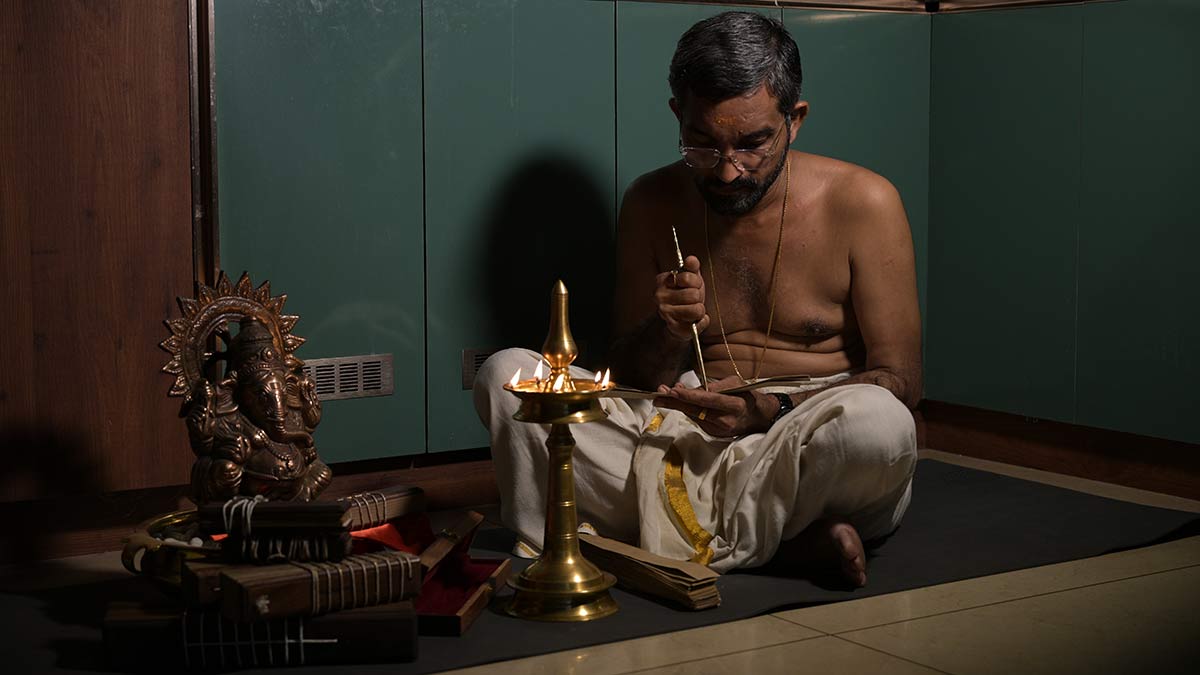
WHILE COUNTLESS PALM-LEAF manuscripts preserved in India’s libraries, museums, temples and private collections are centuries old, those in the study of Kochi-based Rajesh Kumar R. are strikingly new, some not even a year old. That is because he made them himself.
Kumar, 52, is one of the few practitioners in India still making palm-leaf manuscripts. On his worktable lie long, narrow strips of dried palm leaves, golden-yellow in colour. Kumar picks up one in his left hand and a metal stylus in the other. He scratches each letter into the leaf with slow, deliberate strokes. The words remain almost invisible until he rubs charcoal over the surface and gently wipes it away with tulsi leaves. The black settles into the grooves, revealing letters of Devanagari script.
“We also mix the charcoal with lemongrass oil,” he says. The same oil has helped preserve Kerala’s palm-leaf manuscripts for centuries despite the state’s humid climate—some for over 600 years.
It begins with raw palm leaves. Boiled in turmeric water until they become supple, the leaves are dried and pressed between wooden planks for weeks to straighten them before being cut to size. Only then are they ready to be written on.
“While institutions across India are working to preserve the ancient knowledge contained in these manuscripts, what about the ancient art of making them?” asks Kumar.
For centuries, palm-leaf manuscripts served as one of south Asia’s principal writing materials. But with the spread of the printing press, the craft of preparing and inscribing the leaves gradually faded. “Once printing became widespread, the knowledge of how people seasoned and prepared palm leaves for writing gradually disappeared,” says Kumar. “Nobody documented these processes. So this passion project started out of curiosity.”
That curiosity was more rooted in memory than history. “In Kerala, palm-leaf manuscripts are deeply connected to our rituals and culture,” says Kumar. “Almost every household once had its own manuscript because they were required for important ceremonies such as marriages. In these ceremonies, we use something called Ashtamangalyam, which consists of eight auspicious items. Traditionally, one of those items is a palm-leaf manuscript. Unfortunately, my family didn’t have one.”
Today, his passion project has become a full-fledged business. Kumar now sells palm-leaf editions of Hindu religious and philosophical texts. Last year, the business—Palm Leaf Innovations—recorded a turnover of around Rs50 lakh.
Meanwhile, demand emerged from unexpected places. A hotel in Dubai approached him last year to create its menu in the form of a palm-leaf manuscript. Kumar turned it down. “My focus is on religious and philosophical texts,” he says.
While Kumar continues to make authentic palm-leaf manuscripts by hand, most of his commercial orders are produced using machines on textured paper designed to resemble palm leaves. The handmade process is lengthy, and more expensive.
When placed side by side, the differences are unmistakable. The paper copies are neat and durable, but the handmade ones bear the tiny imperfections of laborious hard work. They draw attention almost instantly, with the beautifully-adorned metal stylus resting beside them. He has many of them, acquired from various antique shops, one from Odisha shaped in the form of Lord Jagannath.
It is a quiet yet powerful reminder of a tradition that has endured centuries, yet today survives in only a handful of hands.
