



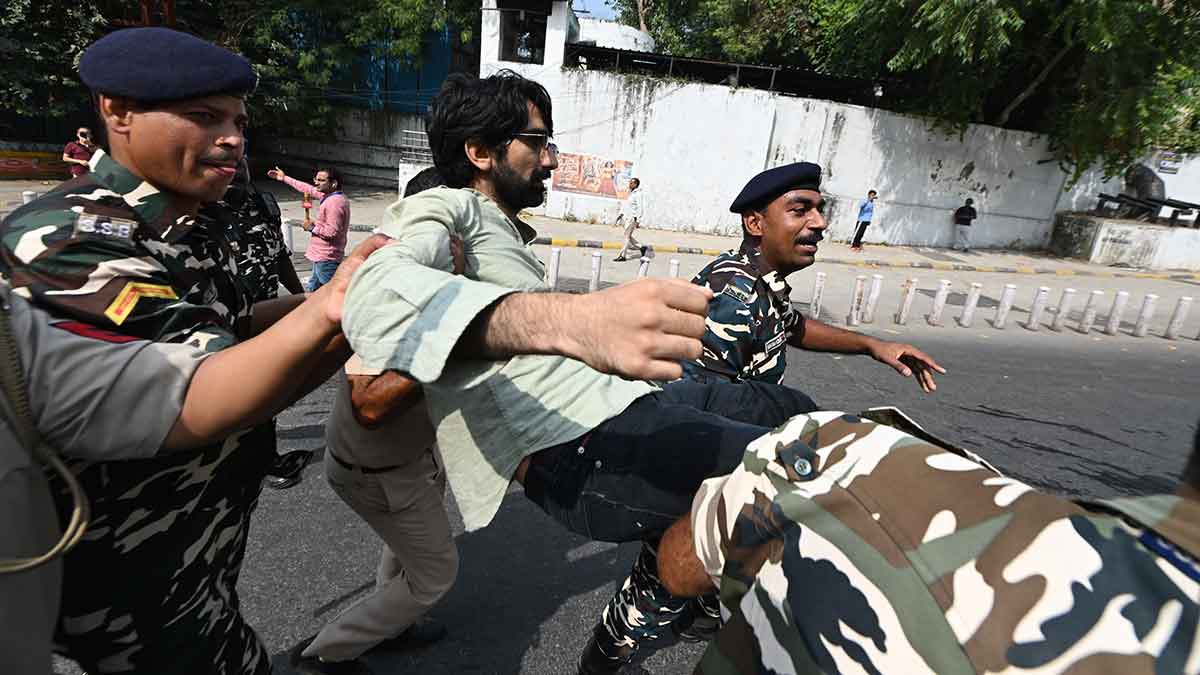
All my life, I have watched men being detained, arrested and beaten as they were pushed into police Gypsies in Kashmir. So when I came to Delhi unscathed, I felt I was chosen.
On the morning of October 10, as a journalist and a Delhiite, I felt more equal than others as I went out to cover the Cockroach Janta Party protest. But I wasn’t; I was detained within 30 minutes, that, too, for something I did not do—protest.
Despite my photographer colleague Kritajna Naik arguing for my release, the police took me away because I wasn’t carrying my press card. During the previous CJP protest, the Delhi Police were softer, allowing people to gather, sloganeer and loiter. But, this time, they were too preventive.
The government had added an extra thick layer of security. It was a mix of police and Central Armed Police Forces. In short, they were people who knew how to pick protesters up by their limbs and load them into buses.
Two policemen held my arms, while two others lifted my legs by the calves. They did it so smoothly that it seemed like they had mastered the technique in the past few eventful months.
To be fair, most policemen wanted to do their job peacefully. But a handful were deliberately trying to provoke protesters by quarrelling. One had to be subservient and swift to escape them.
A policeman slipped his arm into mine and said, “Let’s go in the bus.” I said I was a journalist. The romance did not last long as another policeman responded, “So what? Where is your ID? Move him into the bus.”
Security personnel in Kashmir are proactive and ask fewer questions. They are battle-hardened and make use of their batons. Most Delhi policemen follow orders strictly and refrain from using force. Plus, with media around, they are cautious, too. And then, this was the capital of the world’s largest democracy. They were aware of the rights of protesting people. The police in Kashmir are less aware in that regard.
The bus I was in was one of the last in which protesters were detained at Minto Road. There were 10 of us—two men and eight women. Over a hundred people had somehow gathered at Minto Road. A feat in itself, considering that barricades and checkpoints had been installed almost every 500 metres. Most of the detainees were members or volunteers of left-wing parties.
“Gyanu, your time is over,” they shouted, along with some extempore slogans against the BJP. A policewoman asked me, “Are you not with them?” I said no. She went back into police mode. It seemed like she had orders not to be pally with us.
One woman spilled water on a seat, and another wiped it. Protesters show a different level of camaraderie. There is no “mine” and “thine”. There is just “us” versus “them”. “If people keep coming out, it is to halt democratic backsliding,” Abhitha told me when she got to know my profession.
At one point, a few protesters came in front of the bus to rescue us. But the driver was artful in knocking them off, slowly and forcefully.
Throughout the bus ride, we were told we would be scattered a few miles away. But they took us to the Maurya Enclave police station in northwest Delhi and told us we were under detention.
One of the policemen said, “Don’t worry, we will take you where the other detainees are.”
I said: “Even if you take me somewhere separately, I can’t do anything.” That was my way of telling them I could think beyond the immediate situation and that I was not scared.
At the station I met Pratiksha Rajje—Dimple Yadav (Samajwadi Party leader and wife of Akhilesh) had offered her water after she was allegedly manhandled by police during the student protest in Delhi in July. Rajje had travelled from Indore to be part of this protest. “This time, we have told our parents we will fight on the streets whenever there is a major call,” she said.
Rajje had been leading her own bunch of bus-stoppers. “I was energised when I saw Rajje lying down in front of buses to free the detainees,” Hyder, another detainee, told me excitedly. “We unpacked two buses before we ourselves got detained.”
The mix of protests and social media has given rise to a kind of bravery, I think. I saw many people standing in front of buses with one hand pushing the hoods—it was a visual that had gone viral when a woman in Mumbai did it in July.
Many of the people sitting with me at the station were disengaged citizens till recently. Not any more. Mohsina told me that her name was missing from the voter list. “So I came out. If I won’t fight for my rights, then who will?” she said with a smile.
Spending eight hours at the police station felt different. The tea seller there was nice. He didn’t want me to show him the proof of the online payment I had made. He said he trusted me. “Where will you go with my few rupees?” he said.
Everyone from office kept calling me. They were worried, and rightly so. They are nice people. But the police were nice, too. “If the Delhi Police is so nice, then who is oppressing people?” one Muslim woman asked. Another young man couldn’t swallow the niceties. “This is just optics,” he said, continuing to be suspicious.
To lighten the mood, a lady sitting beside me cracked a joke, which some felt was not so funny given our situation. When a policeman came offering a cup of tea, I refused. I told him I already had one. But the lady intervened, “Have it, it is our own money, we pay tax for this.”
At night, around 8pm, we were told to go. There was no paperwork, no grand speech. It was anti-climactic. Later, one of my colleagues said they felt happy that I was able to tick this box at just 32. Small joys! But it was my inability to run from the police that changed my day’s destiny. Anyway, we call our predicaments our experiences and present them as small adventures.
