



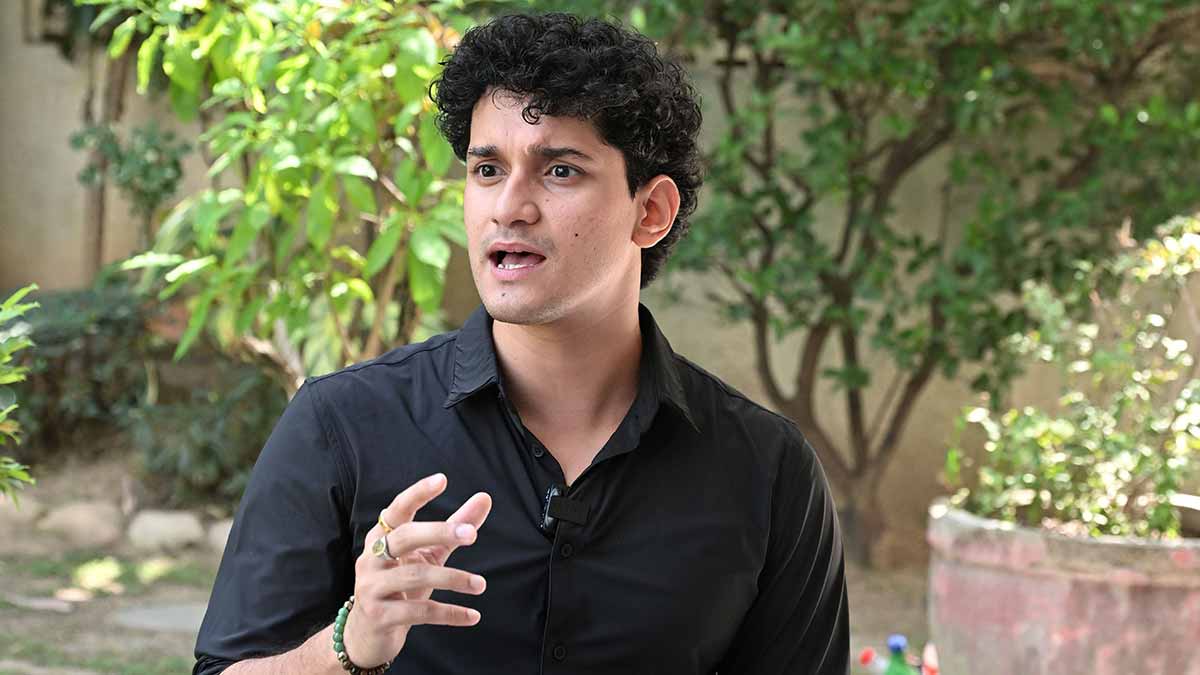
Interview/ Saurav Das, co-convener, Cockroach Janta Party
Saurav Das’s Delhi home feels more like a temporary stop than a permanent residence—a half-unpacked suitcase, clothes strewn around and a bottle of water point to the whirlwind his life has recently been. There might be CRPF personnel standing guard outside, but the CJP spokesperson, 27, is not bothered. He is too focused on creating space for a struggle that can, in his words, give birth to a different kind of politics in India.
It was during his time as a mass communication student at Amity University in Noida that Das became interested in transparency and public accountability. In 2017, he began filing Right to Information applications, an effort that would later become important in his work as an independent journalist.
In an interview with THE WEEK, Das stresses that the CJP wants to build issue-based movements that can pressure whoever is in power, even if that means remaining outside the political mainstream.
It is a strategy that could leave the CJP without the support of established parties, but Das believes that is a price worth paying if it can help trigger a generational change in Indian politics. Excerpts:
Q/ The CJP has emerged as a pressure group outside the traditional political system. Are you trying to create a new space for politics?
We are not trying to become a political party, at least for now. Politics is a dirty, dirty business. Our energies are much better spent fixing education, getting accountability and getting ministers to work. These are people sitting over a lot of the country’s resources. They have thousands of crores [of rupees] in the budgets of their ministries. If they don’t work, nothing is going to change.
We would much rather be outside this political slugfest and pressure the system to work for the betterment of the younger generation.
Q/ But pressure politics has a shelf life. At some point, if you want to change the system, don’t you need political power?
It is not just the CJP that has a stake as a pressure group. Thousands of pressure groups have to bloom at the local, state and national levels. It is the gerontocracy, the older establishment, that has dominated politics. Fresher minds need to enter. If good people want to get in, they should have a fair shot.
Q/ The India Against Corruption movement eventually got into electoral politics. What has the CJP learnt from that experience?
Anyone who has learnt anything from that movement would know not to make tall promises. Politics is so unpredictable and so dirty that even a week or a month is a long time. We ourselves don’t know what is going to happen two, three, five or 10 years down the line. One thing we can ensure is that we will always defend the aspirations of the young generation and work for the betterment of this country.
Q/ Is there a deliberate attempt to keep distance from political parties?
The moment you enter the political slugfest, your priorities change. You start worrying about how not to get into the trap of the ED and the CBI, which we believe are being irrationally and illegally used against opponents of the BJP.
Q/ Is the political establishment failing to understand Gen Z’s demands?
Look at what young people are facing. There is mass unemployment. The economy would need to create roughly one crore jobs every year to absorb the young people who are currently in training or education. Then there is the AI threat. A lot of industries are going to be impacted. What is the government going to do about the unemployment that could be caused by AI? We don’t see a clear answer. Education is also in dire need of reform. Papers are being leaked, coaching centres are coming up everywhere and government educational institutions are in poor condition. All these issues affect the youth.
Q/ You have said India has only 15 to 20 years to “catch the bus”.
India perhaps has only 15 to 20 years to become a more developed and prosperous country. After that, much of our population will start ageing and the workforce will shrink. That is why the government’s track record over the past 12 years does not inspire confidence about the next 15 or 20. It creates despair. The young generation understands this. These issues have been sidelined by the media and the government. People have been fed the opium of religion and caste, but the underlying anxieties about the state of the country remain.

Q/ The CJP questioned the opposition’s decision to continue fighting elections while alleging that the electoral system is compromised. Why did you target the Congress and the opposition?
Be it the Congress or any other political party or any organisation, everybody has to fight their own battle. There is solidarity and mutual respect, as long as the demands are rational, as long as it is for the betterment of the country. As a movement, we will support all of these protests.
Q/ Is this essentially an anti-BJP movement?
It is not as though we are not taking the names of other political parties. It just happens to be a fact that a large part of the country is ruled by the BJP. So the BJP has much to answer for. You have to name and shame them because that is the only thing that is working in today’s scenario.
Q/ You have said that some people within the BJP are unhappy with the current state of affairs.
A lot of people within the BJP are upset at the state of affairs. They are upset at the way the government is being handled. They are also upset that they have been sidelined by the leadership in the BJP. Those people also want to see a change now.
Q/ So, is the problem the BJP or the concentration of power?
The larger issue is institutions and accountability. The institutions do not care about people any more. They have been co-opted or pressured by the political regime, including the Supreme Court and the Election Commission. When institutions are no longer accountable to people, people have to speak up.
Q/ Why has electoral integrity become central to the CJP campaign?
We realised that for many years there had been allegations about electoral integrity being compromised at the hands of the EC and at the behest of the government. But after the newspaper exposé, we realised that no matter how many resignations we sought, nothing would change unless the tool through which you make a change, the right to vote, had unimpeachable integrity.
The only way you change a system is by placing good, competent and brilliant people in it. But if the system itself is corrupt and broken, it will only produce sycophants and incompetent people in the lust for power. We realised that nothing will change if people are unable to elect someone freely and fairly.
Q/ You have argued that Gen Z’s voting rights have been curtailed since 2024.
The changes made in processes being adopted by the EC today complicate matters in a way that Gen Z is unable to register as voters without a hassle. After the BJP lost its majority in 2024, they realised that Gen Z, the younger voters, were seeking answers and that it might be difficult for them to hold on to power. Therefore, since 2024, you see the problems in the electoral system compounding. This is completely unacceptable in a democracy.
Q/ You are demanding the resignation of Gyanesh Kumar. But is the problem bigger than one chief election commissioner?
Gyanesh Kumar is not a lone wolf. We believe he is acting at the behest of [Home Minister] Amit Shah and [Prime Minister] Narendra Modi. The EC is being co-opted by the current political regime with the idea of creating a system where they and the ruling political party remain in power.
Q/ You have also alleged intimidation during the CJP’s campaign in Greater Noida. What happened?
We went to Greater Noida, which falls in the constituency of BJP MP Mahesh Sharma. We saw the pathetic conditions in which people were living, particularly children going to the local school. The roads were in terrible condition, full of water, dirty and unhygienic. Children were falling into clogged drains. When we went there, several people whom we believe were BJP workers came and started creating chaos, with what appeared to be an intention to create violence. The police handled the situation and we left after making our videos and speaking to villagers and students.
The following day, villagers gathered at exactly the same spot and welcomed the CJP team. They told us that the people who had come were not villagers but goons. That showed us that the young and the old were supporting us and the fear that had gripped the country for over a decade had been destroyed by the younger generation. They cannot scare an entire generation into submission.
Q/ There have been reports that CJP leaders could be arrested before the October 10 protest. Are you worried?
During the earlier protest also, we were told by people in the establishment about what was happening within the government. There are people within the establishment who want the country to progress and for the system to work better for the people and the young generation.
We were told that there was a possibility that we would be arrested under a draconian law such as the UAPA (Unlawful Activities (Prevention) Act) or be detained under the National Security Act. I quickly put out a message saying it doesn’t matter if Saurav Das, Abhijeet [Dipke], Ashutosh [Ranka] or Ratna Singh are detained or arrested. This is not a movement of four or five people. This is a movement of the young generation. The CJP may have given the call, but the CJP is part of a larger generation asking for change and a better society and future. The protest has to go on with or without us.
Q/ What has been the biggest challenge for the CJP so far?
The younger generation has a very low attention span. Keeping them engaged with politics—with what is happening in the country and with current affairs over the longer term—is going to be a challenge. I think we have done well so far. Our School Thik Karo campaign has been a hit. A lot of young people across the country have gone out, inspected schools and asked for improvements.
Q/ Ultimately, where do you think change will begin?
No power is eternal. Power shifts hands, it shifts allegiance, it shifts over time and it transforms. The people in power today are not the permanent masters of this country. Every person should have a fair shot at gaining power and changing the system. Our movement will ensure that the electoral system and electoral integrity are not touched. That is the most important part.
