



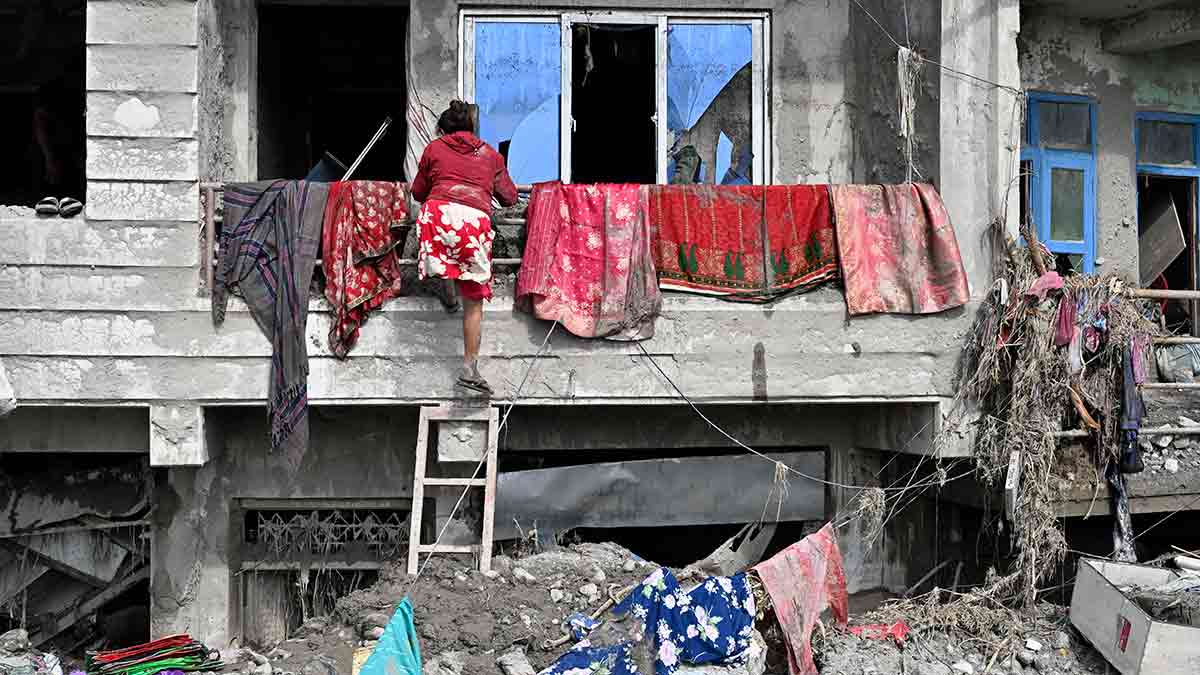
A 24-year-old friend of mine from Rasuwa, living alone in Kathmandu for his higher studies, is among the many who have lost their entire families to this catastrophe. He keeps calling home, again and again, hoping against hope that someone will answer—his mother, his father, his younger sister. But there is no response from the other end.

Yet he continues to call, because when everything else has been taken away, hope is sometimes the only thing left to hold on to.
His story is one among thousands. Across Nepal, families are searching for loved ones, waiting for news and trying to comprehend losses too immense to put into words. For some, homes and livelihoods have disappeared. For others, entire families have been wiped away within hours.
On August 26, Nepal was served a devastating reminder of what the climate crisis looks like when it reaches the high Himalayas. The country is already confronting floods, landslides, extreme rainfall, droughts, glacier retreat, glacial-lake risks and increasingly unpredictable weather.
Yet Nepal has contributed little to the global climate crisis. At the same time, it continues to protect a natural system that benefits the entire world. According to official figures, 46.08 per cent of Nepal’s land area is covered by forests. These forests are not merely a national asset; they support carbon sequestration, biodiversity, water security and ecosystems far beyond Nepal’s borders.
The warning from the Himalayas is becoming impossible to ignore. On March 18, the International Centre for Integrated Mountain Development reported that glaciers across the Hindu Kush Himalaya were losing ice at an accelerating rate, with the rate of this loss having doubled since 2000. The region provides water to nearly two billion people.
This is not a distant future. It is happening now. And when climate change turns into disaster, ordinary people pay the price first.
Women, children, older people, persons with disabilities and communities living in poverty are particularly vulnerable. When floods destroy homes, women can lose livelihoods, documents and access to health care. When roads disappear, pregnant women may be unable to reach hospitals. Displacement also increases the risks of gender-based violence, exploitation and trafficking.
Climate justice is therefore also gender justice. We cannot speak about resilience without asking whose safety and dignity are being protected—and who is being left behind.
Nepal has already been doing its part. Its climate commitments continue to expand, and it submitted its NDC 3.0 (Nationally Determined Contributions) to the UNFCCC (United Nations Framework Convention on Climate Change) in May 2025. But adaptation has a cost: early-warning systems, glacier monitoring, resilient roads and bridges, safe housing, schools and hospitals, disaster preparedness and livelihood recovery all require money.
So, we must ask a fundamental question: Who will pay for the consequences of a crisis Nepal did little to create?
Our demand is not charity. It is climate justice.
Nepal needs meaningful and accessible climate finance, predictable loss-and-damage support, technology and scientific expertise, stronger early-warning systems, climate-resilient infrastructure and international cooperation for glacier monitoring and Himalayan research. Most important, climate finance must reach communities, women, young people and local organisations. It must not remain confined to governments and large projects.
For decades, vulnerable countries like Nepal have been told to become more resilient. But resilience cannot become an excuse for those responsible for the bulk of historical emissions to continue emitting while others are simply told to adapt.
We cannot adapt our way out of injustice.
Nepal did not create this crisis. But Nepal is living through it. Our mountains are changing, glaciers are retreating, rivers are becoming more dangerous and communities are losing their homes and loved ones.
So, when the world looks at Nepal, do not look at us only with sympathy. Look at us with responsibility. Look at the Himalayas and listen to their warning. Look at the families waiting for answers and understand the human cost of climate vulnerability.
This is not a favour. This is justice. And Nepal deserves it.
The writer is a gender and environmental activist; she is founder and chairperson of Mission Smile Nepal.
