



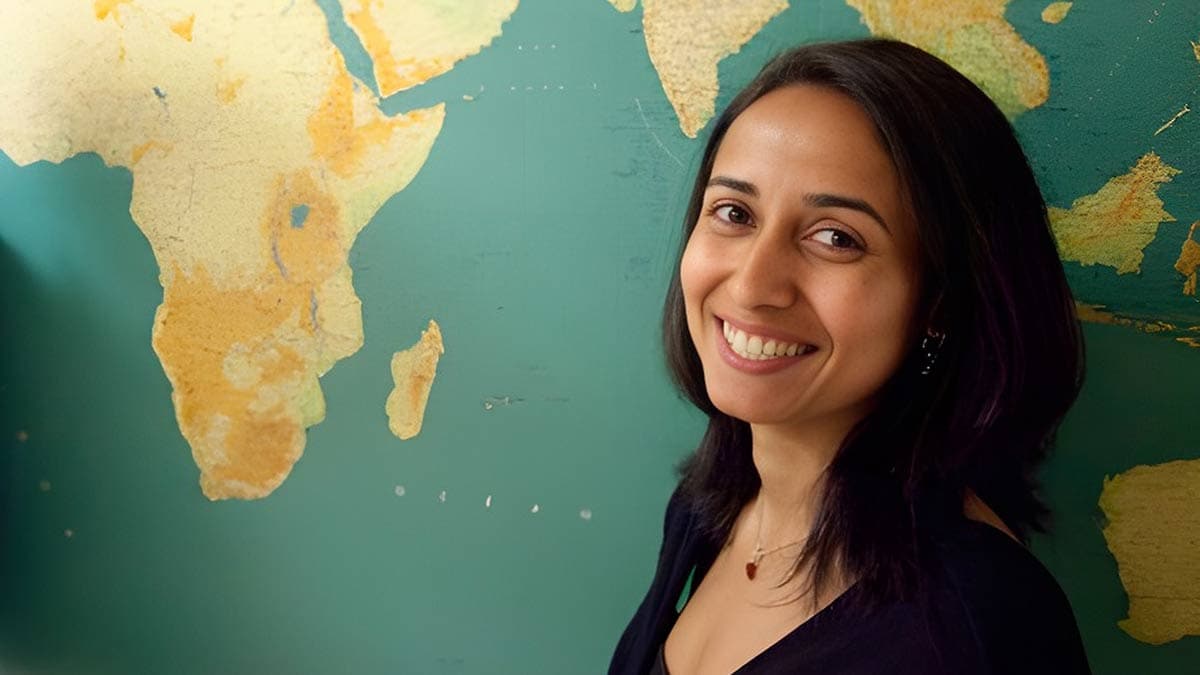
Interview/ Priya Moorjani, University of California, Berkeley
Q/ Your lab works at the intersection of genetics, statistics and history. What questions are you currently focused on, and how do you move from raw data to historical conclusions?
We are interested in understanding when and how populations mixed, how mutation and recombination processes have changed over time and how archaic ancestry persists in modern genomes. Moving from raw data to history involves building statistical models that connect patterns in genetic variation, at a genome-wide and local scale, to demographic events and validating these models using simulations and multiple independent lines of evidence.
Q/ Ancient DNA work in south Asia has been limited compared to Europe. What are the practical and scientific challenges?
The biggest practical challenge is DNA preservation. Hot and tropical climates lead to rapid degradation of DNA, making it difficult to recover ancient genetic material. As a result, we have fewer samples across time, which leaves many questions about the population history of the region still unresolved.
Q/ Your studies have estimated when different Indian populations got mixed. How did you arrive at that timeline, and how was it received?
We used correlations between genetic variants across the genome to infer the timing. These patterns decay over generations as recombination occurs, which allows us to estimate when mixing occurred. The findings were surprising because they showed that widespread mixture occurred relatively recently, followed by a shift toward endogamy. The work generated significant interest, both within genetics and more broadly.
Q/ Your work shows a shift towards strong endogamy after this period. Genetics can detect when mixing was reduced, but can it explain why this shift happened?
Genetics is very powerful for identifying when changes occurred, but it is less direct in explaining why. The shift towards endogamy likely reflects demographic and cultural changes, such as the de-urbanisation of the Indus civilisation, large-scale migrations across the Gangetic Plain and the establishment of stricter marriage practices. But interpreting these requires integrating genetic evidence with historical, archaeological and linguistic data.
Q/ How do you interpret the Rakhigarhi findings?
The Rakhigarhi genome provides an important snapshot of the Harappan civilization and shows no detectable steppe-related ancestry at that time. This suggests that steppe ancestry entered south Asia later, consistent with other lines of genetic evidence. However, the sample has very limited coverage, and we need higher quality and more ancient genomes from India and other regions, like central Asia and Iran across time periods, to fully understand the population history of the subcontinent.
Q/ One of your recent studies based on around 2,700 whole genome sequences explored both population history and diseases. What are the key findings?
These data provide a fine-scale view of population structure across the past 50,000 years of evolutionary history of India and highlight the impact of population mixture and founder events on genetic diversity of present-day individuals. Specifically, they allowed us to reconstruct multiple layers of ancestry and to study how founder events have shaped patterns of variation. Overall, these results highlight how deeply population history is intertwined with present-day genetic diversity and health in India.
Q/ What do your findings suggest about Neanderthal and Denisovan ancestry in Indian populations and their impact today?
Like other non-African populations, Indians carry Neanderthal ancestry, and they also harbour Denisovan ancestry. While each individual carries amounts of archaic ancestry comparable to those of other Eurasian populations, the extensive diversity across India means that, cumulatively, we can recover a substantially larger fraction of both Neanderthal and Denisovan genomes from present-day Indian populations. Most of these archaic segments are neutral or weakly deleterious, but a subset has contributed to traits related to immunity and adaptation. Studying these segments can provide insights into both evolutionary history and present-day biology.
Q/ Research on Indian population history often enters political and cultural debates. Has this affected how you communicate your findings?
Yes, we always try to be careful to clearly communicate what the data can and cannot support, while also emphasising the uncertainties inherent in our inferences.
Q/ What is one ancient DNA study in south Asia that you think is essential but has not yet been done, and why?
A systematic time series of ancient genomes spanning the past 50,000 years would be transformative. There are many important periods, such as the initial peopling of the subcontinent, the populations present before and during the arrival of modern humans and the spread of Neolithic farming and the Indus Valley Civilisation. Such data would allow us to directly track how ancestry components changed over time and would help resolve many open questions about migration, interaction and social structure in south Asia.
