



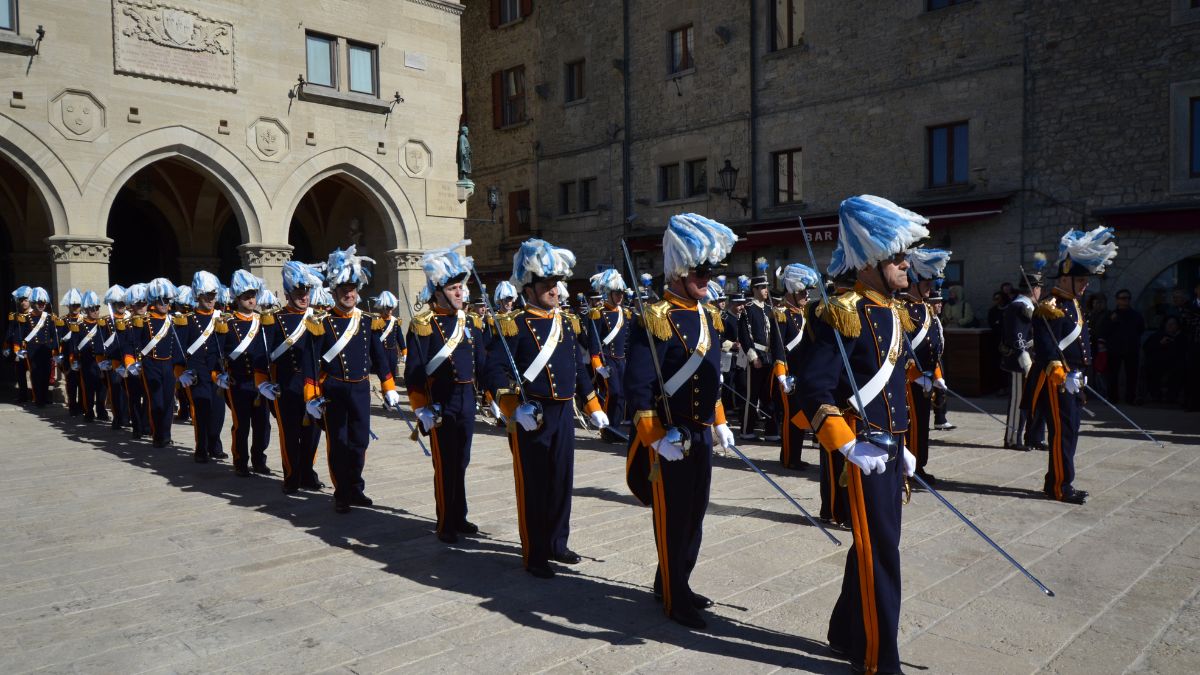
In San Marino, the medieval towers still stand guard, the stone streets remain unchanged, and the old parliamentary rituals continue with almost theatrical precision. Only the ideology has evolved.
There is a deep irony in San Marino's story. Founded in CE 301, it is the world's oldest surviving republic. Yet this ancient sanctuary also became western Europe's most unlikely communist experiment. In 1945, San Marino elected one of the world's earliest communist-led governments, 12 years before Kerala elected a communist government in 1957.
Before Kerala and San Marino, there was British Guiana. In 1953, Cheddi Jagan, a dentist of Indian origin, led a victory in British Guiana, which should have been a democratic milestone. Instead, British troops dissolved his government just 133 days later.
San Marino's communist chapter survived. Kerala’s became legend. British Guiana's was nearly erased.
San Marino is a geographical anomaly: a 61-square-kilometre sovereign republic entirely surrounded by Italy. With a population of barely 34,000, and roughly half the size of Chandigarh, it feels less like a modern nation-state and more like a kingdom lifted from a Disney storyboard.
To reach the capital, one must ascend. A cable car climbs towards Mount Titano, where three medieval towers, Guaita, Cesta and Montale, still guard the republic. I chose the winding hairpin bends and took a lift to enter San Marino. Soldiers in bright green-and-red uniforms look as though they belong in the hand-drawn cels of Sleeping Beauty rather than in a standing army.
In San Marino, even the aesthetics of the left feel refined. There are no smoky tea stalls, only elegant restaurants beneath white awnings where the only visible "red" is the local wine. Waiting for me were Michele Muratori and Gerardo Giovagnoli, two senior leaders from San Marino's ruling coalition.
Muratori, a former captain regent (head of state), now heads the parliamentary group of the Libera Party. Giovagnoli, national secretary of the Socialist and Democratic Party, serves in the parliamentary assembly of the Council of Europe.
"Splits, mergers, name changes," Gerardo said, smiling over a glass of wine. "Two parties still claim communist heritage. But the word 'communist' no longer exists in their names."
In one respect, San Marino practises complete socialism: Wi-Fi is free everywhere. Connected to it, I sat among shops selling ceramic art, rare coins, leather goods and perfumes, trying to untangle the ideological genealogy of the Sammarinese left.
The original Sammarinese Communist Party (PCS) was founded in 1921, the same year the Malabar Rebellion reshaped Kerala. But while the Sino-Soviet split fractured the Indian left, San Marino's communists were transformed by the collapse of the Soviet Union itself. Perestroika, glasnost and the fall of the Berlin Wall pushed the party away from Marxism-Leninism. It renamed itself, fragmented, merged, split again and slowly evolved into softer social democratic formations.
The hammer and sickle faded. The welfare instinct survived.
"Not the name," Muratori told me, "but parts of the ideology remain, less rigid now, less Soviet."
San Marino's early left governments prioritised worker welfare, cooperatives and social security. Yet perhaps the most fascinating aspect of its communist experiment was this: it unfolded inside one of the world's oldest anti-authoritarian constitutional systems. No ruler could hold power for long. The captains regent served only six-month terms, a medieval safeguard against political strongmen centuries before modern democracies invented checks and balances.
The parallels with Kerala become most striking in the story of how these governments were challenged. Kerala remembers the ‘Vimochana Samaram’ (liberation struggle) of 1958–59, when the Church, the Nair Service Society, the opposition and the Union government united against the communist government. Like many anti-communist movements of the Cold War era, the Vimochana Samaram and the 1957 Fatti di Rovereta in San Marino unfolded amidst persistent speculation about western involvement. Italy and the United States backed anti-communist forces inside the republic.
After Soviet tanks crushed the Hungarian Revolution in 1956, anti-communist sentiment surged across Europe. Eventually, a splinter faction formed a parallel government with Italian backing. Unlike many Cold War confrontations, however, San Marino's "liberation struggle" ended without bloodshed.
"So did the communists ever return?" I asked.
Gerardo smiled. "In San Marino, we eventually did something unusual. The 'Father', once guided by Moscow (the communists), and the 'Mother', nurtured by the west (the Christian Democrats), eventually learned to govern together." That single sentence explained decades of European political pragmatism better than any textbook.
As my friends left, I stood alone, watching the light fade from the ancient stones. The banners may be gone and the names may have changed, but the instinct to look after one another, the 'welfare instinct', remains. It is as permanent as the limestone of Mount Titano.
