



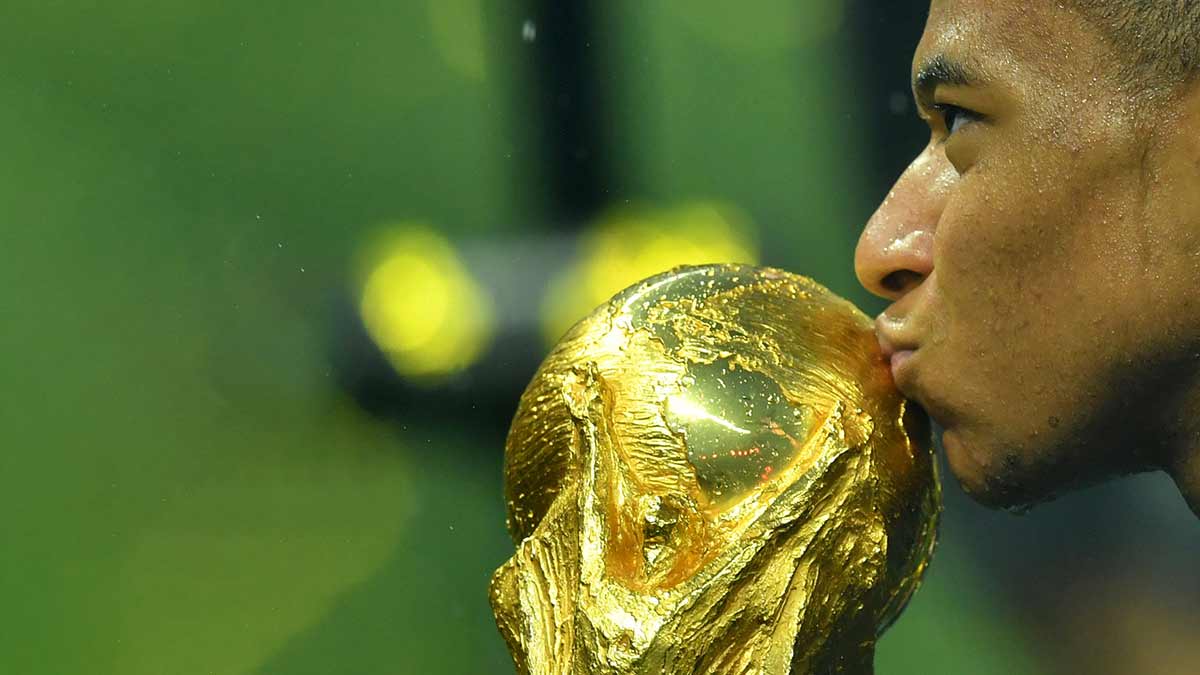
This story will not be printed in blue. It doesn’t matter, because readers can decipher its hue. And the true script of this tale is being written by a young man in blue, Kylian Mbappe.
I have been following the Les Bleus script for decades—40 years, to be precise. In the rainy nights of 1986, telecasts looked like strands of rain falling across black-and-white screens, but I can still recall the glistening faces of Diego Maradona, Socrates, Zico, Enzo Scifo, Preben Elkjaer Larsen and, of course, Michel Platini. Only in the quarterfinals did I realise that Platini’s team wore blue—as World Cup fever peaked, my uncle had bought a colour TV.
Platini—hair dishevelled, shirt untucked—looked more composed than any other captain at Mexico 1986. Seven or eight of the starters in that French side were over 30. In the midfield now immortalised as Le Carre Magique (The Magic Square)—Platini, Jean Tigana, Alain Giresse and Luis Fernandez—all but Fernandez were over 32.
The first World Cup match I watched in colour was the France-Brazil quarterfinal. My heart was with Brazil. The affection for that team—Zico, Socrates, Careca—had bloomed years before. It was a thrilling match, an end-to-end classic. France beat Brazil on penalties, and then lost to West Germany in the semifinals. But the men in blue had lodged themselves in my mind.

Twelve years later, when I went to cover my first World Cup for the Malayala Manorama, a residual affection for Platini’s team lingered. The French stadiums seemed like cathedrals erected for a new religion. The team, managed by Aime Jacquet, was described as ‘Black, Blanc (white), Beur (Arab)’—multicultural in a rousing way. They never lost the discipline of Platini’s France, and added to it the fierce fire of a new generation. It was a revolution. The central figure was Zinedine Zidane, son of Algerian immigrants, rewriting the language of the game.
A few days before the semifinals, I went to La Castellane, the Marseilles suburb where Zidane grew up. It was not purely a journalist’s search for a story angle. The primary draw was Marseilles itself. The city had captured my imagination through the Tarzan stories. Zidane’s modest apartment was in a working-class area. The family had gone to Paris. One of the neighbours said: “Zizou is calm. He doesn’t usually fall for provocations. But if he is truly provoked... he becomes a devil.” I remembered the neighbour as I watched Zidane flatten Marco Materazzi with a headbutt in the 2006 World Cup final.
In the 1998 final on July 12, France were facing favourites Brazil, their ‘O Fenomeno’ having taken the tournament by storm. But Ronaldo was not in the list of players we got at the Stade de France. Thirty minutes later, volunteers in the media box collected the start list from our tables and disappeared. Brazilian reporters then got word that Ronaldo had told the coach ‘okay’ just 40 minutes before kickoff.
What Brazil had tried to hide came out later. After lunch, Ronaldo, not yet 22, sat in his room and wept, unable to bear the weight of expectation. Roberto Carlos, his roommate, tried to get him to sleep. Around 4pm, five hours before kickoff, Brazil’s superstar suffered a seizure. Carlos screamed for help. Edmundo and Cesar Sampaio were the first to arrive and the latter administered first aid. Ronaldo was then taken to hospital. Specialist examination found no specific cause. He was sedated and came round an hour later.
Ronaldo finally took the field as a pale shadow of his glorious self, but the night belonged to Zidane, who leapt twice to head in goals and adorn France’s cockerel with its first World Cup star.
Some journalists say it was the start of the Zidane era. My view is different. France’s golden generation had been lacing its boots for glory at least a few years before that night. Flair, leadership and defensive steel were that generation’s assets. Lilian Thuram, Marcel Desailly, Patrick Vieira, Claude Makelele and David Trezeguet in leading roles, with Zidane as the conductor. Their football was fluid, technical, authoritative—a creative midfield fused with a solid defence and a clinical attack. The formation was often 4-4-2. The results: the 1998 World Cup, Euro 2000, the World Cup 2006 final.
The headbutt and the defeat in 2006 triggered the golden generation’s collective exit. The French press mourned a post-Zidane decline. Indeed, the immediate aftermath saw internal feuds, inconsistent performances and struggle to qualify for major tournaments. Before the 2010 World Cup, a player strike followed coach Raymond Domenech’s leadership failure.
It was time for a complete overhaul. Thankfully, Zidane’s generation had left behind a blueprint of excellence. It seeded the next golden generation.
The regeneration after the 2010 ‘mutiny’ was the most impressive turnaround in modern football. The French football federation did not reach for a quick fix. They committed to a long-term programme. Laurent Blanc—‘Le President’, a key presence in Zidane’s world-champion squad—took charge. Restoring discipline and trust was the first objective; rebuilding the squad came second. Collective responsibility was of paramount importance.
The federation identified the ‘banlieues’ (suburbs) as the richest seam of talent. Pools of children with African, North African, Caribbean and European heritage were already forming there. The French system actively embraced that diversity as a necessity. Even as the Clairefontaine National Academy and regional centres kept churning out talent, the federation adopted one coaching philosophy for all academies—technical quality, tactical intelligence and mental resilience. Coordination between academies, clubs and the federation improved. These investments began to pay dividends around 2013-15. The depth they gave French football is seen in these names: Paul Pogba, Antoine Griezmann, Raphael Varane, N’Golo Kante. The talent pool had regenerated, and everyone noticed.
Didier Deschamps, who had captained the 1998 team, had taken charge in July 2012. His priorities: character and collective responsibility over individual ego; experience and youth together, with no special precedence for seniors; mental strength across the squad; long-term plans only. The 2014 World Cup was not the target, but they still reached the quarterfinals. This was followed by the Euro 2016 final.
In the 2018 World Cup, the average age of the French squad was 26. The 4-4-2 was given prominence, or, a basic 4-3-3. Simple. Predictable. Mid-block defending, quick ball recovery, counterattacks. Individual talent relied upon only in crisis. Defensive foundations first. Critics pointed to lack of creativity. Deschamps paid no heed. Gradually, the system acquired a name: the Deschamps DNA.
From 4-4-2, 4-2-3-1 evolved. Counterattacks required not just speed but asymmetry—the left and right sides behaving differently, but in an organised fashion. Blaise Matuidi in a hybrid winger-midfielder role on the left created space on the right for Mbappe. Olivier Giroud’s hold-up play drew defenders to open space for Griezmann and Mbappe.
After the 1998 final, I experienced the roar of the Blue Army on July 15, 2018, at Luzhniki Stadium in Moscow. Even on the ride from the Yugo-Zapadnaya Metro Station to the ground, chants of “Allez Les Bleus” rang through the air. When Pogba, Griezmann and Giroud combined, France took the lead. Croatia refused to yield. France led at half-time, 2-1. In the 65th minute, the ball fell to the 19-year-old Mbappe’s feet just outside the Croatian box. First touch, second touch, then a bullet into the far corner. France led 3-1. Luzhniki exploded. The first goal by a teenager in a World Cup final since Edson Arantes do Nascimento aka Pele. Croatia pulled one back, but that night had already become France’s. The cameras showed Deschamps thanking the heavens. The eyes of time were focused on the future, on Mbappe.
Football analysts were not ready to give Mbappe full credit—and for good reason. Giroud was the focal point. Supply Giroud to unleash Mbappe was the coach’s central strategy. Pogba threaded irresistible passes into Mbappe’s path. The balanced, compact, well-drilled, counterattacking team maximised Mbappe’s explosive qualities while maintaining defensive discipline. His emergence as a world-class talent was the standout story of Russia 2018.
In Qatar 2022, Mbappe was the undisputed star, while Griezmann dropped deeper as the true link man. France reached the final despite losing to Tunisia in the group stages. Mbappe scored against Australia (4-1), two against Denmark (2-1), and two more against Poland in the round of 16 (3-1). He drew blank against England in the quarterfinal and Morocco in the semifinal.
In the final, Argentina dominated the first half. Lionel Messi’s penalty and Angel Di Maria’s counterattack goal gave them a 2-0 lead. France did not have a shot on target. Possession was at 41 per cent. Griezmann was shackled, the full-backs exposed, Giroud and Mbappe isolated. France trudged to the dressing room in dejection. The coach had already made a double substitution before half-time—Giroud and Ousmane Dembele made way for Randal Kolo Muani and Marcus Thuram in the 41st minute. The idea was more athleticism, physicality and directness to stretch Argentina. And, more pressing and creative transitions.
When Deschamps reached the dressing room, he banged his fist on the table: “Do you know the difference between them and us? They are playing a f***ing World Cup final and we are not playing in it!”
He said nothing further. But Mbappe, who had thrown off his shirt, stood up and spoke. “It’s the World Cup final, guys, it’s the match of our lives! We can’t do any worse than how we played. We are two goals down. We can come back! Either we let them play us like idiots or we get stuck in, put some intensity in our duels and change things.” Senior players, including captain Hugo Lloris, were silent. The documentary Merci Les Bleus gave the world these images. Nobody had asked Mbappe to speak. Deschamps paced the room. But, he, too, was listening.
Deschamps is not a dictatorial coach. He prefers collective leadership and player ownership. He sets direction, makes big decisions like tactics and subs, and empowers senior players to take responsibility. He gave Mbappe silent permission to speak. The attacker had emerged as an on-pitch leader, alongside Lloris. Deschamps understood that his words would carry weight.
In the second half, the tactical changes were deliberate and courageous. Everything France could give to support Mbappe, they gave. And he delivered, scoring twice in regulation time. After Messi put Argentina ahead in extra time, Mbappe equalised in the 118th minute to complete the first hat-trick in a final since Geoff Hurst’s in 1966. Kolo Muani, who had done his job satisfactorily till then, ended up missing a last-gasp one-on-one with Argentina’s keeper Emiliano Martinez. And, French dreams were shattered in the cruelty of the shootout.
On February 26, 2020, The Players’ Tribune published a letter by Mbappe. He was 21. It was addressed to “the young Kylians”: “To the kids in Bondy, to the kids in Ile-de-France, to the kids in the ‘banlieues’, I want to tell you a story. It will probably not surprise you that it’s about football. With me, everything is about football.... In Bondy, in the 93 [Seine-Saint-Denis, department number 93], in the ‘banlieues’, maybe there is not a lot of money, it’s true. But we are dreamers. We’re born that way, I think.... We are France. You are France. We are the crazy dreamers. And lucky for us, dreaming doesn’t cost very much.”
At a time when French society is torn by sharp debate about identity and rights in the city outskirts, Mbappe spoke to children with truths that carry no added sugar, yet no bitterness either. He did not proclaim that those from the outskirts have a bright future and that he is its proof. He tells children to dream and not to place a full stop on that dream. And that dreaming costs nothing.
After the 2022 final, Mbappe said: “Argentina deserved to win. From the beginning to the end of the match, they were the better side.” For France’s hat-trick hero, ecstasy and agony were compressed into 120 minutes. He wept and apologised to his family for letting them down. A few hours later, he posted: “Nous reviendrons (We will be back)”.
The Boy from Bondy has always looked back at the roads he has travelled—family, neighbours, surroundings, culture. There is a sense of belonging. He must regard those words as a promise—including to the kids who were not born then.
Now, leading France into the 2026 World Cup as captain, he says: “It’s different now. It’s a different responsibility. But I’m ready for that. I’m ready to lead my team to the biggest stage again.”
The national team has for decades been a mirror to French nationhood. That reflection is not always a soothing sight. When a son of the ‘banlieues’ marches to the World Cup as captain, nobody will deny his contribution to a victory. But ‘banlieues’ realities will not be discussed as a factor either. What if the team loses? There are people who dislike Mbappe’s engagement with French society since taking on the captaincy. He has spoken out against the far right, urged young people not to turn away from the right to vote, and argued that athletes should not confine themselves to sport.
He is a different kind of captain—entirely unlike his predecessor Lloris. This captain likes to speak, but is emphatic it must not produce unnecessary noise. Like a shot in the penalty area, it must find its mark. At Euro 2024, he led the team with a broken nose, managing only one goal from the penalty spot. France lost in the semifinals. Difficulties adjusting to Real Madrid were well documented. But positive signs have emerged—motivating interventions before Nations League fixtures, rallying teammates through penalty shootouts, and praise from the coach for his ability to bridge the squad’s youngest and most experienced players. He is showing maturity and accountability. His work rate and intensity in key moments set high standards. His charisma is undeniable. So are his instincts.
As England boss Thomas Tuchel, who was then managing Mbappe at Paris Saint-Germain, put it in 2021: “On the pitch, he’s a shark. That is what the big guys are. If there is one drop of blood in the water, they arrive.”
His weakness, as per 1998 World Cup winner Frank Leboeuf, is that he is “too selfish in his thoughts”. Euro 2024 remains on the record. The argument that the freedom granted to Mbappe adversely affects other attackers is live. Critics add that even minor dips in his form will damage team confidence.
The key questions the 2026 World Cup raises are: can Mbappe elevate the team even if he is not scoring? Can the captain instil unity? Can he peak physically and mentally across the tournament?
Mbappe’s World Cup record is enviable—four goals in 2018, eight in 2022. In statistical terms, he occupies the territory of Pele. But football history marks out its greats not by goals, but by trophies. Mbappe has not won the Champions League—neither PSG nor Real Madrid has managed it with him. The Ballon d’Or has not come either, despite consistent individual performances—he has scored 40 goals or more in five of his last six seasons. Messi and Cristiano Ronaldo conquered the football world on the strength of club achievements more than national team glory. Mbappe’s brilliance, in its current state, is an island. If France win this World Cup, he wins not just a trophy but the entire world.
The weight of expectation is frightening, arguably greater than what Ronaldo faced in 1998. France can rightly claim to be the most consistent high-level performer of the last decade, despite winning only one of the five major tournaments of the decade. But the dominance of Zidane’s France in 1998-2000 or Spain’s in 2008-2012, remains out of grasp. Football history tends to forget near-misses.
We are still within the script being written in blue. Mbappe has said it already—‘nous reviendrons’. If defeat in yet another final is the result, restrained critics might say this about France: an impressive but slightly frustrating era of high expectations and respectable returns.
