



Majuli, with the mighty Brahmaputra on the one side and the rough Subansiri on the other, is the world’s largest inhabited river island. It is also the cradle of Assam’s culture, where the saint-reformer Srimanta Sankardev established monasteries to nurture the neo-Vaishnavite movement.
The children of Majuli were among the first to call Himanta Biswa Sarma ‘Mama’ (maternal uncle). “It went viral. Now, regardless of age, everyone calls him Mama. You can even see elderly women addressing him that way. It was even a question on Amitabh Bachchan’s quiz show,” said a local man.
Even though it is not included under the Sixth Schedule of the Constitution, outsiders are not allowed to buy land in Majuli. This decision was taken by Sarma’s government to protect the island’s cultural heritage. Broadly, it was meant to prevent demographic changes, one of the key election issues in Assam and the central plank of Sarma’s political narrative.
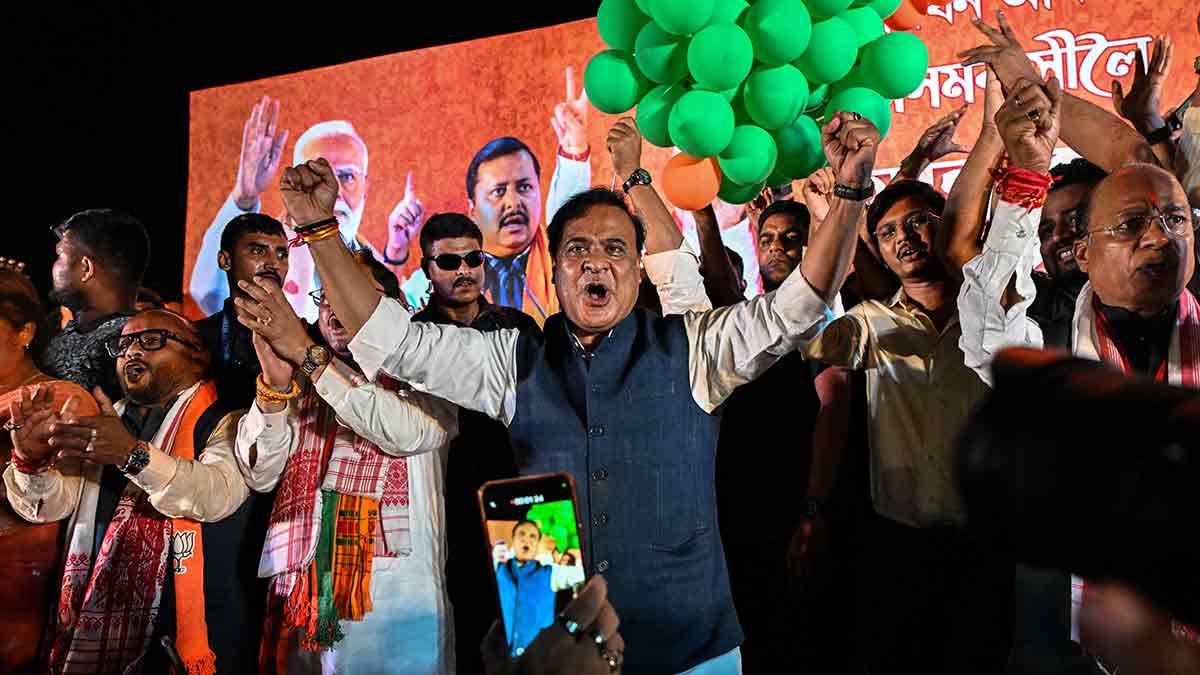
Sarma popularised ‘Mama politics’ in Assam—a mix of affection and authority. This approach helped the BJP-led NDA win 102 seats in the 126-member assembly, the highest in the history of the state. The BJP alone has two-thirds majority, while the opposition Congress was reduced from 29 to 19 seats and the AIUDF from 16 to 2.
The election outcome is an endorsement of Sarma’s political narrative, one that might have had implications in neighbouring West Bengal, where the BJP scored a thumping victory against Mamata Banerjee’s Trinamool Congress, as well.
Four main factors worked in the BJP’s favour in Assam: its stance on the Bengali-speaking ‘Miya’ Muslims (often accused by the party as infiltrators from Bangladesh), its development initiatives, the welfare schemes, and the perception that the BJP is protecting Assam’s indigenous culture.
Sarma had sparked controversy on several occasions over his posturing, with intellectuals like Hiren Gohain approaching the Supreme Court seeking action over alleged inflammatory remarks against Bengali-speaking Muslims. The Congress had alleged that Sarma and his family amassed wealth and that his wife held multiple passports. According to Sarma, these accusations created a public perception that Congress was targeting “Assam’s daughter”, which helped in its election victory alongside the opposition alliance’s politicisation of the death of singer Zubeen Garg.
Gaurav Gogoi, the Congress’s deputy leader in the Lok Sabha as well as the party’s state president, suffered a humiliating defeat in the Jorhat constituency. Though the opposition has broadly alleged vote theft, Gogoi accepted the defeat. The loss has placed the Congress in an existential crisis—the party risks being perceived as primarily a Muslim party. Of the 19 Congress MLAs, 18 are Muslims, and the other won from an ST-reserved seat in a minority-dominated area.
To counter the narrative that it has become another ‘Muslim League’, the Congress will need significant restructuring. Notably, the sons of three former chief ministers—Gaurav Gogoi (son of Tarun Gogoi), Debabrata Saikia (son of Hiteswar Saikia) and Diganta Barman (son of Bhumidhar Barman)—who contested as Congress candidates lost. Sarma described the results as a rejection of “blue-blood politics” and predicted that more senior Congress leaders would join the BJP.
Several senior Congress leaders like Lok Sabha member Pradyut Bordoloi and former state president Bhupen Kumar Borah had defected to the BJP before the elections. While critics portray the BJP in Assam as an ‘elite club’ of former Congress leaders, Sarma has been openly welcoming his former colleagues. Preventing further defections will be a significant challenge for Gogoi.
The Congress strategy to conquer Upper Assam by appeasing the Ahom community through alliances with Raijor Dal and Assam Jatiya Parishad ultimately failed. The alliance—led by three Gogois: Gaurav, Akhil and Lurinjyoti—did not resonate with voters. Voters largely aligned with the BJP’s broader ‘Sanatani’ narrative, placing less emphasis on internal sub-classifications. While Akhil retained his seat in Sivasagar, Lurinjyoti lost.
Raijor Dal has, however, doubled its seat count from one to two, and may grow further, with Sarma himself suggesting that it could become the principal opposition in future.
The AIUDF, founded by perfume baron Maulana Badruddin Ajmal and supported largely by Bengali-speaking Muslims, is in decline. As seen in the last Lok Sabha elections, a majority of its supporters shifted towards the Congress. Ajmal and senior leader Mazibur Rahman were the only winners for the party.
The BJP’s allies—the Asom Gana Parishad (AGP) and the Bodoland People’s Front (BPF)—secured 10 seats each. Interestingly, the AGP, which traces its origin to the anti-foreigner movement, fielded 13 Bengali-speaking Muslim candidates, but none won.
The BJP’s victory has implications beyond the state. Sarma has consistently advocated for stronger nationalist governance along the Bangladesh border to curb infiltration and cross-border smuggling. He has also emphasised the strategic importance of the Siliguri Corridor, often referred to as the Chicken’s Neck, in north Bengal. Eviction drives in Assam are expected to continue, and he is likely to advise his party’s new chief minister in Bengal, as both states share strategic boundaries.
In fact, Sarma’s political narrative has created an atmosphere reminiscent of the Assam Movement, fostering sentiments against 'Miyas' and consolidating a large section of Hindu, tribal and tea tribe votes that were earlier aligned with the Congress. Women voters have also largely shifted towards the BJP owing to beneficiary schemes.
The Congress faces a difficult road ahead. Rebuilding and sustaining the party will require both strategic patience and organisational transformation, as the political dynamics of the Brahmaputra valley continue to evolve—much like the river itself, unpredictable and constantly shifting its course.
