The heat is unforgiving, but in Pudukottai, the mood is festive. Drumbeats rise above the hum of a restless afternoon in this southern Tamil Nadu town as men and women sway, chant and clap in rhythm. “Ammanvin anbodu, Vijayabhaskar yendrum nammodu”—with the love of our Amma, Vijayabhaskar is always with us. At the centre of it all, AIADMK’s Viralimalai MLA and former health minister C. Vijayabhaskar leans into the moment. “Do you want scorching heat, or warmth under green trees?” he asks. The crowd roars back. Shawls in red, white and black whirl through the air.
A hundred kilometres to the south, in Kaarai village in Karaikudi constituency, the soundtrack shifts but the energy does not. Here, the sharp blast of whistles cuts through the steady thud of war drums. Dr T.K. Prabhu’s campaign is thick with young faces. “The DMK has deceived us. It is an evil force. Vote for the whistle to throw them out,” he says, hands folded. A dentist who runs a hospital in Karaikudi, he is contesting on behalf of actor Vijay’s Tamilaga Vettri Kazhagam. He is up against the incumbent S. Mangudi of the Congress, Amma Makkal Munnetra Kazhagam’s Therpogi Pandi and Seeman, chief coordinator of the Naam Tamilar Katchi. “This is a fight for change. People are looking for change,” says Prabhu, reminding voters of his party’s whistle symbol.
In Bodinayakkanur in Theni district, the script turns again. Three-time chief minister O. Panneerselvam now stands with the DMK, bringing with him a slice of the southern belt that once formed the AIADMK’s core. His presence lends the ruling party an unexpected advantage in a region where it has often struggled. “We all came from the DMK. It is our parent organisation, and we share the same ideologies and core principles,” says Panneerselvam.
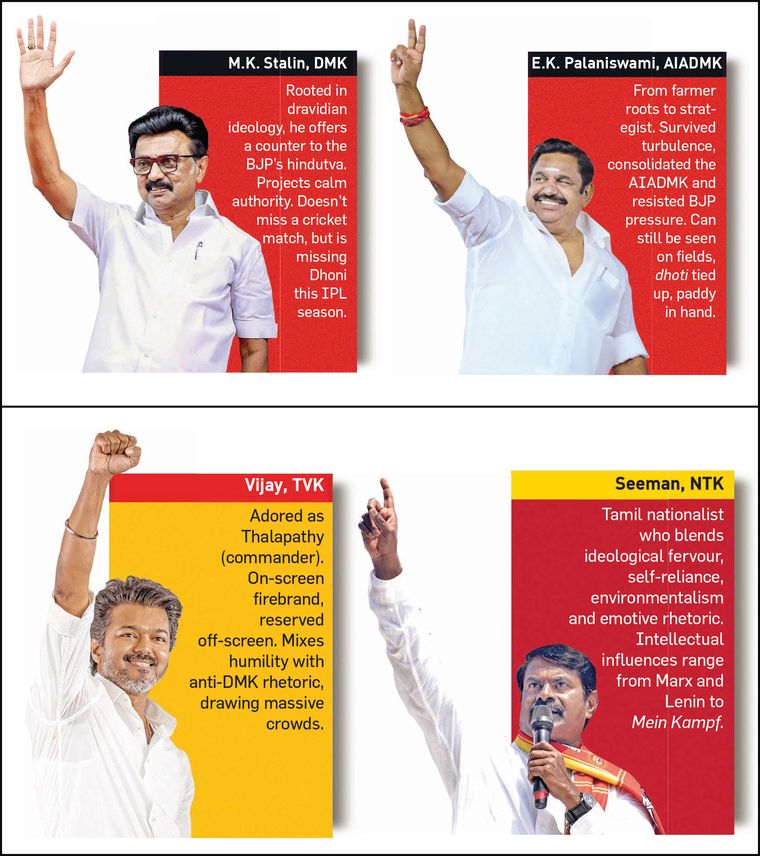
Taken together, these scattered scenes capture the mood of an election that refuses to follow a familiar script. Tamil Nadu is heading into one of its most unusual assembly contests—a four-cornered fight in which the old certainties of dravidian politics are being tested from multiple directions at once. The DMK seeks to retain power. The AIADMK is attempting a return. Seeman’s NTK and Vijay’s TVK are trying to convert popularity into votes.
A total of 5.57 crore voters will cast their ballots on April 23 to elect representatives to the 234-member assembly, with 4,621 candidates in the fray. But the arithmetic this time is less about simple swings and more about fragmentation. With votes split across four poles, margins may shrink and outcomes could hinge on small, local shifts.
For the DMK, this election is about more than a second term. Chief Minister M.K. Stalin is attempting what eluded his father, M. Karunanidhi: consecutive terms. He has framed the contest as one between Tamil Nadu and Delhi, between social justice and Central overreach, between state rights and administrative pressure. His campaign carries a confidence that borders on swagger, even as the party works to hold together a broad and sometimes unwieldy alliance. That confidence rests on welfare delivery, the branding of the “dravidian model” and the belief that anti-BJP sentiment still provides a protective umbrella across much of the state.
“The BJP, which betrayed Tamil Nadu by not fulfilling even one hallmark project, is trying to enter the state using the slave AIADMK and the NDA banner,” says Stalin in an exclusive interview. “Because the BJP continuously attacks Tamil Nadu’s financial, linguistic, educational, cultural and political rights, we call this election ‘Tamil Nadu vs Delhi’. In this battle between Tamil culture and BJP’s fascism, Tamil Nadu will fight. Tamil Nadu will win.”
Yet the DMK carries the weight of incumbency—allegations of corruption, complaints over law and order and the familiar fatigue that comes with power. Across constituencies, the opposition is attempting to turn local grievances into a referendum on what it calls arrogance.
Still, the ruling party appears confident that opposition anger is louder on stage than at the ballot box. In Tiruchirappalli West, for instance, minister K.N. Nehru remains confident despite Enforcement Directorate scrutiny over cash-for-jobs and tender scandals. The DMK expects Nehru’s development record and long career to blunt the sting of the allegations. In Athoor in Dindigul district, minister I. Periyasamy is seen so entrenched that rivals are struggling even to make the election appear competitive. Meanwhile, the party has shifted its strongman and former minister V. Senthil Balaji, who is battling multiple ED cases, from Karur to Coimbatore South. He has been tasked with winning at least 35 constituencies in west Tamil Nadu or the Kongu region for the DMK, where it performed poorly in the 2021 elections.
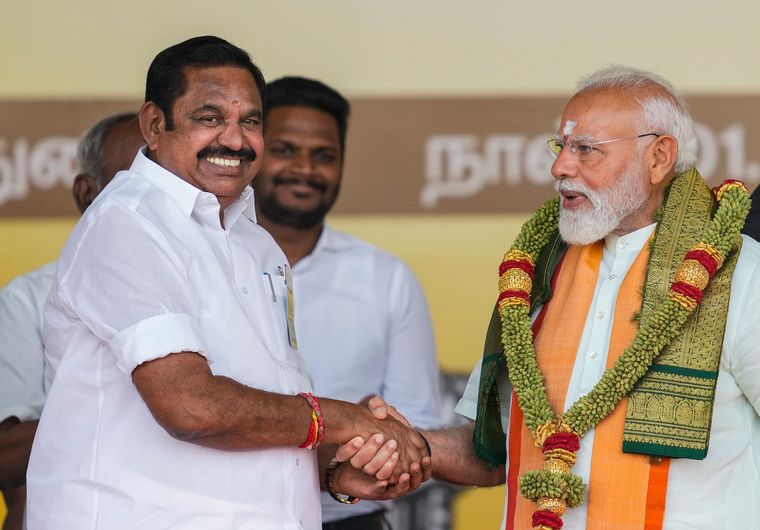 Stronger together: Prime Minister Narendra Modi with AIADMK leader Edappadi K. Palaniswami at a campaign event in Madurai | PTI
For the AIADMK, it is a fight to prove that Edappadi K. Palaniswami can lead the party back to power. After years of internal squabbles, defections, rival claimants to Jayalalithaa’s memory and the long shadow of Delhi over regional calculations, the party is asking voters to see it once again as the natural vessel of anti-DMK sentiment. The strategy is straightforward: turn this election into a verdict on the DMK government, tap local dissatisfaction and stitch together caste arithmetic, booth structure and alliance transfer. The party has backed Election Commission moves such as the transfer of top state officials, and it continues to insist that the DMK is using both power and narrative to tilt the field. “There is anti-incumbency and people want to vote out Stalin and the DMK. They want our leader Palaniswami to bring back Amma’s rule,” says Vijayabhaskar.
But the AIADMK’s comeback script has too many editors. The BJP wants growth, not merely partnership. AMMK cadres in some pockets complain of neglect. AMMK leader T.T.V. Dhinakaran, who chose to return to the NDA fold on Union Home Minister Amit Shah’s instructions, has his own apprehensions. He is not canvassing for any of the AIADMK candidates. His campaign speeches attack Stalin, but do not praise Palaniswami. In Karaikudi, where one of Dhinakaran’s loyalists, Therpogi Pandi, is contesting, the AIADMK is not even working on the ground.
Meanwhile, the AIADMK’s former ally, the Desiya Murpokku Dravida Kazhagam, founded by the late Vijayakanth, has moved to the DMK alliance. “Palaniswami did not keep his promise. We were a loyal ally and we never spoke anything ill of him,” says DMDK general secretary Premalatha Vijayakanth. The DMDK today may be a diminished force, but in north Tamil Nadu, Vijayakanth loyalists and Naidu community votes are an added strength for the DMK alliance. The party is contesting 10 seats, and Premalatha hopes that the memory of her husband will still translate into votes.
For the BJP, Tamil Nadu remains both a challenge and an obsession. It knows that outright victory is unlikely, but a higher vote share, deeper booth presence and a stronger ideological footprint would itself count as strategic success. The party’s calculation is incremental: weaken the DMK’s monopoly over anti-Centre criticism, use alliance arithmetic to remain electorally relevant and position itself as the indispensable national link in a state that still resists it culturally.
BJP leaders have sharpened their attack on the DMK, branding it a family-run outfit and accusing it of manufacturing linguistic and federal confrontations for electoral gain. “Stalin says Tamil Nadu is out of control for Delhi. He should go to Delhi and see how Prime Minister Narendra Modi is governing the country when the entire world is going through a war-like situation,” says Tamilisai Soundararajan, former Telangana governor and BJP candidate from Mylapore. Mocking the DMK’s campaign pitch, she adds: “Stalin says their manifesto is the ‘superstar’ in this election. His schemes were not superstars, his government was not a superstar, his governance was not a superstar. And yet he calls his manifesto a superstar, despite not fulfilling most of the previous promises.”
The BJP has also trained its guns on Vijay, signalling that it views him as a passing celebrity presence. Union Minister Piyush Goyal dismissed him as lacking grounding in Tamil Nadu’s political culture. But that is where another key player, Seeman, begins to matter. Seeman remains, as ever, part ideologue, part protester and part electoral irritant. Positioning the Naam Tamilar Katchi as a Tamil nationalist alternative, he has attacked freebie politics and argued that both dravidian majors have exhausted themselves. Whether that converts into seats remains uncertain, but in a tight contest, committed vote pockets could make a difference.
Campaigning in Karaikudi, from where he is contesting, Seeman frames his bid in existential terms. “You are looking at a petty electoral victory. I am running towards political liberation. Every party began with the politics of rights, but has ended at the counter of political business,” he says.
Yet Karaikudi may not be easy terrain for Seeman. It is the home turf of former Union minister P. Chidambaram. In fact, it was Chidambaram and his son Karti who ensured that the Congress stayed in the DMK alliance. “Of course, I ironed out certain issues,” says Karti. “I do have good personal equations with people across many parties, particularly the DMK. I have worked with them for the past 30 years,” he says, as he steps out to campaign for the Congress candidate Mangudi.
Then there is V.K. Sasikala, refusing to fade into irrelevance. Her re-entry with a new party flag and an alignment with a faction linked to Pattali Makkal Katchi founder S. Ramadoss has added a layer of symbolic disruption. Campaigning in Rajapalayam in Virudhunagar district, she frames her effort less as a bid for victory and more as a political intervention. “I am seeking justice for the betrayal done to me. I am not trying to help or hurt anyone. People in the south know me as Amma’s aide,” she says, signalling her intent to cut into vote banks in the southern and delta regions.
The Ramadoss family feud has further complicated matters. The tussle between the patriarch and his son Anbumani over the PMK’s mango symbol has turned a once-disciplined outfit into a divided house. In northern districts such as Dharmapuri and Krishnagiri, this split could prove decisive. Anbumani’s wife, Sowmiya, contesting from Dharmapuri, has made women’s safety and alleged governance failures of the DMK her central plank.
Also Read
- The Chettinad gambit: Why Karaikudi is the litmus test for Tamil Nadu’s new political order
- DMK lashes out at Vijay's viral church prayer video before TVK's Trichy East campaign: 'Where were you when...'
- ‘The battle is between Tamil culture and BJP's fascism’: TN CM M.K. Stalin
- Tamil Nadu elections | Less is more? How Vijay is trying to make his absence speak
- How Vijay's TVK could reshape the DMK and AIADMK vote banks
- Tamil Nadu Elections: Can Palaniswami revive AIADMK's past glory?
Still, the principal challenge to the DMK remains anchored around Palaniswami. His campaign, initially subdued, has gained traction with sharper attacks on Deputy Chief Minister Udhayanidhi Stalin. His slogan, “save the people, reclaim Tamil Nadu”, has resonated particularly in the Kongu belt, the AIADMK’s traditional stronghold. Yet, as political analyst S. Ramu Manivannan notes, the AIADMK’s alliance with the BJP has diluted its cohesion. Internal divisions, the influence of Sasikala and Dhinakaran and mutual distrust within the coalition have weakened its electoral machinery.
Hovering over all this is Vijay and his TVK, the most persistent subplot of the election. His presence is not confined to constituencies where his party is strong; it travels through screens, conversations and crowd energy across rival camps. “That is the thing about celebrities in Tamil Nadu politics. It may not begin as structure, but it begins as atmosphere,” says Karti. Interestingly, the DMK leadership has largely avoided direct engagement with Vijay. Yet in Chennai, especially in Perambur and its neighbouring constituencies, the contest has taken on the contours of DMK versus TVK. Vijay’s supporters insist that youth and women are gravitating towards him, pointing to the scale of crowds at his rallies.
In the end, this is not just a four-cornered contest but a cluster of simultaneous battles. For Stalin, it is a test of permanence and legacy; for the AIADMK, a fight for recovery and relevance; for the BJP, an incremental push into a resistant political culture; and for Seeman, Sasikala and Ramadoss, proof that even smaller players can alter margins, disrupt equations and unsettle narratives.