



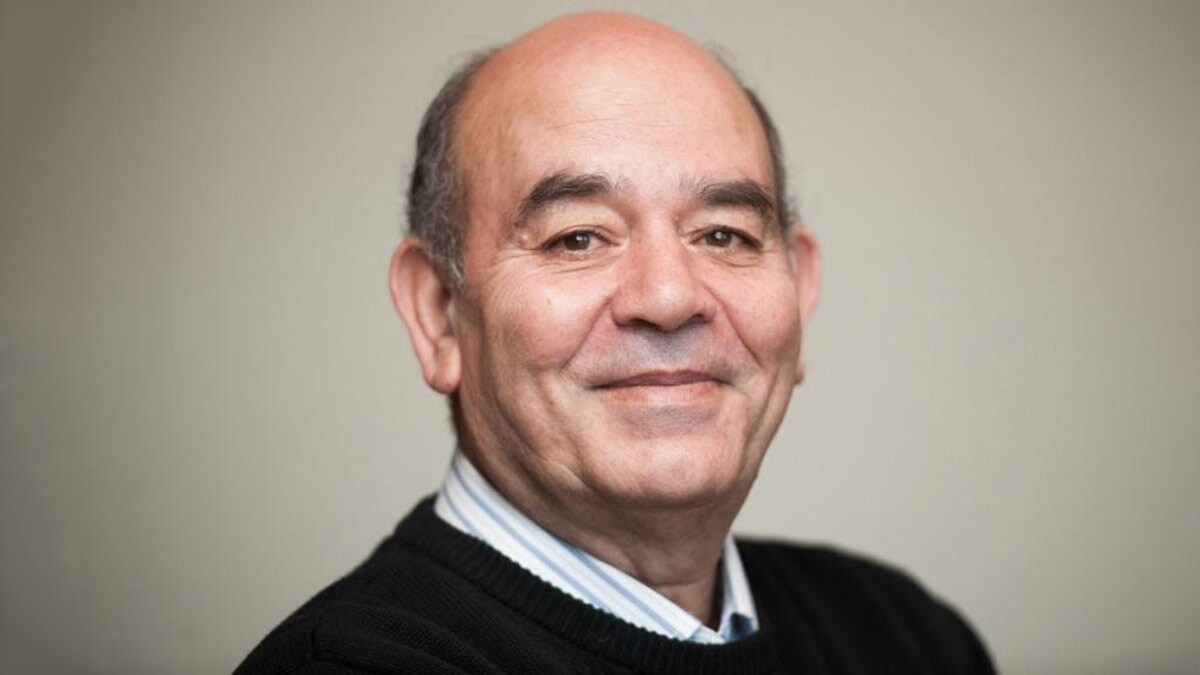
Interview/ Raji Sourani, director, Palestinian Centre for Human Rights
RAJI SOURANI, Gaza’s foremost human rights lawyer, is on a mission to present evidence before the International Court of Justice against Israel’s alleged violation of human rights laws. After a bomb attack on his house in 2023, he escaped to Egypt with his wife and son. Although he has been targeted several times, Sourani is still working for the two-state solution based on a Palestinian state in Gaza and the West Bank, with East Jerusalem as its capital. “Peace must come with justice and the inalienable rights of the Palestinian people,” he says in an exclusive interview. Excerpts:
Q/ Given the humanitarian crisis in Gaza, what does the ceasefire mean for the Palestinian people?
A/ People wanted a ceasefire badly. But that alone will not stop the pain and suffering. It will not end the occupation or the ethnic cleansing. We hope things don’t stop with a ceasefire, forgetting that there are two and a half million people in Gaza without shelter, in famine and subjected to genocide. Peace must come with justice and the inalienable rights of the Palestinian people. We must not forget that this ceasefire came after two years of genocidal war, where civilians were the main target. Ninety per cent of Gaza has been erased. There are no schools, no universities and not one functioning hospital. There is no electricity, no water or trees left to bear fruit. We lost 70,000 people, while 300,000 had to undergo amputations. We struggled and paid a heavy price, but we did not surrender to criminals and genocide. We will not give up until justice is achieved with the help of the world’s committed people, especially India.
Q/ Israel has called for the disarmament of Hamas before talks.
A/ Shame on them. Who is the victim and who is the aggressor? We don’t have nuclear arms, Israel does. We don’t have the strongest army, Israel does. We are not occupying Israel, Israel is occupying us. We don’t impose an apartheid system, they do. Are we the ones committing genocide, occupation and starvation? No. We are the victims—for 78 years—of Israel’s military occupation. We didn’t build settlements in the West Bank. We didn’t carry out ethnic cleansing in Jerusalem or place a million settlers there. We didn’t commit genocide in Gaza. Shame on those who twist the truth. Israel must end the occupation and allow the Palestinian people to practise their right to dignity and freedom by establishing their state next to Israel.
The problem is not Hamas. The problem is Israel’s refusal to recognise any Palestinian political entity. For them, the Palestinian people simply do not exist. They killed Arafat. They call our president a terrorist. They label the Palestinian Authority and the Palestine Liberation Organisation terrorist organisations. Whether it is Hamas, Islamic Jihad, Popular Front for the Liberation of Palestine or any secular or nationalist Palestinian group, Israel sees them all as enemies. We compromised 78 per cent of historical Palestine and the reality is that we are the victims of Israel and of a west that supports it blindly.
Q/ What role can India play in resolving the conflict?
A/ India can help in reconstruction by rebuilding hospitals, schools, homes and supporting electricity and water supply. It has credibility with both western and Arab countries and can act as a bridge to guarantee reconstruction and dignity for Palestinians. India must play an active role, not just a symbolic presence at the table. It can also press for accountability at the United Nations to deliver dignity and justice.
I want a new home for my family
By Moaz Al-Amour

IN 735 DAYS OF WAR, I have lived through unimaginable horror—genocide, forced displacement, constant fear. We have endured starvation and the absence of the most basic necessities, and human rights.
Before the war, I was a journalist—married and father of two. A week after the war, I was forced to leave Gaza City to save my family. My eldest daughter, Julia, fell sick—terrified by the sound of relentless bombings. My younger child, Jad, was still in his mother’s womb. Like any Palestinian father, I only wanted to protect my family.
Journalism has always been my passion—not just my profession. At the beginning of the war, it became my sole means of supporting my family. As the crisis deepened and famine spread, we struggled to afford basic goods.
Working as a journalist in Gaza is perhaps the most dangerous job. Beyond the lack of equipment, we face constant internet blackouts, severe transport crises and the ever-present risk of being targeted by Israeli forces.
Throughout the war, I lived in constant search of shelter. My only goal was to keep my family safe. The truth is no place in Gaza is safe. We tried to move as far as possible from Israeli tanks that could besiege us and starve us again. People in Gaza even feared being near journalists—afraid that the proximity might invite danger.
I look forward to reuniting with my family after a month of separation. My only wish is to find a new home—a place where my children can grow up without fear, violence and with a hope of a future.
The writer is a Palestinian journalist.
