


Devika Bulchandani, CEO of Ogilvy & Mather
Malihabad, Uttar Pradesh
WHEN OGLIVY’S GLOBAL CEO Devika Bulchandani met designer and chikan specialist Anjul Bhandari in Delhi, her only brief to Bhandari was she wanted something she could wear anywhere in the world. Bhandari then suggested a coat in chikan that was luxurious as well as versatile.
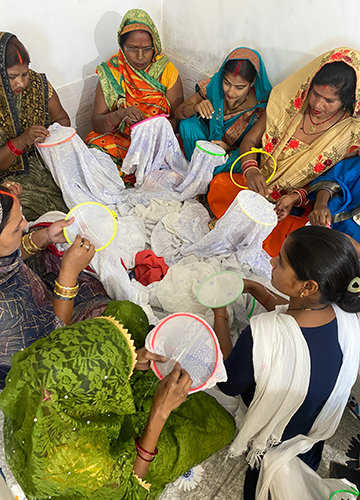 The women embroiderers of Malihabad, at Shanno and Shahana Parveen’s home, say they spend their earnings on themselves | Namrata Zakaria
“Black is clearly not my colour, I prefer pastels. But Devika wanted something western, so we customised for her. I’ve used coloured threads that stand out instead,” Bhandari tells me as we drive from the Lucknow airport to Malihabad, nearly two hours away.
We are meeting sisters Shanno, 50, and Shahana Parveen, 35. They are the daughters of Abdullahbhai, a master embroiderer renowned across Lucknow. Chikan embroidery enjoys a Geographical Indication (GI) tag in and around 100km of Lucknow. It traditionally consists of white thread work done on white muslin, but its popularity has seen many derivatives in coloured thread and assorted fabrics. Fine chikan comprises 32 known styles of embroidery, with old names like murri (from Kakori region), bijli, kauri, bakhiya, pechni, jaali, phanda, keel and the like.
“All my learning in chikan or kamdani (metallic embroidery, also known as mukaish) is courtesy Abdullahbhai. I don’t have a store or take part in fashion weeks; my only mission is to keep the income of my artisans going,” Bhandari says. “Even if they give me only 90 working days in a year, I am fine. I have much to learn from them about work-life balance.”
Shanno has just recovered from a kidney ailment and is still weak. Shahana had no interest in embroidery, but had to take over the atelier, where more than 100 girls work. The atelier is also their residence, partly funded by the Pradhan Mantri Awas Yojana housing scheme. Since it is Ramzan, the holy month of fasting for Muslims, only the Hindu women have come to work. They wear alta on their feet as they celebrate Holi for one month in UP, even though the festival of colours is a one-day affair. “Lucknow is the only place in UP which has not seen Hindu-Muslim riots yet, and I hope it remains like this,” Bhandari says.
 Designer Anjul Bhandari’s only mission is to keep the income of her artisans going | Instagram@anjulbhandari
The girls are embroidering on a white georgette fabric with indigo block-printing done by a master printer called Munnabhai. After the intricate embroidery is done, the large spaces will be filled with jaali work, an airy grid borrowed from Mughal architecture. Then the fabric is washed, starched with charak (rice water) and dyed (the white cotton embroidery threads do not catch the dye, they remain white). Finally, after the embroidery, the work is embellished with mukaish, or then glass beads that Bhandari imports from Japan. Then it is stitched to make a sari or an outfit. “It takes me one year to get a sari ready. If it is ek-taar (embroidered with a single strand as opposed to a two-strand thread), it takes two years,” she says.
The Parveen sisters who manage the atelier receive 20 per cent of the fee for the final product, so they can make between Rs1.5 lakh and Rs2 lakh per month. The other women workers make around Rs15,000 per month. “All our husbands work and run the house. We use our money for ourselves, buying fancy clothes and such,” Rekha, an artisan, tells me.
Our next stop is Munnabhai’s home in the old city of Lucknow. His real name is Mohammed Wasif, but no one knows him by it. Munnabhai, 55, is married to a much younger woman who he serenades every few hours when he isn't up at the nearby mosque calling the azaan. He is a master storyteller and claims to have called the azaan in Saudi Arabia and Dubai, too. Munnabhai learned the craft from his maternal grandfather, and has hand-carved blocks that are 150 years old. Some are so slim, no one can replicate them any more. “Block-printing is the secret code between a printer and an embroiderer,” he says. “A printer has to know which embroidery pattern works where, and we lead the embroiderers without even meeting them.”
Also Read
- Farm to fashion
- Bargachia and Bandpur, Bengal | How Rahul Mishra nailed the pre-stitched sari for Zendaya
- Gondal and Adesar, Gujarat | Himanshu Shani and 11.11: Pioneering India's artisanal fashion
- Semra, Uttar Pradesh | Raw Mango's handloom revolution: Blending tradition and modernity
- Pochampally, Telangana | Shreeranjan Weaves: Preserving ikat's heritage
I also visit the beadwork and zardozi embroidery unit in old Lucknow. Shanu Mirza (name changed to protect privacy) says this is the area from where actor and singer Begum Akhtar hails. His sons continue to work in the atelier here (one of them was the Dubai Sheikh’s private embroiderer but has moved back). Mirza tells me locally sourced plastic beads cost Rs20 per kilo, but Bhandari’s glass beads are at Rs14,000 per kilo.
Our final stop is the kamdani workshop of the two brothers of the Parveen sisters, Shahnavaz and Parvez. Mukaish is a metallic thread embroidered into a circle by hand, then rolled over for smoothness with a seashell. It has also been passed through a mechanical rolling machine. A mukaish sari can take five years to make. Shahnavaz shows me how the circle is embroidered, just within a minute thanks to his expertise, and he even cuts the metal with his bare hands. It’s magic, I tell him. “But very hard to do, so no takers,” he replies.