


Anita Chhiba, founder of the media platform Diet Paratha
Semra, Uttar Pradesh
IT WAS DURING the Sepoy Mutiny of 1857 that master weaver Mohammed Naseem Khan’s (name changed to protect privacy) family moved from Azamgarh to Varanasi, or Benares. “We were a family of cotton weavers, but the British had banned cotton weaving. Benares is known for weaving in silk, so we came here,” says Khan, 64.
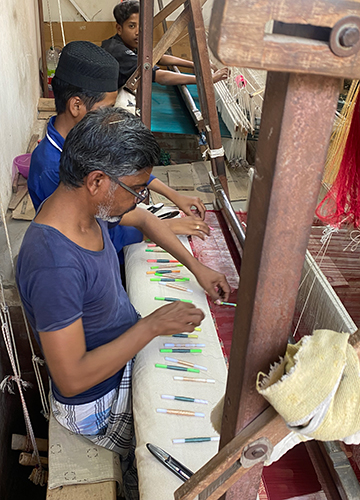 Six yards of suave: This atelier in Semra, near Varanasi, is where Raw Mango commissioned the handloom silk and lycra blend sari | Namrata Zakaria
Khan now has his own weaving centre, an expansive three-storey residential and weaving space, in Semra, one hour from Varanasi, where nearly 150 weavers work. The Benaresi sari is among India’s most glamorous saris, thanks to the buttery silk and gold threads woven all over it.
More than 80 per cent of Khan’s commissions come from Raw Mango, the extraordinary Benaresi-special label helmed by designer Sanjay Garg. As we meet, one of Garg’s textile design assistants, Manya Agarwal, is also accompanying him. She is carrying an extraordinary sari with her, a chessboard of black and gold checks, but the pallu turns into a stretchy lycra. The sari, part of Garg’s experimental ‘Children of the Night’ collection of 2024, was shown at a fashion week last August to celebrate 15 years of the Raw Mango label.
But before this, the sari made its debut when Diet Paratha’s Anita Chhiba wore it at London’s British Fashion Awards in December 2023. Chhiba is a London-based New Zealander who launched her Instagram handle Diet Paratha to chronicle and promote South Asian culture globally.
“Sanjay started weaving Benaresis with me,” says Khan. “I used to work at the Weavers’ Service Centre in Varanasi. There are 28 such centres across India set up by the ministry of textiles. Sanjay met me here. In 2018, I started my own studio in this space. In 2020, I retired from the government job.”
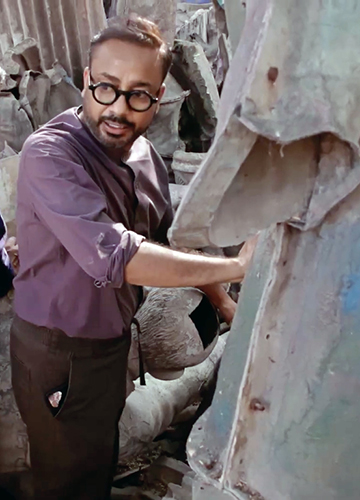 Designer Sanjay Garg of Raw Mango | Instagram@raw_mango
Khan recognises the sari immediately and brings over another weaver, Mushtaq Mohammed, 60, who actually wove it. “I like learning new things. I had practised weaving this sari seven to eight times, and through trial and error I made the final product,” he tells me.
The sari is plain silk and zari, with lycra introduced in the pallu to make for elastic strips. It has a one-warp, two-weft (one black and the other gold zari) weave. The sari is thus reversible, a black check on one side is a gold check on the other. Khan explains this is called ‘backed cloth’ in textile language.
Garg has been experimenting with the Benaresi handloom since 2020. He was determined to introduce knitwear into handloom, the Benaresi weave, as the whole world wears knitwear. He wanted to create a “handloom knit” product, a technical first, that could dress the world. This sari was his attempt at handloom mimicking knit. Agarwal tells me Raw Mango made only 20 pieces of this sari, and some in a white and blue variation as well.
“We wanted to make pieces that appear to dance with the ebb and flow of elasticity, like flickers of light,” Garg tells me. “One of the ideas was what a ‘handloom knit’ could look like; this questioning underpinned our process. We were able to create this technically through the introduction of lycra on the handloom, and the use of gota, a typical surface ornamentation. Alternating between silk and lycra, we were able to create an elastic palla, treating it as a fluid blouse. The gota made the textile heavier, allowing us to experiment with draping. We wanted to push the limitations of the handloom, responding to contemporary demands.”
Also Read
- Farm to fashion
- Bargachia and Bandpur, Bengal | How Rahul Mishra nailed the pre-stitched sari for Zendaya
- Gondal and Adesar, Gujarat | Himanshu Shani and 11.11: Pioneering India's artisanal fashion
- Malihabad, Uttar Pradesh | Anjul Bhandari is on a mission to empower chikan artisans
- Pochampally, Telangana | Shreeranjan Weaves: Preserving ikat's heritage
Khan is thrilled with this sari. “Benaresis are very popular and the business of the silk-gold sari is thriving,” he says. “But we also need to focus on the younger generation, as they ensure longevity for a textile tradition. We need to keep offering them new things, as this ensures continued work for us for generations.”
Even as he shows me around, Khan says he is keen that more women get involved in Benaresi sari weaving. “All the pre-loom activities—the winding and warping of thread—are done by the women. Usually they don’t get paid for this service, as they only help the husbands in their work. But we ensure the women get paid for pre-loom work, too,” he says. He shows me the residential chambers of the centre—large rooms with a bed, sofa, cupboards and curtains like a regular home. The women’s spinning and pre-loom equipment lies around, even as their children study for exams.