


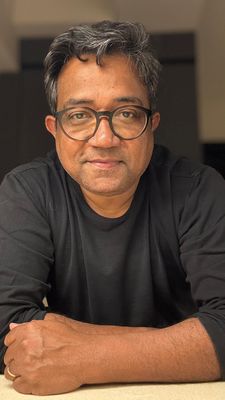
 Sudeep Chatterjee
Have watched Guru Dutt’s films countless times—at different stages in my life—and each time, they have spoken to me differently. One thing remains constant: his work is pure cinematic language. He didn’t rely solely on dialogue to communicate emotion; he crafted images so evocative that they transcended words. Watching his films is an experience that reminds you what cinema is meant to be—seen, felt and absorbed on the big screen.
That is something we have lost today. Much of contemporary filmmaking forgets that cinema has a distinct visual language, meant for the grandeur and immersion of the big screen. Dutt never forgot that. Films like Pyaasa (1957) and Kaagaz Ke Phool (1959) are steeped in a deep aesthetic vision, one that speaks in shadows, light and silence.
While studying at The Film and Television Institute of India, Dutt was a significant part of our film appreciation module. His work, especially his song picturisations, was something we studied deeply. His visual storytelling was a gateway into the kind of cinematography I wanted to pursue. I wouldn’t call myself a technical person, but I am someone deeply drawn to the power of images, and that’s what Dutt excelled at.
One song I always return to is ‘Na Jao Saiyan Chhuda Ke Baiyan’ from Sahib Bibi Aur Ghulam (1962). It is built around a single bed in a bedroom—a minimal setting that becomes a stage for incredible drama. It is a masterclass in restraint and intimacy. To pull off such evocative visuals in such a confined space is nearly impossible unless you are a genius. The lighting, the mood, the rhythm—it is all there, perfectly balanced.
Another one is ‘Piya Aiso Jiya Mein Samaaye Gayo Re’. The way melancholy and beauty are woven into the visuals is stunning. Then there is ‘Saqiya Aaj Mujhe Nind Nahin Aayegi’—a song that is choreographed with such precision and stylised lighting that even today, with all the technology at our disposal, we struggle to recreate that effect.
Even in black-and-white, Dutt’s visuals were graphic, modern and striking. A song from Mr. & Mrs. 55 (1955), where Madhubala is on screen, stands out for the way the umbrellas spin, bodies dive into water, and patterns emerge in synchrony. He was using choreography, geometry and emotion all at once—things that we now call “contemporary” or “experimental”, but which he mastered decades ago.
And then there is that unforgettable beam of light in Kaagaz Ke Phool. That was V.K. Murthy’s genius. He and Dutt were a dream team—the kind that comes together once in a generation. Murthy wasn’t just one of the best cinematographers in India; he was one of the best in the world. People still don’t know how he achieved some of those lighting effects.
It is tempting to ask what kind of magic Dutt could have created with today’s technology. But the truth is, technology wasn’t what defined his work. He had lights, he had a camera, and he had vision. The same fundamentals exist today. It is about the idea behind the frame, not the gear. Give him today’s tools, and yes, he would have made wonders—but his poetry was never dependent on technology. It was born of deep aesthetic understanding and human insight.
He also had the ability to get the best out of his collaborators—Murthy, (music directors) S.D. Burman, Hemant Kumar. That is an art in itself. To inspire someone to go beyond their own boundaries, to lead with a sense of shared vision—Dutt did that effortlessly.
I think we have moved far from that kind of cinema—craft that bore a moral and social responsibility, that held up a mirror to society while never letting go of beauty. Today, I feel, we sometimes forget how powerful this medium is.
Do we have that camaraderie on sets anymore? I think we still do. I have had deeply meaningful creative partnerships with directors, and filmmaking remains, for me, one of the most collaborative and joyous art forms. That is the heart of it. And it is something I know Dutt valued deeply.
Also Read
- 'Ek Din' review: Even Sai Pallavi cannot save this messy romantic drama
- 'All is well', again: Can '3 Idiots 2' recapture a generation's spirit?
- 'Bhooth Bangla' Day 11 Box Office Collection: Akshay Kumar eyes next milestone after becoming commercial success
- THE WEEK Salon: Karan Johar calls Gen Z 'deeply emotional', praises small filmmakers
- THE WEEK Salon: Karan Johar talks paid narratives, not letting success and failure dictate emotions, and seeking joy in small things
- ‘Bhooth Bangla’ box office collection Day 6: Priyadarshan directorial is now fourth highest-grossing Hindi movie of the year domestically
As a cinematographer, I may not deliberately try to recreate his frames, but I carry his influence within me. It is subconscious, like muscle memory. When I shot Gangubai Kathiawadi (2022), I didn’t set out to emulate him. But there was a song that I listened to repeatedly—‘Ye Hanste Hue Phool’ from Pyaasa—it captured an emotion that reminded me of the empathy and tenderness with which he portrayed even the most marginalised. That’s what stays with you. Not just the visuals, but the humanity.
In the end, Dutt wasn’t just a filmmaker. He was a poet with a camera. And for those of us who follow him, he is a constant reminder of what cinema can be.
—As told to Pooja Biraia
The writer is a cinematographer.