



Perumbavoor is a town in Kerala that breathes Malayalam, speaks Bengali and dreams in Odia.
A thriving labour hub, it is home to tens of thousands of workers from eastern India, who keep the town’s plywood factories and the construction sites in nearby Kochi up and running. The bhais—as Malayalis patronisingly call the workers—take time off every Sunday. They gather at the bustling Gandhi Bazaar to chat with one another, buy groceries, clothes and cellphones, browse the internet, make long-distance calls, and queue up before cash deposit machines to send money home.
In the evening, pints of bitter are topped up with B-grade Bengali and Odia potboilers, playing at ramshackle theatres that were once known for soft-core Malayalam flicks. The cottages they live in, the businesses they help run and the bars they frequent are owned mostly by Malayali expats, whose life abroad is not much different from that of the bhais back home.
Perumbavoor finely illustrates what Census 2011 revealed about the migrational tendencies of Indians. For the poor who are willing to travel, India itself is a land of opportunities. But, for the well-off who are equally willing, India is not.
In 2011, there were 45 crore migrants within India—people who had left their earlier place of residence to work and raise families. Even as they relocated, more than 33 lakh people left the country in search of greener pastures—most of them from Kerala, Andhra Pradesh and Punjab.
The arrivals and departures often have curious effects—like in the case of Perumbavoor, now a slice of east in the south. Sometimes, they also cause upheavals—like in Maharashtra, where the Marathas complain about migrants stealing opportunities, and in Assam, where indigenous people are wary of Bengali settlers.
Maharashtra and Assam symbolise two very different epochs in India’s migration history. Before the 1990s, the flow of people within India was from rich to poor states; that is how Bengali babus put down roots in the northeastern hills and valleys. The trend reversed in the 1990s. “The number of net migrants (the difference between departures and arrivals) for each state showed Maharashtra at the top of the list with 23.8 lakh net migrants, followed by Delhi (17.6 lakh), Gujarat (6.8 lakh) and Haryana (6.7 lakh),” said Census 2001. “Uttar Pradesh (-26.9 lakh) and Bihar (-17.2 lakh) were the two states that had the largest number of persons migrating out.”
What is the biggest factor driving Indians to leave home?
Marriage, says Census 2011. Nearly half the number of migrants relocated after tying the knot—97 per cent of them women. Only 10 per cent of the total migrant population left home to find jobs or establish businesses. Among cities, Mumbai remains India’s biggest migrant magnet, with 90 lakh and counting.
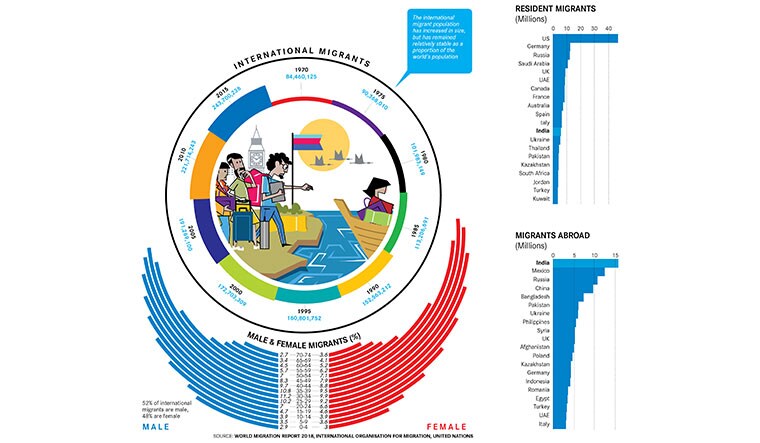
Those who crossed the seas have done even better. More than 1.31 crore Indian expatriates now live in 201 countries. The UAE, Saudi Arabia and the US together have more than 70 lakh Indians. Nicaragua and Tonga have six each, Liechtenstein has five, and Micronesia has a lone desi.
Guess how many are there in Pakistan? Zero, according to the ministry of external affairs.
