



The shape of ‘India’ has changed over time. The largest empire in the Indian subcontinent was neither what the Mughals ruled over, nor British India before partition. It was the one that belonged to the third Mauryan emperor, Ashoka, whose inheritance extended all the way from the outer limits of present- day Afghanistan in the west to Assam in the east. It encompassed almost all of modern day India, except for the northeastern extremity, the southern stub of the peninsula, and one small and prosperous territory called Kalinga. The Mauryans had been coveting this coastal kingdom since Chandragupta’s failed attempt to conquer it.
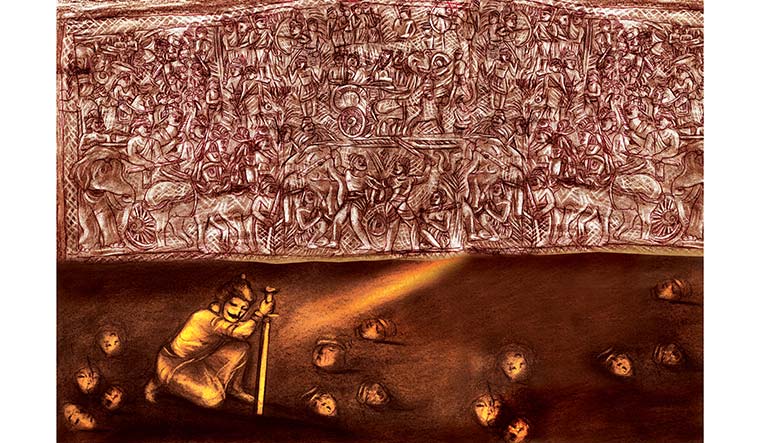
Eight years after Ashoka coronated himself king, following a fratricidal bloodbath, he marched the mighty Mauryan army towards Kalinga. It is believed that the fighting first began around Dhauli, near the banks of the Daya river, but later reached Tosali, the Kalingan capital. There is not much description of the war itself to be found, except those legends that Kalinga put up a defiant resistance against the Mauryan might. The aftermath, however, is well chronicled by Ashoka himself. In his 13th rock edict, he speaks about the remorse he felt while walking through the battlegrounds after his victory: “The sight of the dead and the wails of the injured and bereaved caused him, the beloved of the gods, great sorrow.”
By the time the battle of Kalinga ended in 262 BC, it had claimed the lives of one lakh soldiers and countless civilians, making it perhaps one of the bloodiest battles in history. One and a half lakh captives were deported. Ashoka says he felt even greater sorrow on understanding the anguish of the friends and families of the deceased.
From this violence arose a transformation that was never seen before, or after, in any conqueror. It developed a pacifism that would become the hallmark of his reign, and an ideal that India would use effectively to wrest independence thousands of years later. The war became a turning point in Ashoka’s life, as he became a fierce proponent of non-violence, or ahimsa. Most, including popular historian Charles Allen, concur that Ashoka had been a Buddhist for at least a couple of years before the battle; he did not convert after it. But, post Kalinga, he became an ardent patron of the religion. He commissioned edicts, through which he directly speaks to us across a chasm of over two thousand years. The inscriptions at Kalinga say he considers all his subjects his own children, and that he strives for their welfare and happiness. He talks about non-violence even towards animals and was perhaps the first ruler who issued laws for the protection and humane treatment of animals. He talks about secularism and tolerance, ideals that are as relevant, or perhaps even more, in the land today.
Authors like Sanjeev Sanyal believe that Ashoka was not as non-violent as he was made out to be. In the book The Ocean of Churn, Sanyal writes that according to Ashokvadana, a Buddhist text, Ashoka had 18,000 Jains put to death in Bengal even after his turn towards pacifism. A closer reading of the edicts show that Ashoka had not renounced violence, but made it the last option. There was still capital punishment, but it was not arbitrary, and the condemned had enough chance to appeal.
In another edict, he says that conquests, if executed, should entail minimal violence; he recommends that the best form of conquests is through dhamma. He stopped marauding other kingdoms; his foreign policy was one of peaceful coexistence. He was instrumental in the spread of Buddhism to Sri Lanka, sending his children, Mahinda and Sanghamitra, as emissaries. There are no stories of any other major military expedition by Ashoka. In fact, the spread of Buddhism to southeast Asia started after the conquest of Kalinga.
The legacy of Kalinga is not that India turned non-violent or secular. Or, even Buddhist. Bloody wars would be fought on these lands, religious intolerance would tear people apart time and again, and Buddhism would become a minority religion soon after him.
But, he was the first ruler to propound a legacy that India strives for, even today. Mahatma Gandhi put the idea of ahimsa to brilliant use when he spearheaded the non-cooperation movement against British rule. The ancient ideal of secularism was appropriated by modern India; the state remains secular despite the communalism within. Whether it is the use of soft power for foreign policy, or the state’s present-day ambivalence on capital punishment, it can be traced right back to Ashoka.
On the other hand, it is due to an atavistic Ashokan legacy that Indians never tried annexing territory beyond the boundaries of his empire. We read of no conquerors who went beyond these lands, apart from some Chola expansion and Muhammad bin Tughlaq’s Chinese misadventure. India remained the defender, never the aggressor, till 1971.
