



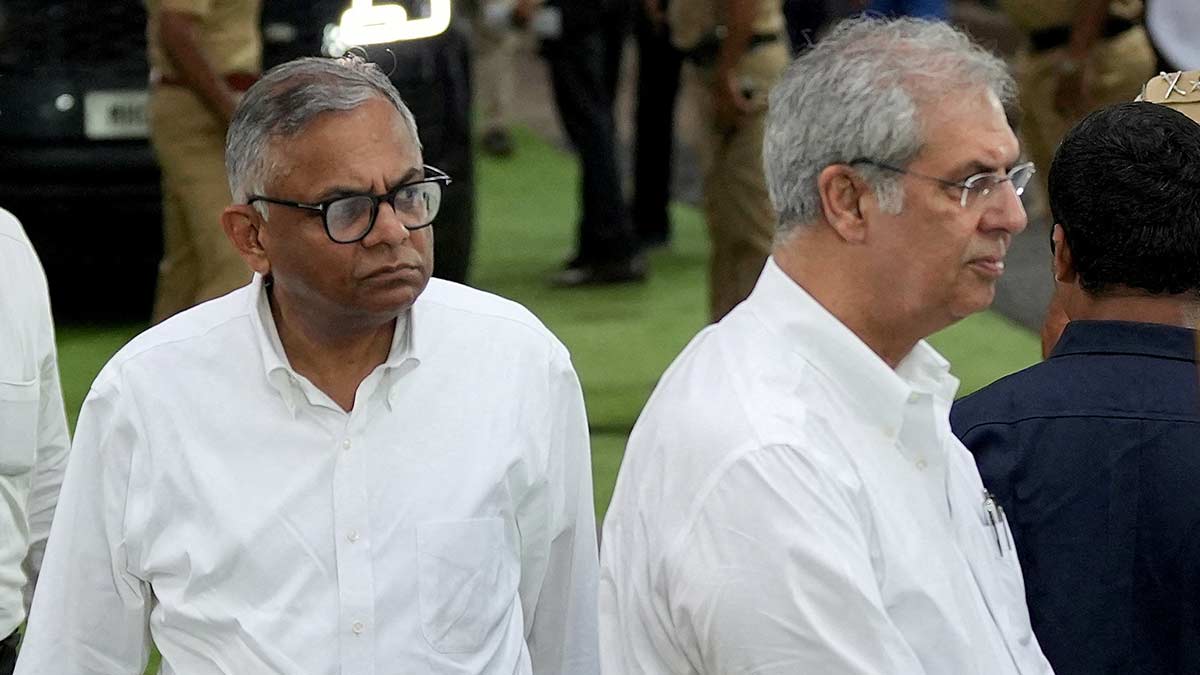
N. Chandrasekaran’s decision not to seek another term as chairman of Tata Sons came as a surprise to India Inc. Apparently, he was offered a truncated extension—two years instead of five—that would have taken him up to the group’s retirement age of 65. But he chose to step aside citing the board’s failure to reach a unanimous decision on the resolution to renew his term. Tata trusts, the majority shareholder of Tata Sons, accepted the decision and has begun the process of constituting a selection committee to identify his successor.
The transition closes a defining chapter in the history of the 158-year-old Tata Group. Chandrasekaran’s decade-long tenure brought stability to the group after the bruising boardroom battle between Cyrus Mistry and Ratan Tata in 2016. Yet, it also comes at a time when tensions between Tata Sons and the Tata trusts have become increasingly visible.
The disagreement over Chandrasekaran’s extension raised questions about governance, accountability and the balance of power between Tata Sons and its principal shareholder. In recent months, legal complaints filed by Tata trustees against the trust and differences over succession planning have triggered an unusual public debate over the governance architecture of India’s largest business conglomerate. “Can a Tata group chairman, who is expected to uphold the Tata ethos, seek a longer tenure than what is prescribed in the retirement policy? And that, too, at a time when the performance of group companies like Air India and Tata Digital was not up to the mark as per the principal shareholder (Tata trusts)?” asked a Tata Group insider.
While the friction has not affected the day-to-day functioning of the group companies, it seems to have a bearing on the future of the sprawling group.
The next chairman will inherit a larger, more capital intensive conglomerate than the one Chandrasekaran did, as well as one of the highest loss-making portfolios in the group’s history. Tata charitable trusts own 66 per cent of Tata Sons, the holding company of Tata Group. SP Group (18.4 per cent), various Tata companies and Tata family members own the rest. The dividends received by Tata trusts from Tata Sons are used to set up and maintain hospitals and educational institutions across India unlike traditional Indian companies where the promoter takes home the dividends. Any disruption in Tata Sons dividend flows would impact the charity initiatives of Tata trusts and that is why the trusts keep a close eye on the financial performance of the group.
A decade of big bets
When Chandrasekaran took charge in 2017, the group’s strengths were well established. TCS was generating enormous amounts of cash. Titan was growing rapidly. Jaguar Land Rover had stabilised after years of volatility. Tata Steel was on a recovery path. Indian Hotels, the operator of Taj hotels, was entering a new growth phase.
Chandrasekaran chose not merely to manage these businesses; he sought to reshape the future of the group. Tata Group entered sectors that required patience, scale and massive financial commitment under his watch.
Semiconductors became one of the most visible examples. For decades, India had spoken about becoming a semiconductor manufacturing nation. Under Chandrasekaran, Tata Group became one of the first private-sector champions of that ambition. Simultaneously, the group expanded into electronics manufacturing, battery technology and electric mobility.
Agratas emerged as a flagship bet on the future of battery manufacturing. The venture was designed not simply as another Tata company but as a strategic platform to participate in the global transition towards electric vehicles and energy storage.
The group is also pursuing its largest international acquisition with Tata Motors agreeing to acquire Italian truck maker Iveco for $4.4 billion.
Viewed individually, each of these decisions had a compelling strategic rationale. Viewed collectively, they represented a fundamental shift in the identity of Tata Sons—from a holding company overseeing mature businesses to an investor backing long-duration industrial projects. The next chairman will now have to determine whether these bets can deliver returns commensurate with the capital committed or scale them down.
Analysts believe the governance tensions at the holding company are unlikely to affect the operating performance of the group companies. “Despite the friction on the board indicating a power struggle, we do not expect the performance of the individual Tata group companies to be impaired, given each business is managed and governed by a dedicated management team,” said CreditSights analysts Jonathan Tan Jun Jie and Lakshmanan R. in a recent note.
The TCS cushion
For years, Tata Consultancy Services has been the financial backbone of Tata Group. Its dividend stream has funded investments, supported expansion plans, strengthened Tata Sons’s balance sheet and indirectly financed the philanthropic activities of Tata trusts. In many ways, TCS gave Tata Sons the freedom to think long term.
The challenge is that the dependence on TCS has become increasingly visible as newer businesses continue to burn cash. Without the TCS-generated cash flows, many of Tata Sons’s recent investment programmes would have been difficult to sustain at their current scale.
The next chairman will confront a challenge that has lingered in the background for years: Tata Sons needs another major cash-generating engine. While there is little doubt about the quality of TCS—it remains one of the most profitable companies in India—the concentration is a concern.
When a holding company depends disproportionately on one business for cash generation, every new investment ultimately competes for the same pool of capital. There was no change in this equation in the past 10 years. The challenge for the next chairman will be to broaden the sources of cash flow within the Tata portfolio.
Air India: The ultimate test
No investment symbolises Chandrasekaran’s tenure better than Air India. The acquisition carried both strategic and emotional significance. It restored Air India to the Tata fold, reuniting the airline with the group that originally founded it under J.R.D. Tata in 1932.
But then the romance of history collided with the reality of aviation economics.
Air India is one of the largest consumers of capital within the Tata ecosystem. The Ahmedabad air crash last year further complicated an already difficult turnaround. The airline reported a loss of more than Rs22,000 crore in FY26 and is expected to remain deeply loss-making in FY27.
Fleet renewal, airline integration, technology upgrades, network expansion and operational restructuring have all required sustained investment. “The challenge is not merely financial. Airlines are among the most difficult businesses in the world to transform. Market share can be bought. Aircraft can be acquired. But culture, service quality and operational discipline often take years to build,” said an airline sector analyst.
Chandrasekaran himself acknowledged in Tata Sons’s FY26 annual report that turning around Air India could take a decade. That statement may be the most important clue to the challenge awaiting his successor.
Air India recently appointed former Ethiopian Airlines Group chief executive Tewolde GebreMariam Tesfay as its chief executive officer and managing director. “The group looks clueless on what to do and how to turn around the airline. The task for the new CEO is cut out,” said the insider.
Tata Digital’s unfinished story
If Air India represents a traditional turnaround, Tata Digital is a modern technology experiment.
Chandrasekaran’s initial plans for Tata Digital was big: create a digital ecosystem connecting retail, payments, loyalty programmes, financial services and e-commerce through a single platform capable of competing with Amazon and Walmart-backed Flipkart. The strategy was bold and reflected the changing nature of India’s economy.
But, after years of investments and frequent changes in senior management, Tata Digital remains a work in progress. This was despite India’s digital economy rapidly expanding and consumer behaviour shifting to online shopping. An extremely poor consumer experience and execution issues have prevented the group’s super-app strategy from gaining the originally envisioned traction. “How long should a business continue consuming capital before it begins generating meaningful returns?” asked the insider.
That is a question the next chairman will have to answer. The dilemma echoes an earlier decision made by Chandrasekaran when Tata Sons exited the loss-making wireless telephony business of Tata Teleservices after years of investment. Tata Teleservices is still saddled with Rs 16,798 crore of government dues which Tata Sons will have to pay in equal instalments for five years.
Whether Tata Digital eventually becomes a strategic success or an expensive experiment remains one of the biggest unanswered questions within the group. It would stand as a benchmark of the Chandrasekaran era.
The semiconductor and Agratas challenge
Unlike consumer internet ventures, semiconductor and battery projects are rooted in manufacturing and industrial policy. They require massive capital commitments long before meaningful profits emerge. “Thanks to the government subsidies, the semiconductor business will show a profit,” said a Tata group official.
These investments may ultimately prove transformational. But they are unlikely to become significant contributors to Tata Sons’s cash flows anytime soon. The next chairman will therefore face a delicate balancing act: continue investing aggressively while maintaining financial discipline.
A common thread links Air India, Tata Digital, semiconductors, batteries and electronics manufacturing—all require a massive dose of capital. That reality may become the defining issue of the next decade. Capital allocation, rather than strategy, may become the most important responsibility of the next chairman.
Governance and the Noel Tata era
After the death of Ratan Tata, Noel Tata has emerged as the central figure within the Tata trusts structure and the most influential voice in the group’s governance framework. The Tata trusts nominees on the Tata Sons board hold veto powers over the board decisions. Soon after Ratan Tata’s death, a bitter battle broke out among the trustees. Two of the rebel trustees—Venu Srinivasan and Vijay Singh—even complained to the Charity Commissioner against the Tata trusts, igniting a debate whether someone sitting on the trusts and on the company’s board could take his own organisation to court after participating and agreeing to previous unanimous decisions.
The dispute over Chandrasekaran’s tenure has underlined that the relationship between Tata Sons and Tata trusts is entering a new phase. For decades, Ratan Tata’s firm authority bridged the differences between the trusts and the group companies. Noel Tata is taking a leaf out of his half brother’s book to take the group towards a new direction.
Tata Group’s next decade, in more ways than one, will belong as much to Noel Tata as it does to the next Tata Sons chairman.
