



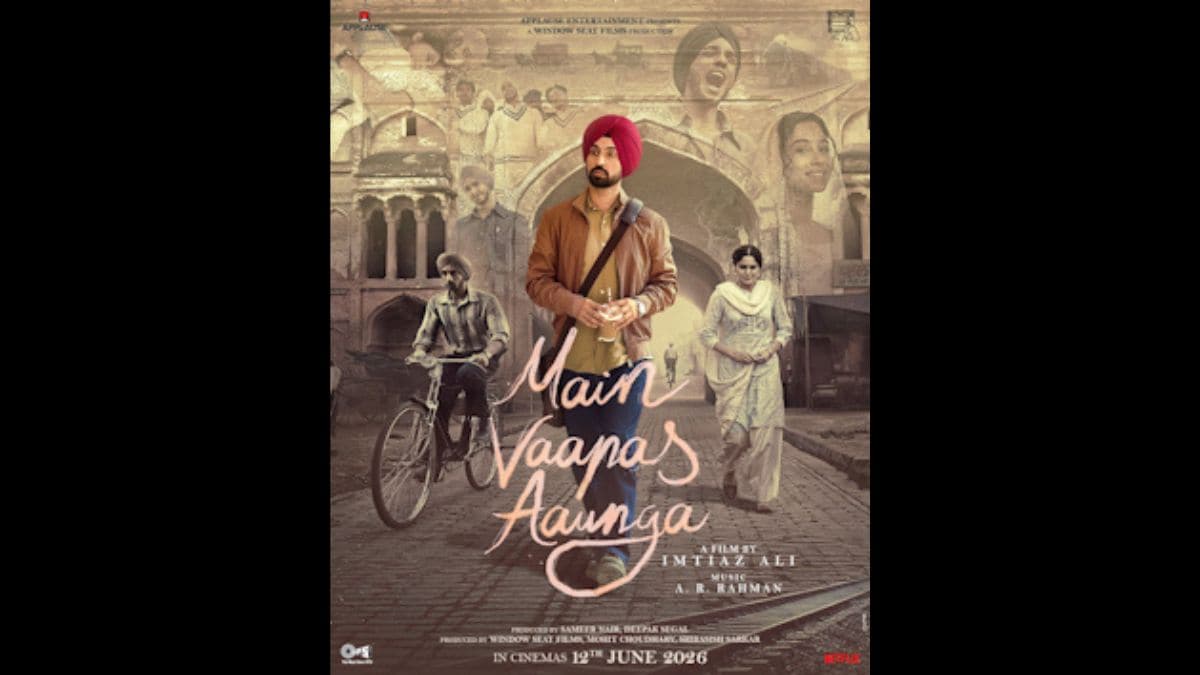
In a scene in Imtiaz Ali's Main Vaapas Aaunga, 95-year-old patriarch Ishar Singh Grewal (Naseeruddin Shah) berates his son Iqbal (Rajat Kapoor) for ignoring his advice never to marry. On his deathbed, with dementia pulling him deeper into the past, he suggests that the men in the family were responsible for the deaths of the women who married into it. Iqbal is a widower. "We all killed her," Ishar says.
Since he now communicates in incoherent mumblings decipherable only to his grandson Nirvair (Diljit Dosanjh), the accusation initially sounds bewildering. But it gradually reveals something deep and traumatic, buried beneath the many wounds of partition. To this bloodiest event in India’s history, Ishar lost his home, his love, himself, and all the women in his family, to rape, murder, and communal hatred. And it’s this unresolved pain of loss that still haunts him 78 years later.
This is where the heart of Ali's latest film lies: in laying bare an individual's trauma of partition, often overshadowed by the enormity of collective suffering.
The film opens in Chandigarh with Ishar desperately trying to return to Sargodha, his home. Deep in the grip of dementia, he no longer remembers that partition placed it across the border in Pakistan. Yet he remains fixated. As it unfolds, we learn that he is driven by a piece of unfinished business he cannot let go of, despite multiple strokes and his failing memory.
The film then travels back to the years leading up to partition. Love blossoms between a young Ishar (Vedang Raina) and Afsana (Sharvari) as communal tensions intensify. At first, Ishar dismisses the signs. When threatened by a group led by Afzal (Danish Pandor), he refuses to leave. "I'm not going anywhere," he asserts, plonking on the ground.
Ali allows the threat to creep in gradually. It first emerges in conversations and rumours, then in distant fires, before finally arriving at Ishar's doorstep. The violence uproots him from his home and drives him to a place where he feels like an outsider till the very end.
Ishar makes one final attempt to return to get the women back, and for Afsana. In an affecting sequence, he boards a train to Pakistan, disguising himself in a Rumi cap to conceal his Sikh identity. Along the way, he witnesses the brutality unleashed by his fellow Sikhs against Muslim women, men and children.
While Ali has rarely made overtly political films, Main Vaapas Aaunga leaves little ambiguity about where it stands. Rather than dividing people along religious lines, it separates them into perpetrators and victims. Hindus, Muslims and Sikhs are all implicated in the violence, and are victims to it. Religious identity becomes secondary to the fanaticism that consumes ordinary people and transforms them into participants in collective brutality.
The film's politics are often expressed through small, understated moments. In one scene, as the elderly Ishar attempts to cross the border, a well-meaning security official (Kumud Mishra) tries to explain why Sargodha now lies in another country.
"It was so the people of the two communities could live peacefully," he says before correcting himself. "Three."
"But the nations created were two."
In a few simple lines, Ali exposes the contradictions that continue to haunt the logic of partition.
The film is equally interested in what happened after the violence ended. For Ishar, partition becomes a wound that never healed. The loss of everyone he loved hardens him into a cold and distant father. The film suggests that trauma does not disappear with time; it merely changes shape. What begins as a historical tragedy eventually manifests as generational trauma, shaping his future relationships.
That is what makes Main Vaapas Aaunga particularly moving. It is a film about the horrors of 1947, but about their afterlife. It asks what becomes of those who survive history's catastrophes, and how their scars are inherited by those who come after them.
The film's final stretch broadens its gaze beyond the subcontinent. Co-written by Ali and Nayanika Mahtani, it places partition within a wider history of displacement, war and sectarian violence. The suggestion is clear: the forces that produced partition have not disappeared. They continue to surface in different forms across the world, and remain capable of returning whenever hatred is allowed to masquerade as identity or patriotism.
Performance-wise, the film is anchored by an exceptional cast. Vedang Raina is excellent the younger Ishar, while Sharvari lends innocence to Afsana that reminds you of a bygone, simpler time. Dosanjh serves as the film's emotional bridge between past and present, grounding it exceptionally well.
Towering above them all, however, is Shah. Few actors can communicate so much through a trembling hand, a gaze or an incoherent sentence, as he catches the grammar of a dementia patient perfectly. Not for a second does he seem performative.
Meanwhile, Ali, known for making deeply personal stories, mostly on misfits, offers something new and refreshing. Most filmmakers arrive at the political through the personal. Ali reverses the journey. And the result is a story that’s humane, heartbreaking and relevant, especially in the present times.
Film: Main Vaapas Aaunga
Director: Imtiaz Ali
Cast: Diljit Dosanjh, Vedang Raina, Sharvari Wagh, Naseeruddin Shah
Rating: 3.5/5
