



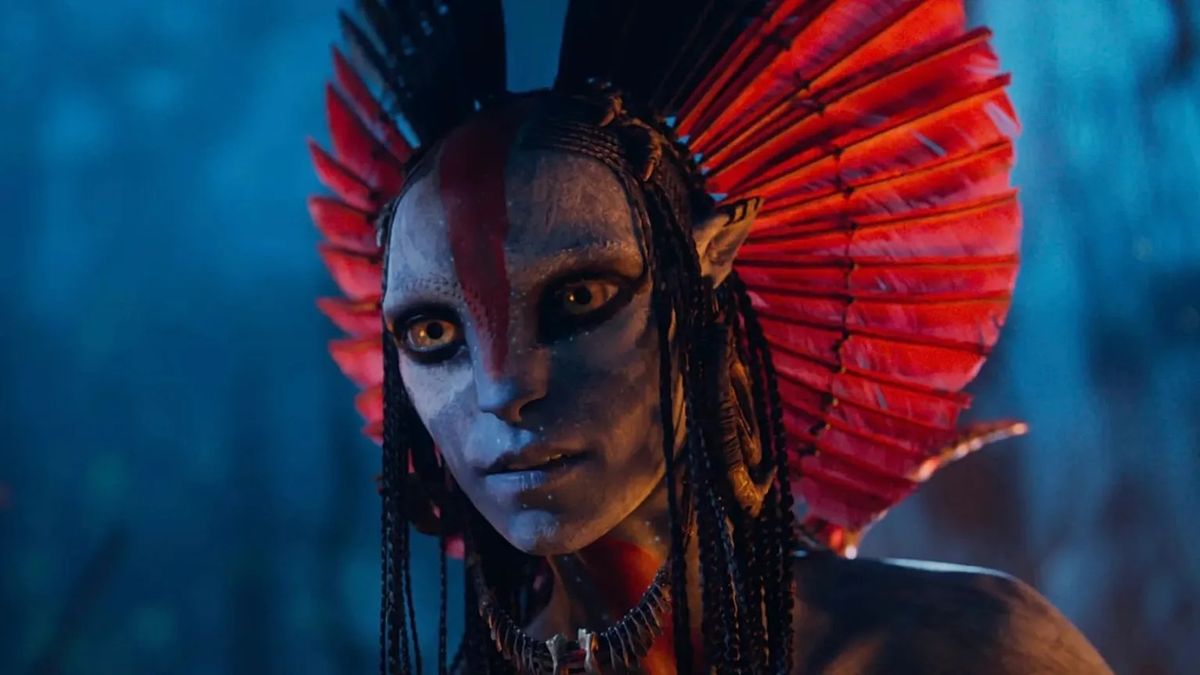
If it wasn't already obvious, James Cameron once again shows, with Avatar: Fire & Ash, how much he loves the colour blue — aside from the idea of being in close proximity to water and exploring its deepest depths to seek whatever invisible or unfathomable magic exists in that otherworldly realm. There's a long stretch in the early portions where Jake Scully's (Sam Worthington) children spend a lot of time in the water with the friendly aquatic creatures, Ilu. There are shots where various shades of blues — of the Na'vi children's skin (blue-purple), the water (bright blue), and the Ilu design (turquoise, aqua, and lighter blue) — merge to create a near-hallucinatory effect. The next stunning sequence is a huge battle — a glorious combination of scenes featuring cold blue tones and intense, fiery oranges. But it takes a little over three hours to get there. Everything else that comes in between is just plain underwhelming.
What Cameron wants to say seems more interesting than the manner in which he has executed it. There's the nagging sense that sincerity and emotion are being forced out of the characters and the actors playing them. Cameron is a great visualist — a quality I'll always admire him for — more than a good screenwriter (he's a good screenwriter in terms of writing vivid imagery; in fact, unparalleled). However, the Avatar titles have more than one writer involved. Their writing often ends up creating the illusion of, say, a high-intensity drama rather than working hard to transport it straight to the heart. I'm also beginning to suspect, after three Avatar movies, that the design of the Na'vi facial features is a key reason for the emotional disconnect. They don't look like us! But with this kind of writing, I doubt even setting the story on Earth would have helped. Perhaps it would've made things even worse.
Fire & Ash is The Matrix Revolutions of the trilogy. Wait, that wouldn't be right, because the Keanu Reeves film had more interesting things going on in it (especially upon revisits) than whatever Cameron thought was profound in his material for Fire & Ash. Perhaps, the third Mad Max movie, Beyond Thunderdome, would be a more fitting comparison. It's my least favourite Mad Max movie, because it spends a lot of time, if I remember correctly, with Max and his interactions with a cult comprising children, until we get to the goods. In Fire & Ash children take more precedence, unlike in the last two films. And it makes sense because it's only a natural continuation of the events in The Way of Water, which ended on a tragic note.
Fire & Ash picks up shortly after its predecessor, catching the Jake Scully family in mourning. The loss of one child is expected to be compensated for in the strengthening bonds of the other children. So, the movie's spending more time with the children makes perfect sense.
There's another reason why I bring up Mad Max: Beyond Thunderdome. Varang, the female villain in Fire & Ash, Varang (Oona Chaplin), reminded me of Tina Turner's 'Aunty Entity' in the George Miller film.
But here's the major problem. Neither of these characters nor their interactions fails to generate any kind of emotional involvement. It's evident that Cameron is trying to tell, first and foremost, a very personal family story involving sons and fathers, mothers and daughters, siblings and the ever-growing relationship with the flora and fauna, not to mention their deity Eywa, the planet-wide, interconnected consciousness that's the fantastical Avatar-equivalent of the 'Force' in the Star Wars saga. Fire & Ash finds Cameron further exploring the complicated dynamic between the Avatar-upgraded Colonel Quaritch (Stephen Lang) and his son Spider (Jack Champion).
Complications also arise from Neytiri's (Zoe Saldana) refusal to accept Spider as a possible replacement for their lost son. Later, a crucial moment between Jake and Spider reveals strong biblical undertones. However, none of these come together well in the same way as that spectacular battle sequence finale. Besides, some repetitive ideas from the previous Avatar movies (as well as Cameron's earlier work) contribute to the whole enterprise running out of steam. Things get slightly exhausting, and one begins to wish that Cameron would attempt a completely original, different concept next time around.
The first time I saw the 2009 Avatar, it left me a bit depressed for a good reason. It was so immersive — despite the wafer-thin plot that's a combination of familiar stories explored before in far better films — that the idea of confronting "returning" to Earth right after filled me with some dread. So, what did I do? I saw it three more times, on the big screen, in 3D. The second one, while not completely remarkable in terms of overall storytelling, offered a fair amount of interesting world-building and significant visual pleasures that made me consider a rewatch — in fact, I ended up seeing it thrice. The third one is... well, I'm unsure I would revisit it even once.
Film: Avatar: Fire & Ash
Director: James Cameron
Cast: Sam Worthington, Zoe Saldana, Oona Chaplin, Stephen Lang, Sigourney Weaver
Rating: 2/5
