



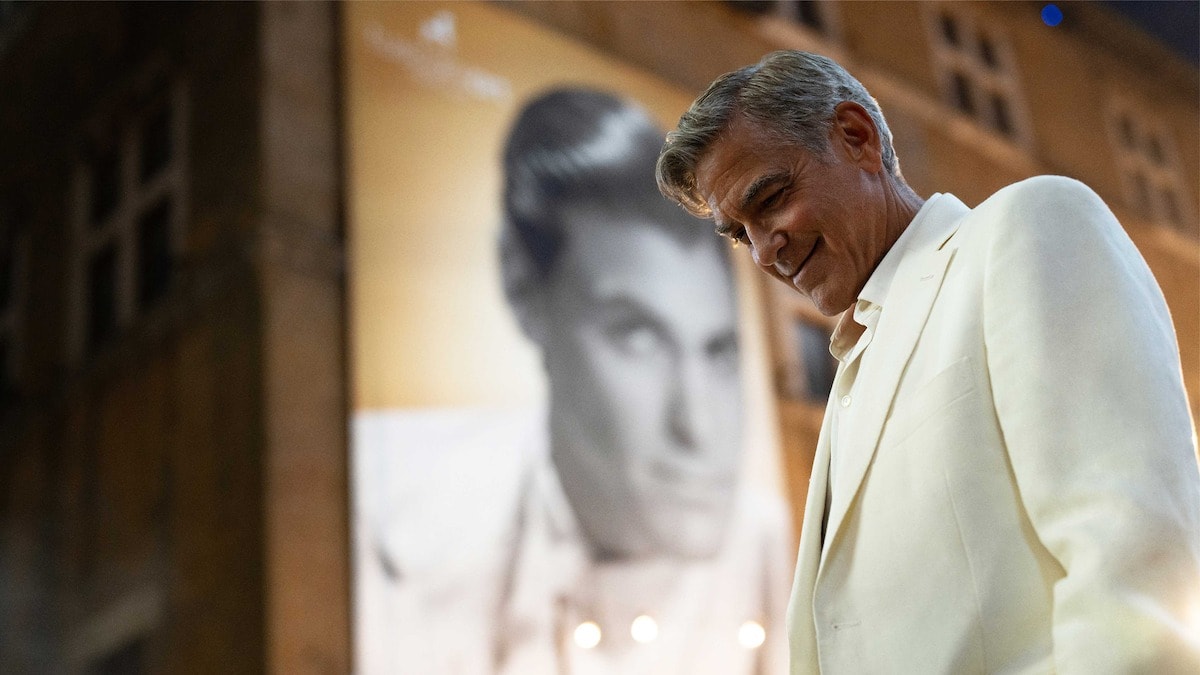
At one point in Jay Kelly, its eponymous protagonist, a middle-aged actor (George Clooney), undertakes a train journey to attend a tribute event. In the meantime, he is besieged by the after-effects of multiple events: a fight with a former best friend at a bar, a midlife crisis, and an attempt to reconnect with his estranged daughters. Hollywood itself has ventured into this terrain too often — including one starring Clooney himself, and directed by Alexander Payne. But the film that Jay Kelly reminded me most of was Satyajit Ray's 1966 classic Nayak, also about an actor re-examining his life and reflecting on the wrong, regretful choices he made in the past.
One of the filmmakers associated with the 'mumblecore' movement, Noah Baumbach's work has caught different characters at different points of their existence, grappling with all kinds of dilemmas. The most notable — and my favourite — is Frances Ha (led by Greta Gerwig), which I saw at a crucial point in my life, when neither Frances nor I had my s*** together. That monochrome-textured film didn't offer me any solution for my situation, but it was one of those films that had telepathically conveyed a message: “Just hang in there, man.”
13 years later, Baumbach has made a film — out now on Netflix — about a man who is a victor in one department and a failure in another. Jay Kelly seems to ask: If you're somebody who was fortunate enough to achieve many professional wins, but at the cost of isolating your loved ones, would you consider yourself successful? When we catch Jay Kelly, the character, at the beginning of the film, he is being bombarded by a lot of things. His youngest daughter shows no interest in bonding with him. The demise of his mentor, the one who gave him his first big acting break. And then he runs into his former best friend, Timothy Galligan (Billy Crudup), who is still bitter about the fact that Kelly has attained a position that he once dreamt of. (The reality, we later learn, was something else.) Cue the ugly fight. In Nayak, however, the fight happened with a random stranger, for a different reason — one that Uttam Kumar reads about in the papers as he is about to embark on his journey to collect an award in a different city.
In the Ray film, we also saw the Uttam Kumar character being advised by a manager, the presence of whom automatically lends the star a larger-than-life quality. (Today, even an influencer born yesterday has a manager.) Kelly’s manager is Ron Sukenick, played by Adam Sandler. We usually don't see films where individuals in this area of work are given the necessary importance. The portrayal is often reduced to an annoyingly hyperactive, talking-walking diary following the celebrity, informing them about their upcoming engagements. Baumbach writes Sukenick as someone fiercely loyal; he is serious about his profession, not as a dubious figure resorting to threats to get a news story pulled or launching a whitewashing campaign.
Sukenick, we gradually learn, is also dealing with his midlife crisis. Burdened by the weight of managing someone of Kelly's stature while also trying to manage his family life has taken a toll on him. (Gerwig plays Sukenick's concerned better half in a cameo). Jay Kelly is the film where ‘Adam Sandler the actor’ gets more prominence than ‘Adam Sandler the comedian’. We are also introduced to Laura Dern, who, in a brief appearance, plays Kelly's publicist; like Sukenick, she too realises the unhealthy after-effects of dealing with Kelly. We also learn that Sukenick and Liz share a bittersweet backstory. Again, occupational hazards that accompany a profession where you’re managing a — in their own words — “child.”
Here’s the problem with this film, though. The poignant moments are few and far between. I think one of the main reasons is Baumbach's attempts to pay attention to every character and their backstories, but his (and Emily Mortimer's) writing doesn’t allow enough time to get us acquainted with these characters to the point of getting us deeply invested in their lives. Ironic, considering the film's protagonist is a father whose daughters are now leading independent lives without wanting him near them. Or perhaps, the film is asking us to see things from Kelly's point of view — or that of any celebrity who had to endure the "misfortune" of becoming world famous but also the pain of alienating those who played a part in their growth.
Strangely enough, the most touching aspect of Baumbach's script is the climactic moment, which functions as much as a George Clooney tribute as Kelly’s. It works for two reasons: One, it reaffirms the fact that Clooney is one of the best (and most underappreciated?) actors we have. Two, it touched the Clooney fan in me who discovered him for the first time while watching The Peacemaker (co-starring Nicole Kidman) on television as a child. So, yeah, maybe there's something to take away from Jay Kelly, after all.
Film: Jay Kelly
Director: Noah Baumbach
Cast: George Clooney, Adam Sandler, Laura Dern, Billy Crudup, Riley Keough, Grace Edwards, Stacy Keach
Rating: 3.5/5
