



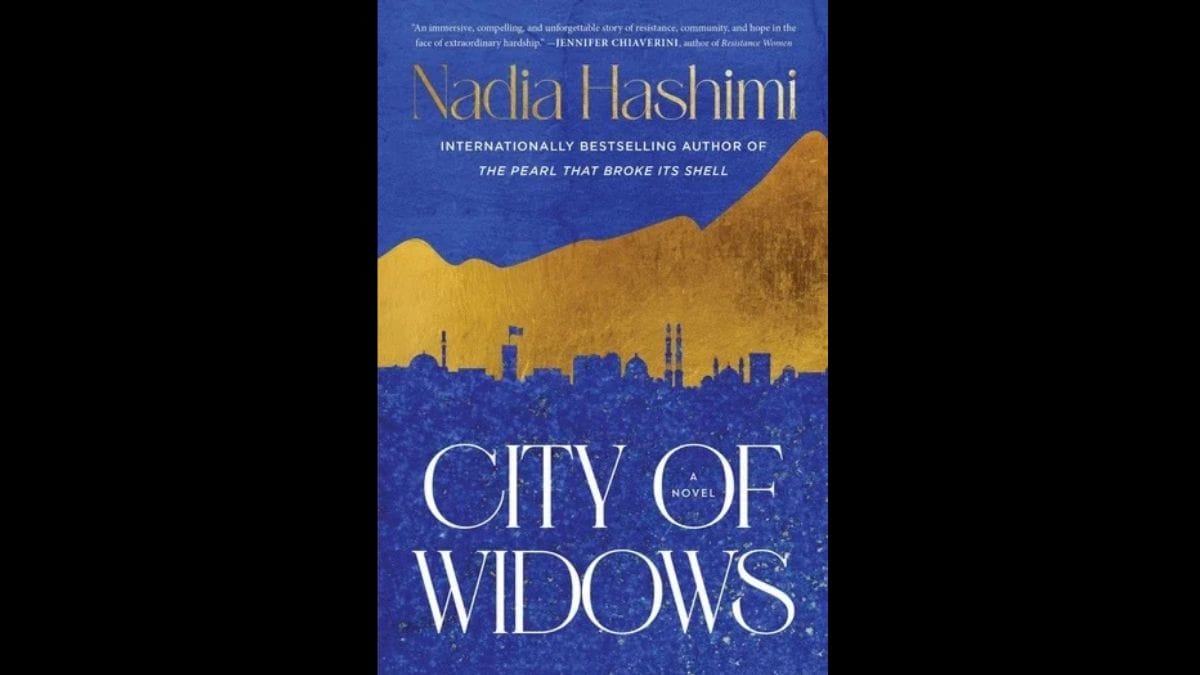
August 15, 2021. It was a tragic day, after a spate of tragic days in Afghanistan. The capital, Kabul, fell to the Taliban after ex-president Ashraf Ghani made a cowardly exit. Americans withdrew. Common Afghans, desperate to leave, even clung to the wings of airplanes, falling to their death. The Taliban is brutal; they knew. It's even more brutal to their women, who are the focus of the acclaimed Afghan-American author Nadia Hashimi's new book City of Widows (HarperCollins India).
The story unfolds in two timelines: 2014, when a teenage pregnant runaway wife, Rahima, has fled her warlord husband, Abdul Khaliq. Building strength bit by bit, she renames herself Marjan, after a wounded lion at the Kabul zoo. In the second, set in August 2021, Marjan, an ex-member of the now-dissolved Female Tactical Platoon, an elite unit trained by American Special Forces, is fleeing both the Taliban and her husband, who, if he found her, would kill her and take her daughter, Hawa, away.
The poignant story revolves around this mother-daughter duo, who navigate a world not known to be kind to women, alone. They have no one but each other, and a few other women who take them in.
The world is cruel. But what's interesting is how Hashimi writes Afghan women's experiences as not specific to them but in the larger context of what women experience in a patriarchal world.
For instance, Marjan was a bacha posh, a practice in Afghanistan in which a girl is raised and dressed as a boy until puberty. Hence, she would run around and play soccer. The practice is intrinsic to Afghanistan, but the social context is universal.
"As a daughter, these behaviours would have brought shame to her family. As a son, her assertiveness was applauded," Hashimi writes. This brings down the shock value, and in turn humanises the experiences of the Afghan women.
In literature, where we often see women's writing being seen as a very specific female experience, and writing around men as more universal, Hashimi seems to be taking the latter route, while writing about women. Men wanted to flee Afghanistan, so did the women. The Taliban is brutal both against men and women. The difference, however, is in the degree, and this is the in-between that Hashimi explores.
That said, the pace reads slower in the first half, and it's only in the second half that it picks up.
Hashimi is at her strongest when she writes about music. Absolutely beautifully, so much so that the reader can actually feel the music. Hawa (which literally translates to air) learns rubab, and music is almost like air she breathes. Hence, when the Taliban takes over, bans music and destroys instruments, you can actually feel the violence inflicted on something so intangible.
It’s also interesting how the novel moves back and forth between timelines. Yet the experiences of its women remain strikingly similar, suggesting that the threats women face are not new. “The past is the future,” Hashimi writes.
In the end, the book is a good read for those who want to get a good understanding of a contemporary crisis through fiction.
And why not? Zanabad is the city of widows. Zanabad isn't a fictional place, but a real one on the outskirts of Kabul, self-built by widows fleeing violence, stigma and poverty. 'City of women' is what it literally translates to.
City of Widows
Nadia Hashimi
HarperCollins India
pp 418, Rs 599
