



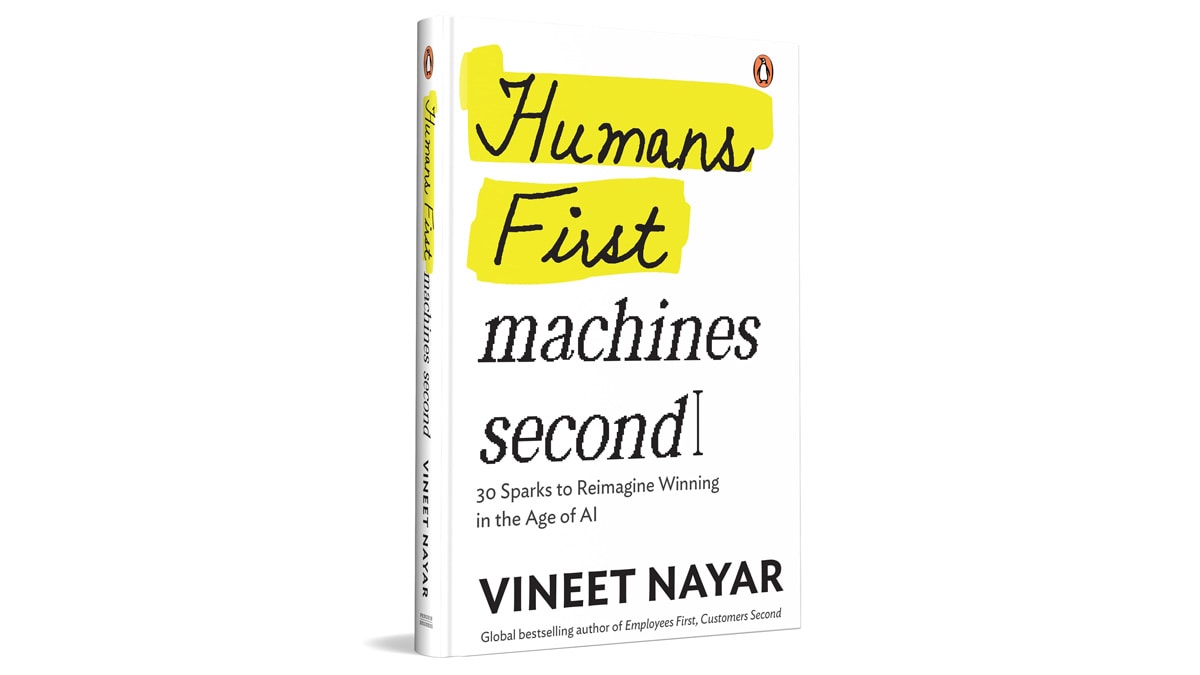
Artificial Intelligence is billed as the corporate world’s favourite buzzword, what every boardroom wants, what every startup sells, what many LinkedIn posts claim to be the saviour or destructor of civilisation—the discourse goes on. Vineet Nayar, in his Humans First, Machines Second, however, is taking none of that drama.
The former HCLTech CEO, in his book, makes a persuasive case that while AI might be the newest employee in the organisation, it should not be promoted to the corner office just yet. Drawing from his years at HCLTech, his entrepreneurial journey with Comnet, and his work with the Sampark Foundation, Nayar argues that organisations obsessed with algorithms often forget the one competitive advantage machines cannot replicate: people.
Built around 30 “sparks” to reimagine winning in the age of AI, Humans First, Machines Second is neatly divided into four themes—Trust, Empower, Reimagine, and Amplify. That may sound suspiciously close to the kind of framework management consultants unveil with an expensive PowerPoint presentation, but Nayar keeps things grounded through stories rather than spreadsheets. Each chapter mixes personal anecdotes, leadership lessons, and practical ways AI can support decision-making without replacing human judgement.
The book’s biggest strength is, without a doubt, its anecdotes, which are presented most engagingly. Be it HCLTech's decision not to lay off employees during the 2008 financial crisis or Nayar’s explanation of how the Sampark Foundation uses AI to help teachers instead of replacing them, he consistently returns to the same point: technology works best when it serves people, not the other way around. The stories from Comnet, where he hired people with little technical experience and built a thriving business, reinforce his belief that curiosity and judgement often matter more than polished résumés.
There is something refreshing about a business book that doesn’t treat AI as a god-sent entity or a cinematic villain. Nayar, throughout the book, reiterates that AI merely amplifies the existing culture of an organisation. If your workplace already runs on trust and transparency, AI will probably make it better. If it thrives on confusion and bureaucracy, congratulations, you have just automated the chaos.
Some chapters did feel a little repetitive. Readers hoping for a deeper dive into the mechanics or ethics of artificial intelligence may also wish the discussion ventured beyond broad principles.
Still, the book knows exactly what it wants to be. It isn't trying to explain how large language models work or predict the future of AI regulation. Instead, it asks a simpler question: how do we stop becoming passive spectators while machines do more of our thinking? Nayar's answer is to double-down on the qualities that make us human: empathy, intuition, imagination and the willingness to challenge the obvious.
Humans First, Machines Second is brisk, accessible and easy to read. Even readers who spend most of their time with fiction will find this a welcome detour. And in an age where AI is busy writing emails, generating presentations and occasionally inventing court cases, a book reminding us that humans still need to think for themselves feels less like a management lesson and more like sound advice.
Humans First, Machines Second
By Vineet Nayar
Published by Penguin Random House India
Price 799; pages 216
