



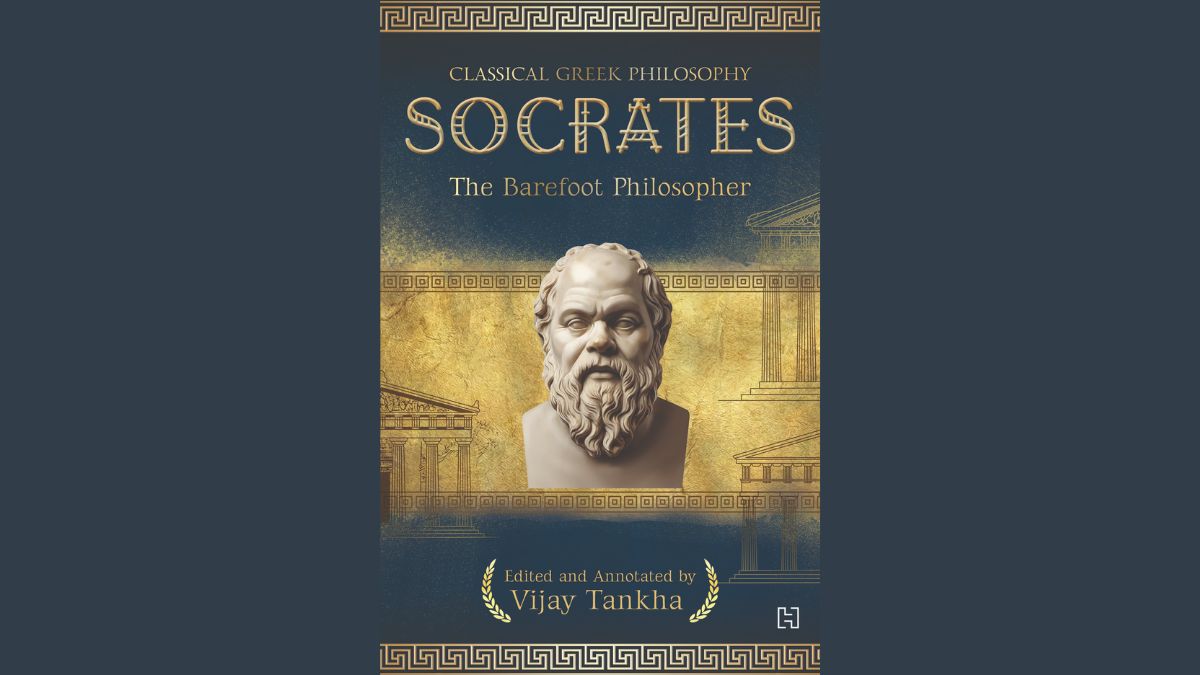
Writing about Socrates is never easy. The philosopher left behind no books, no treatises and no manifesto. What survives are the voices of others: Plato, Xenophon, and Aristophanes each offering a different Socrates. In Socrates: The Barefoot Philosopher, Vijay Tankha embraces this uncertainty instead of trying to eliminate it.
The result is an engaging introduction that is as much about understanding Socrates as it is about understanding why he remains so difficult to pin down.
Tankha is well suited to the task. A respected scholar of Greek philosophy and a former Head of the Philosophy Department at St. Stephen's College, he writes with authority.
The book is clearly aimed at readers who are curious about philosophy but may not have a formal background in it, and it succeeds admirably on that count.
Rather than reducing Socrates to the familiar image of the wise old man dispensing timeless truths, Tankha restores him to the noisy streets of Athens.
This Socrates is a soldier, a citizen, an irritant and, above all, an uncompromising questioner. By placing him firmly within the political and intellectual climate of fifth-century BCE Athens, the book explains why his questions were seen as both necessary and dangerous.
The strongest chapters explore the Socratic method. Tankha shows that Socrates did not claim to possess wisdom; his gift lay in exposing false certainty. His relentless questioning forced politicians, poets and ordinary citizens alike to confront the limits of their own knowledge.
In Tankha's hands, the famous dictum that the unexamined life is not worth living regains its original force. It becomes less a philosophical slogan than an invitation to intellectual honesty.
The account of Socrates' trial and execution is equally compelling. Tankha avoids easy moral binaries. He neither romanticises the philosopher nor demonises Athenian democracy. Instead, he presents the trial as the outcome of a deeply uneasy relationship between a society under strain and a citizen who refused to stop asking uncomfortable questions. That nuanced treatment is one of the book's greatest strengths.
If there is a criticism, it is that the book occasionally leaves the reader wanting more. The discussion of Socrates' influence on Plato and later philosophical traditions is necessarily brief, and those already familiar with Greek philosophy may find few surprises.
But this is less a shortcoming than a consequence of the book's purpose. It is meant to open the door, not provide the last word.
Socrates: The Barefoot Philosopher
Author: Vijay Tankha
Publisher: Hachette India
Page: 228
Price: ₹499
